The IndieWeb and the small web, explained
2026-11-10, originally published on pablomurad.com.
For most people today, the web is a few apps. Open one, scroll, and whatever gets posted lives on someone else's servers, under rules the poster didn't write, inside a feed only the company controls.
Underneath all of that, the original web is still there and still works the same way. Anyone can get a domain, put an HTML file on a server, and anyone else in the world can read it with a browser, no account needed. A lot of people never stopped doing that. Two names keep coming up when people talk about them: the IndieWeb and the small web. They overlap a lot, and they aren't the same thing, so this post covers what each one means, what it looks like in practice and how to get in.
The IndieWeb #
The IndieWeb describes itself as "a people-focused alternative to the corporate web": a community of independent and personal websites built around a few ideas. Each person owns a domain and uses it as their main identity online, publishes on that site first, and only then, if they want, somewhere else. And each person owns what they write.
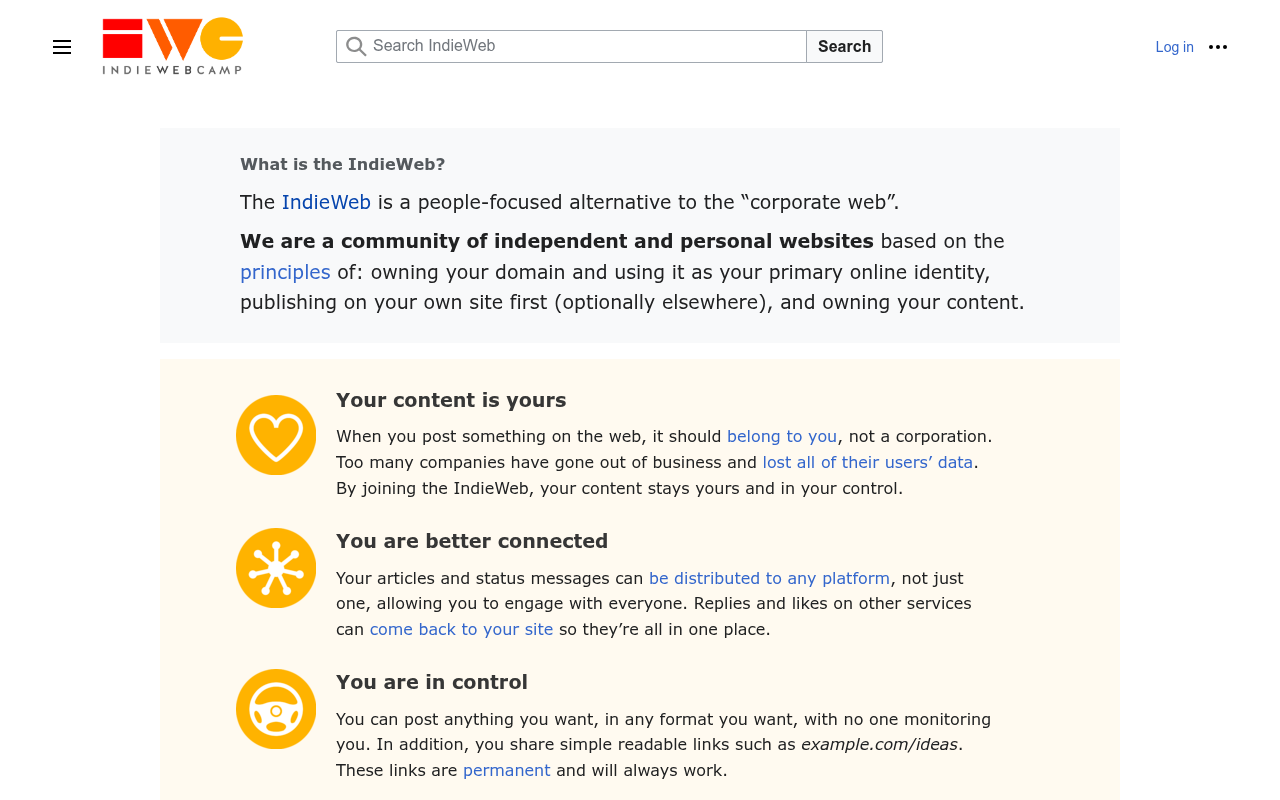
It has a home at indieweb.org, a wiki that is also its documentation, and a history of meetups. The earliest IndieWebCamp on the wiki's list happened in Portland, Oregon, in 2011, and there are still small online and local gatherings for people who are building their own sites.
The community keeps a list of principles. Some are the expected ones: own your domain and data, use what you make, make your code open source, build for the long web. Others are a little more surprising, like "Make what you need" (for yourself first, not for "everyone") and "Pluralism", which means there's no single right way or software to do any of this. The last one closes the list: "Above all, Have fun. Keep the web weird and interesting."
POSSE #
The idea people bring up most is POSSE: Publish (on your) Own Site, Syndicate Elsewhere. The post goes on the author's own site, at their address, and then a copy or a link goes out to Mastodon, Bluesky or wherever the friends are. If the platform disappears, changes its rules or locks the author out, the original is still at that address. The links shared over the years keep working, because they point to the author.
The building blocks #
Owning a site is the easy part. The interesting work is making independent sites talk to each other the way social networks do, with replies, likes and follows, but without a company in the middle. The IndieWeb uses a handful of small standards for that, and none of them needs more than ordinary HTML and HTTP:
-
Microformats are plain class names added to the HTML so software can read it. An
h-cardsays who the author is (name, photo, URL), anh-entrymarks a post, with its title, date and content. The page looks exactly the same to people. -
rel="me" links connect a site to its owner's other profiles. If the site links to a GitHub profile with
rel="me"and that GitHub profile links back, that's proof both belong to the same person. Mastodon uses the same trick to show a verified link on a profile. - Webmention is how sites notify each other. When a reply on one blog answers a post on someone else's blog, the first site sends a small notice to the other saying "this page mentions you". Their site can then show your reply as a comment. It became a W3C Recommendation in January 2017.
- IndieAuth signs in to services with a personal domain as the identity, instead of a Google or Facebook account.
- Micropub publishes to a site from other apps, like a phone app for quick notes or photos. It became a W3C Recommendation in May 2017.
Nobody needs all of them. Most IndieWeb sites start with a domain, an h-card and a few rel="me" links, and add the rest over time.
What that looks like on this blog #
This blog runs on PaCord, my own CMS, and it speaks most of that language. The source of the home page, among the usual tags in the <head>, has lines like these:
<link rel="webmention" href="https://cms.pablomurad.com/webmention">
<link rel="micropub" href="https://cms.pablomurad.com/micropub">
<link rel="authorization_endpoint" href="https://cms.pablomurad.com/indieauth/auth">
<link rel="token_endpoint" href="https://cms.pablomurad.com/indieauth/token">
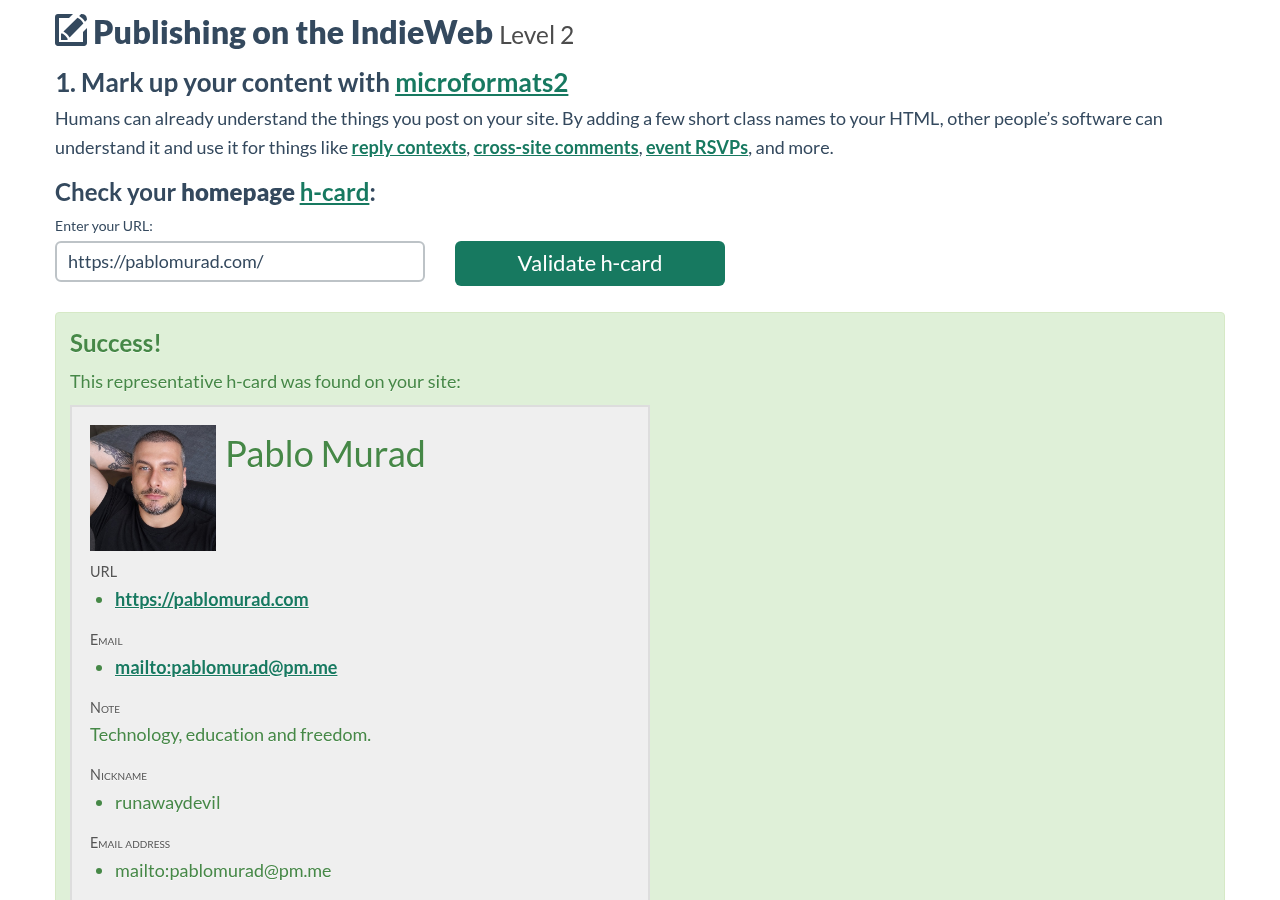
Those tell other software where to send webmentions, where a Micropub app can post, and how to sign in with pablomurad.com through IndieAuth. Further down, the page has an h-card with my name and photo, every post is marked as an h-entry, and the footer links to my other profiles with rel="me": GitHub, Codeberg, sourcehut, my own Git server and murad.social, among others. There are feeds too, in RSS, Atom, JSON Feed and JF2, so any reader can follow along.
The easiest way to check a site is IndieWebify.me, which walks through each step and tests the pages. This is what it finds here:
The small web #
The small web is harder to pin down, because nobody owns the term. There's no wiki that defines it, no list of principles and no standard to implement. It's a loose name for the part of the internet made of personal, non-commercial, usually lightweight sites, made by one person or a few, because they wanted that thing to exist.
Where the IndieWeb talks about protocols and ownership, the small web is about scale and feel. A small web site is usually:
- personal: a homepage, a blog, a fan shrine, a collection of recipes, a page about one strange hobby;
- light: plain HTML, a little CSS, few or no scripts, no trackers and no cookie banners;
- made by hand, or close to it, often with the seams showing;
- connected in old ways: links to friends, webrings, blogrolls, guestbooks, RSS, and those tiny 88x31 buttons from the 2000s.
Some people take the "small" literally. The 512KB Club and the 1MB Club, which showed up in Neat Finds #02, only list sites whose pages weigh less than that.
The small web also goes beyond HTTP. Gemini is a protocol made in 2019 to be deliberately simpler than the web, with text pages and no scripts at all. Gopher, from 1991, still has people writing phlogs on it. Nex is even smaller: you connect, send a path and get back text. And there are pubnixes, or tildes, shared Unix servers where members get a shell account, a home page at /~name and a community that talks through the terminal.
Where it lives #
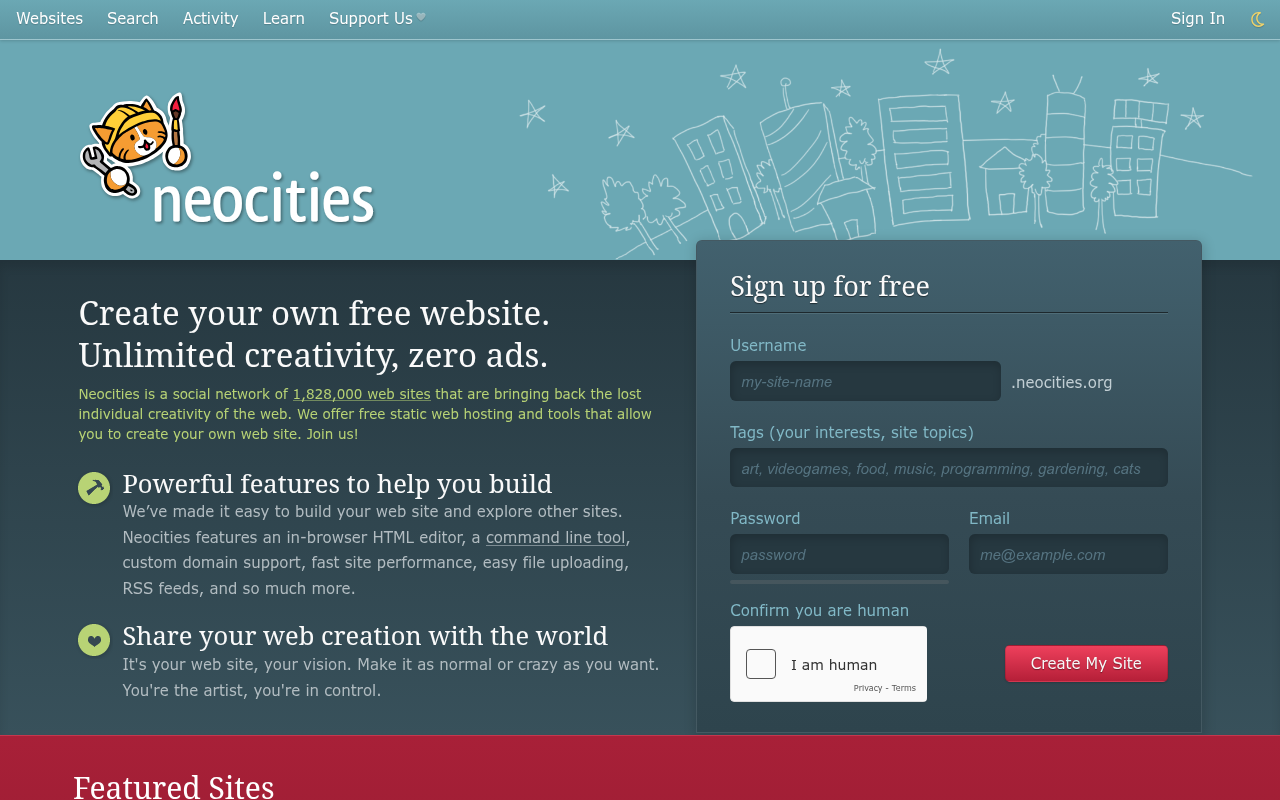
A lot of the small web lives on Neocities, a free host for static sites that took the place GeoCities left empty. You get yourname.neocities.org, an editor in the browser and a community where sites follow each other. The counter on its home page shows more than 1.8 million sites.
The rest is spread across personal domains, cheap shared hosting, home servers, Raspberry Pis on a shelf, pubnixes and Gemini capsules.
How to find it #
Little of it shows up in the big search engines or social feeds, which favor large commercial sites. A few tools are made for this.
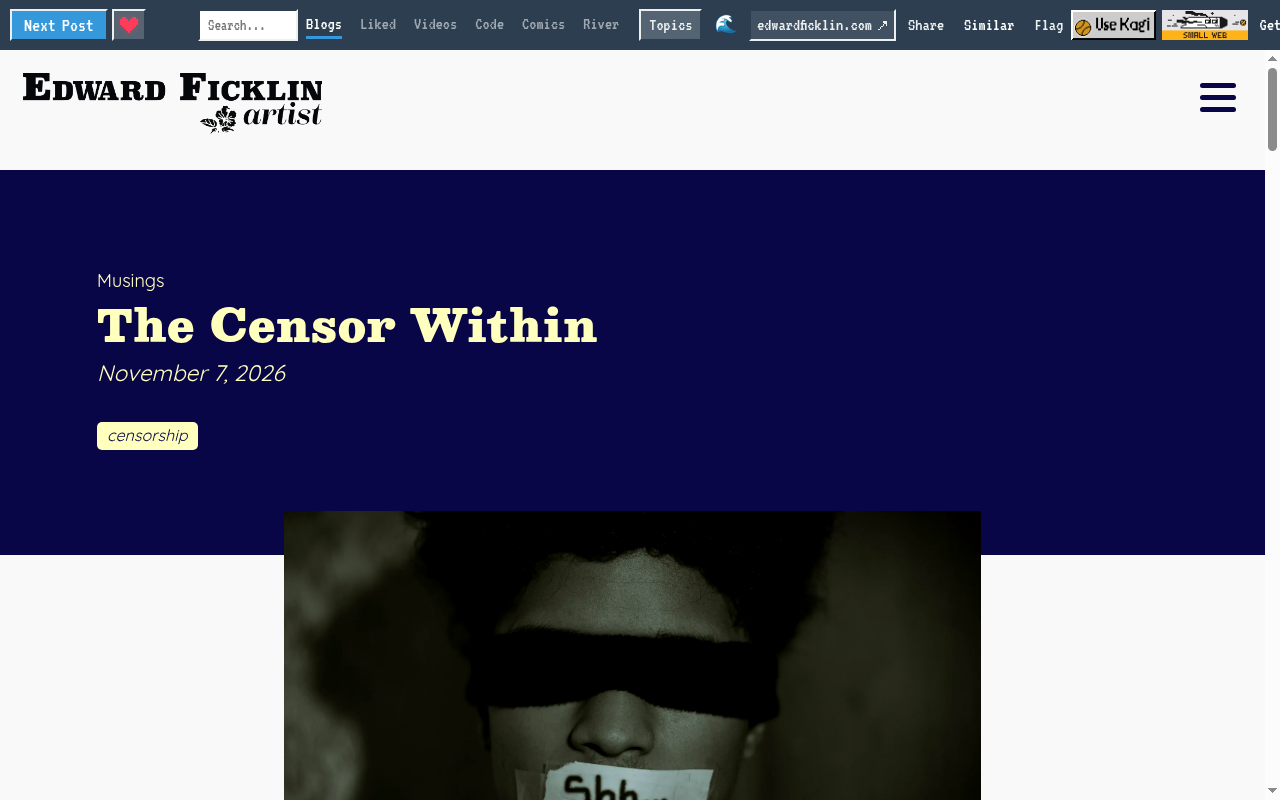
Kagi Small Web shows recent posts from personal blogs, independent video channels and webcomics, one at a time. A press on "Next Post" lands on someone's site, with a thin toolbar on top. It's free to use, and the list of sources is open on GitHub.
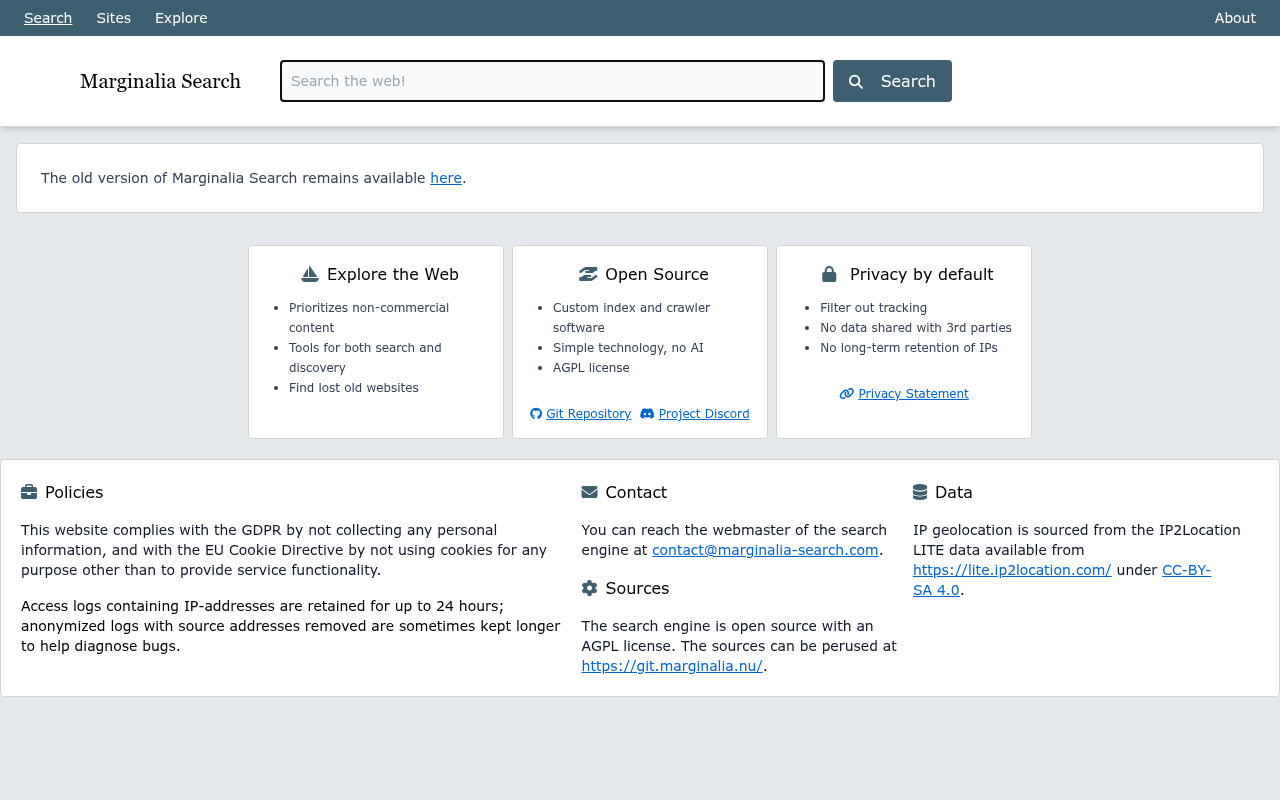
Marginalia Search is an independent search engine that puts non-commercial, text-heavy sites first and finds old websites the big engines forgot. It's open source, and it doesn't share data or keep IP addresses for long.
Then there are the old ways, which still work. Webrings, where every site links to the next one in a loop. Directories made by people instead of algorithms. And the links page on the sites you already like: one personal site almost always leads to five more.
Same neighborhood, different streets #
A Neocities shrine to a 90s cartoon, with a guestbook and a hit counter, is pure small web, and it doesn't need a single microformat. A developer's blog with Webmention, IndieAuth and a Micropub app is IndieWeb, even if it's built on a big framework and isn't small at all. Many sites are both, and nobody is checking.
What they share is the starting point: a person with their own address, publishing for other people, with no platform deciding who gets to see it.
My corners of it #
Besides this blog, a few of my projects live in this neighborhood.
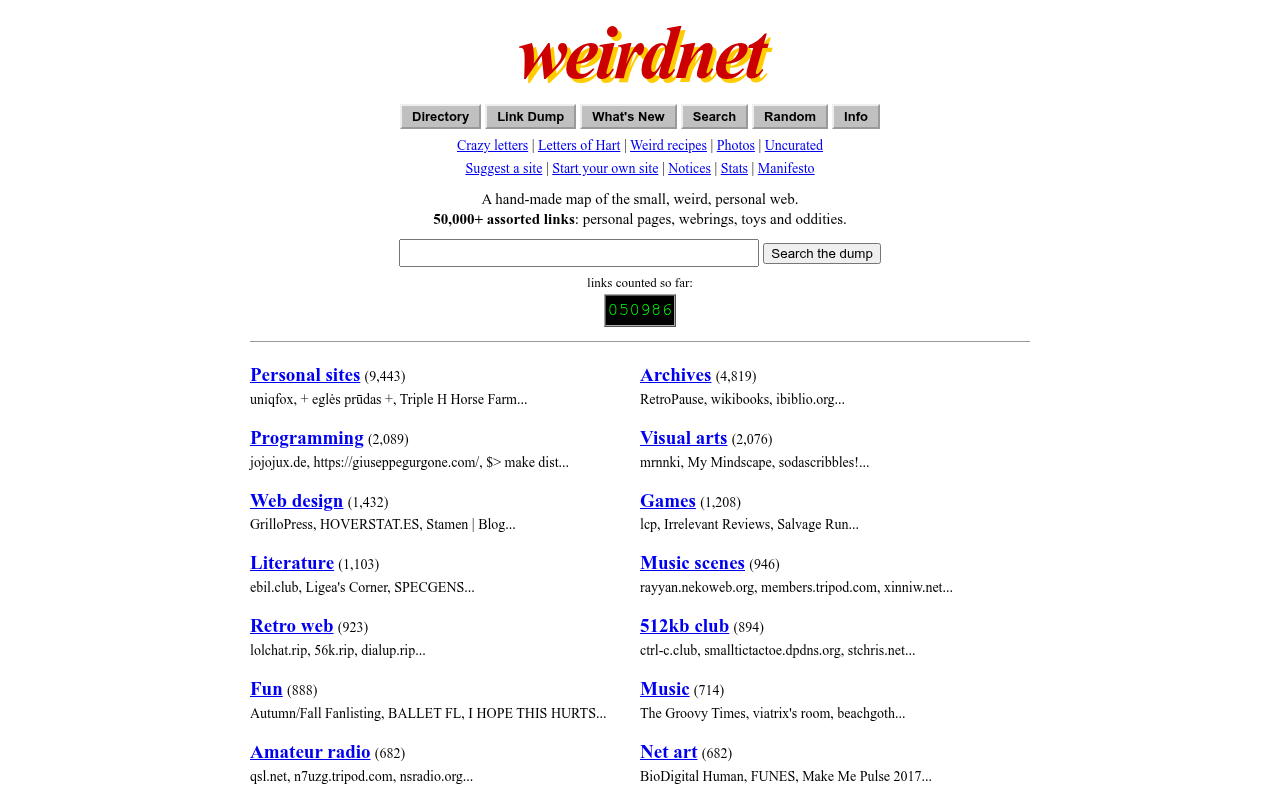
weirdnet is a directory of the small and personal web, organized by hand. It has more than 50,000 links across 314 categories, from personal sites and archives to webrings, amateur radio and the 512KB Club, plus a random button that leads somewhere unexpected. For a site that belongs there, the suggestion page explains how to send it. There's also a short guide on starting your own site.
phlog.space is a small, free photo log, written in plain PHP with SQLite and no JavaScript. Soledade is a blog in Portuguese shaped like a little town, also readable from a terminal over a Nex-style port. runv.club is a pubnix, and noctem.cafe and noctem9.cafe are two more I look after. And for building a site by hand, Pablo, how? has a seven-part series called Web by hand that goes from an empty folder to a styled site with its own RSS feed, and Docs do Murad has the same kind of material in Portuguese.
How to start #
No permission or framework required. A reasonable path:
- Get a place to live. A personal domain is the IndieWeb way, and it keeps the address in its owner's hands. A free Neocities page is the fastest way to start today, and a domain can point at it later.
- Write one page by hand: a short introduction, some favorite things, a few links. It can be ugly. Plenty of sites start like that.
- Add an h-card to that page and
rel="me"links to the other profiles. Ten minutes of work, and IndieWebify.me says whether it's right. - Start a feed, even for one post a month. RSS is still how most people on the small web follow each other.
- Go out and meet the neighbors. Join a webring, sign a few guestbooks, add a links page, and send the site to directories.
From there, add anything: webmentions, a guestbook, a Gemini mirror, an 88x31 button. The site will change over the years, and it will still be at the same address.
Original: https://pablomurad.com/indieweb-and-small-web-explained/