The small things I love
2026-11-08, originally published on pablomurad.com.
Some of my favorite things on the internet are tiny: a page that does one job, a tool with a cat on it, a place where nobody counts followers.
So I keep making them. This post is a walk through eight small things I built and love: five cozy places from the same house, and three ravens that carry email around. All of them are free. Like I wrote on theraven.my: "All my projects are free to use. And when they mature, they become free and open-source software."
Five rooms in the same house #
The first five share a house called muradcorp. Each one has a single job and the same rule: no ads, no tracking, nothing unrequested.
bimb.ooo, somewhere to put things #
bimb.ooo is a small home for text, guarded by a pink elephant. It takes a snippet of code, a page in Markdown or a hand-rolled tiny site with an index, a style.css and an about. Everything lands at you.bimb.ooo, under a chosen name, at paths short enough to read out loud over the phone.
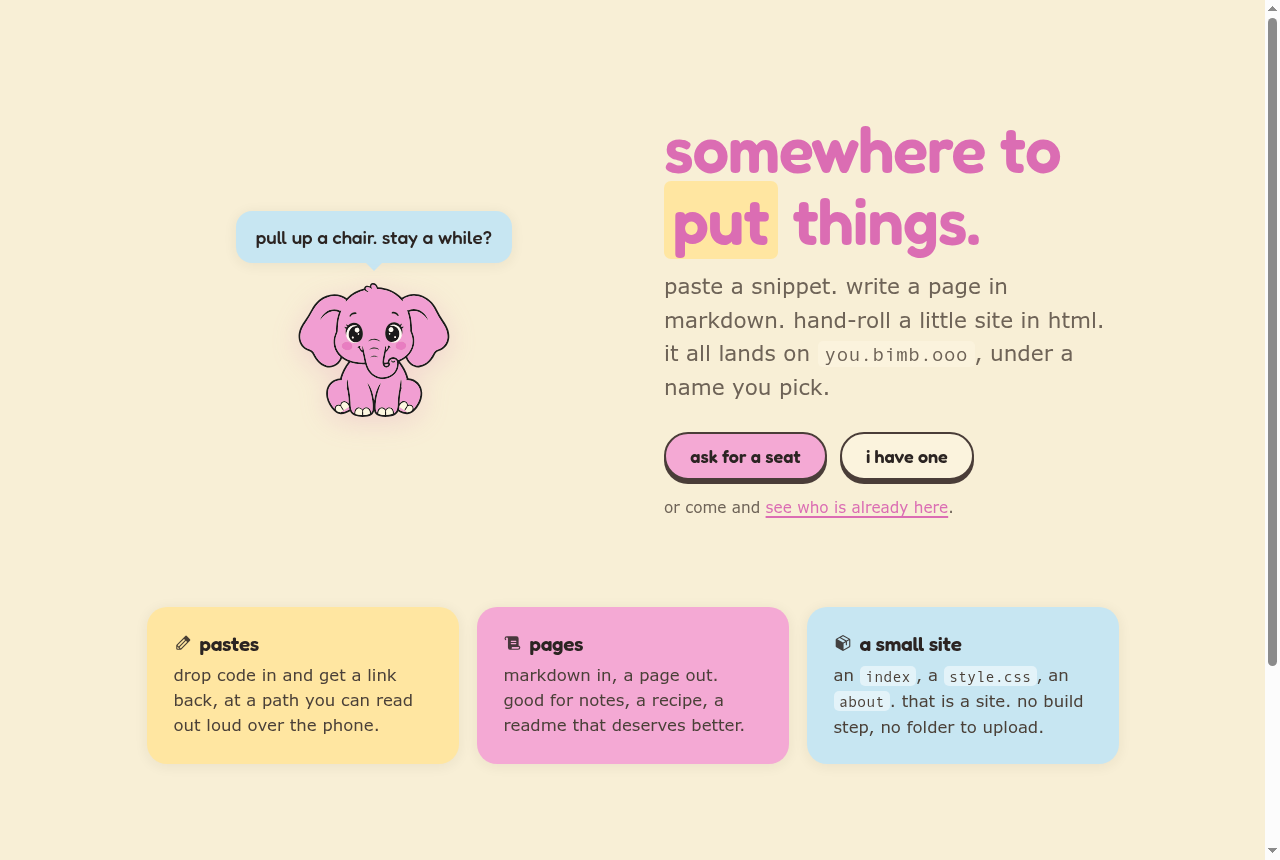
There's no build step and no folder to upload. Every site gets an Atom feed at /feed.xml on its own, so people can follow along from a feed reader with no extra work. Under the hood it's one Go binary with SQLite behind it, and every person lives on their own subdomain, so one person's HTML can never touch someone else's.
It's invite only, in the nicest way: there's a page to ask for a seat, and a way to see who is already here first.
tuno.place, a board for loose notes #
tuno.place is a board of colorful note cards, with Tuno, a white cat holding a pencil, at the top. Each note gets its own look: rounded rectangle, square, circle, arch, pill or hexagon, a shuffled background, a string tied from one note to another. A finished note can be saved as a picture or printed.
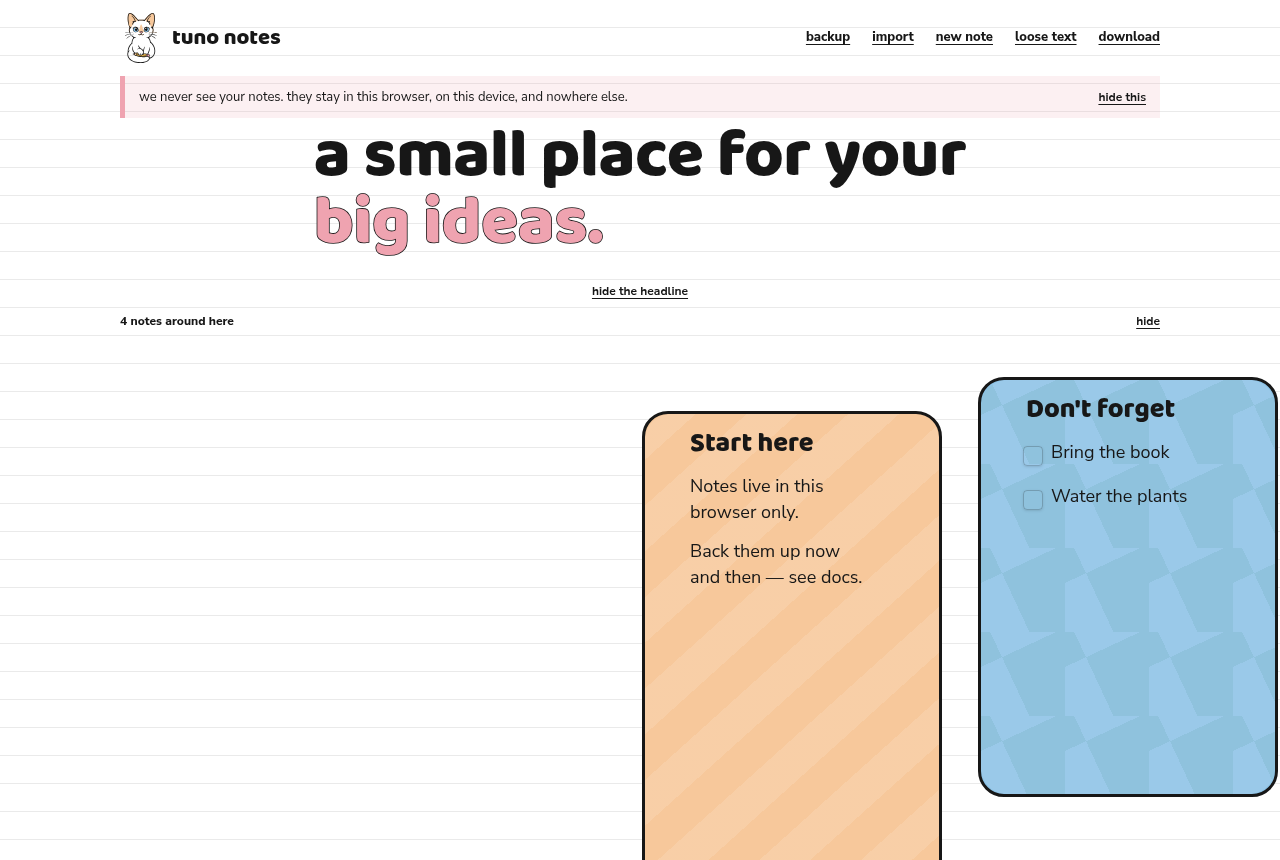
The notes never leave the browser. There's no account and no server holding them, which also means backups are the user's job (there's a button for that). It's officially described as "delightfully buggy".
pupu.page, a quiet place to write #
pupu.page is a room for writing one thing at a time. The first thing it asks is "how is the light where you are?", night or day, and then it gets out of the way. Pupu, a small black cat, sleeps through both.
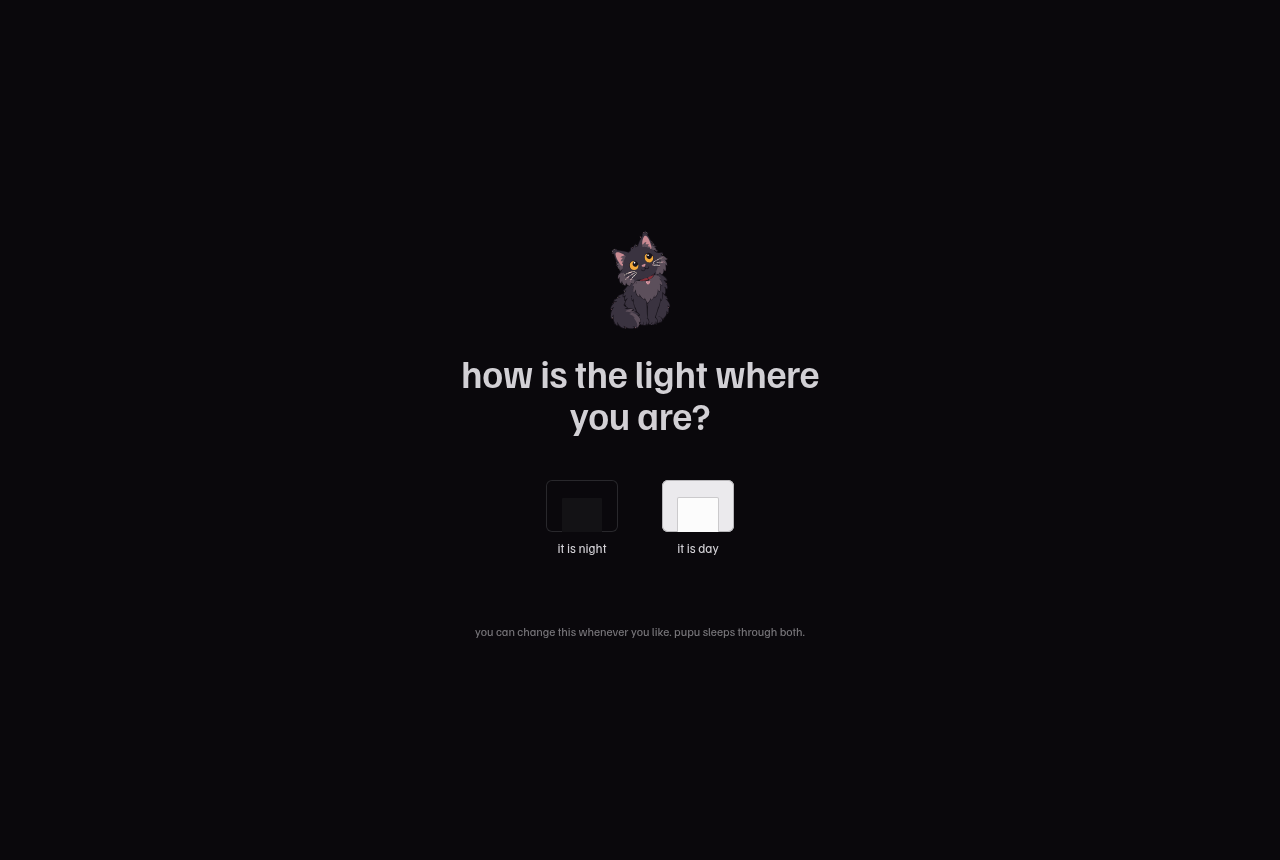
The writing is Markdown, and the punctuation steps aside: the stars and pound signs hide on every line except the current one, so the screen already reads like finished writing. The line being typed holds still while the page moves around it, and everything except the current sentence can fade out, so the eyes have nowhere else to go. At the end, the export is a .md file that's byte for byte what was on the screen.
It works offline, saves while typing, and makes no request to anywhere else. Even the fonts live on the site itself, so nobody learns that someone sat down to write today. No account, no server, no AI.
tedy.science, a desk for everyday sums #
Tedy's Science is a notepad that does math. Lines go in the way they'd be said out loud, and the margin answers. Ted, a ginger cat with his tongue out, supervises.
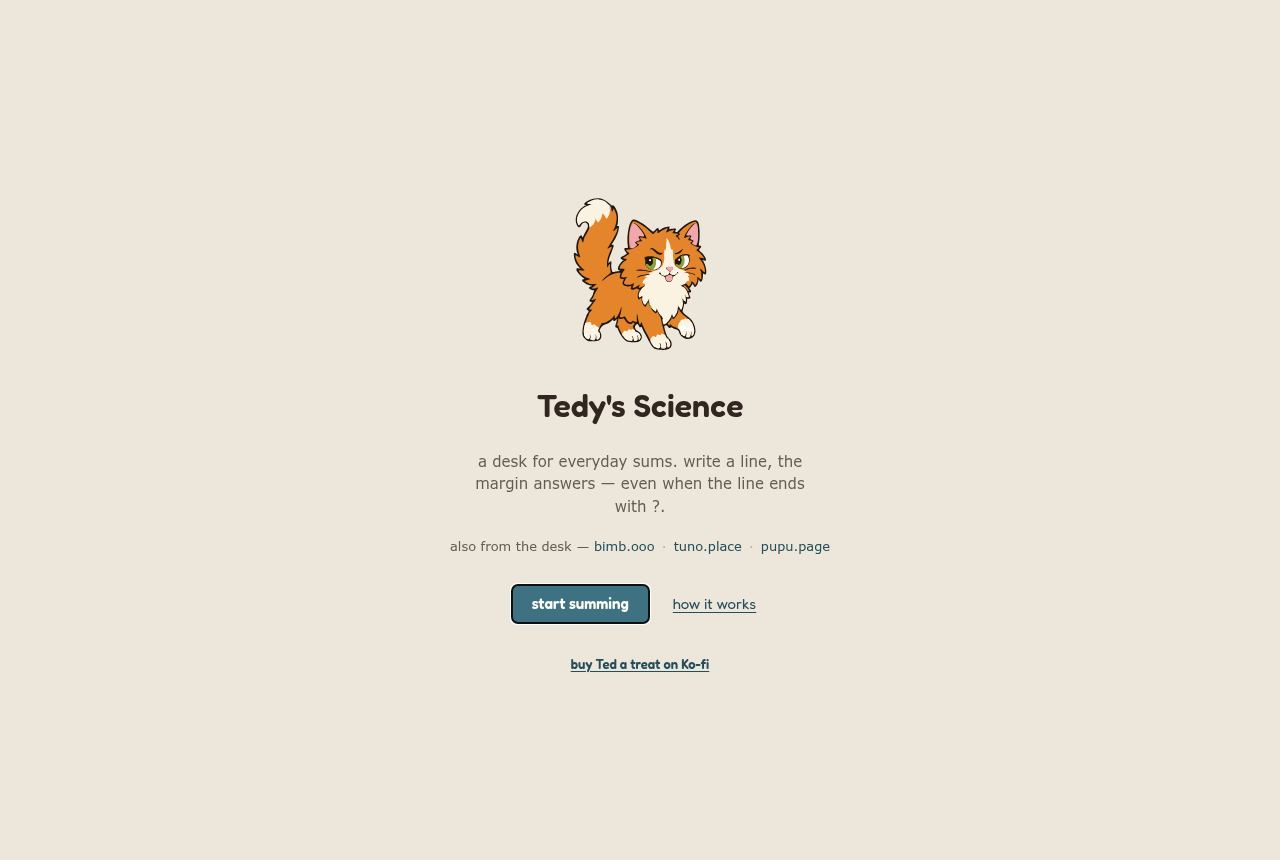
Write lunch 45 + uber 22 and the margin says 67. The words are just labels, so the sums stay readable. A few more things it understands:
850 + 20%: 1020
15% of ? = 60: ? = 400
120 km / 2 hours: 60 km/h
today + 30 days: the date 30 days from now
1200 in 12x: twelve payments of 100
1/3 cup * 3: 1 cup
The ? is the neat part: put it anywhere in a line and Ted solves for it. There are variables, headings that split a sheet into sections with their own subtotals, units that refuse to add kilograms to hours, dates, fractions, a scientific calculator running the same engine, and a set of ready-made formulas to paste in.
Sheets live in the browser. Sharing one means sending a link, and the whole sheet travels inside the part of the address after the #, which never reaches the server. And if Ted is earning his keep, there's a way to buy him a treat on Ko-fi.
phlog.space, a photo log of wrecked photos #
phlog.space is a photo log where pictures get wrecked on purpose. A JPEG or PNG goes up, and on the way in it gets one of 36 effects, picked at random: crunchy JPEG, pixel sorting, VHS, CGA and VGA palettes, fax, thermal camera, Kodachrome, Super 8, silent film, cyanotype, a square 2012 phone-app filter and more. Then it's shrunk to 400 pixels or less, and the original isn't kept.
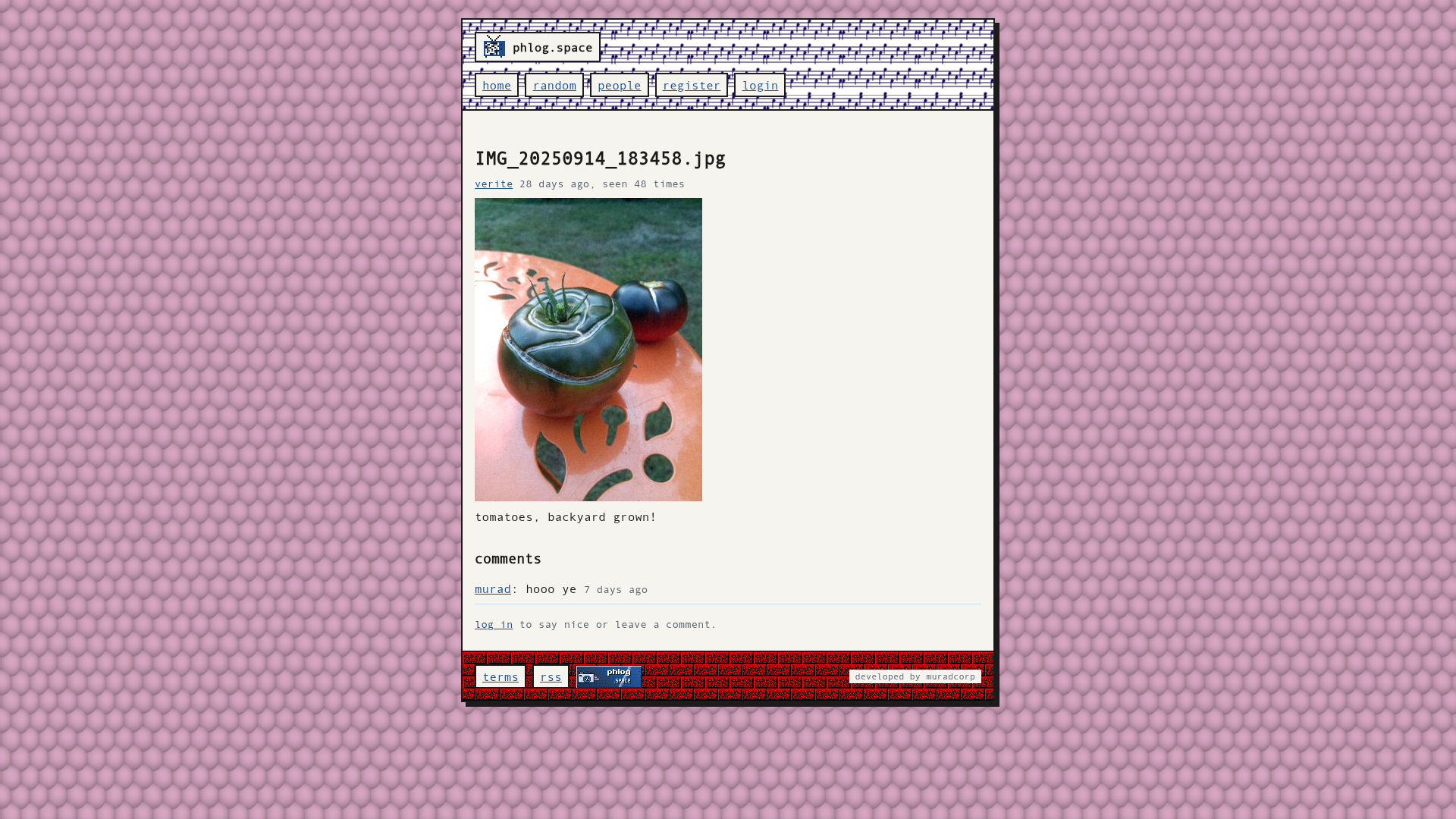
To post a photo as it is, the effects can be turned off in the settings. The rest is built like the old web: each member can leave one "nice" and one single-line comment per photo, sign other members' guestbooks and browse by month. Profiles live at /~name and come with a hit counter, and there's a random photo link, a member list, an RSS feed and an 88x31 button for other sites.
Under the hood it's plain PHP with SQLite, no framework and no JavaScript. New accounts wait for an admin to let them in, so register and give it a little time.
Three ravens #
The other three are about the one protocol that everybody already has: email. No app to install, no new password, no feed. The writing happens in whatever mail program is already in use.
theraven.email, contact forms delivered by raven #
RavenMail makes free contact forms for any website. Make a form, put it on a site, and every message lands in the inbox, with Reply-To set to the sender so answering is pressing reply.
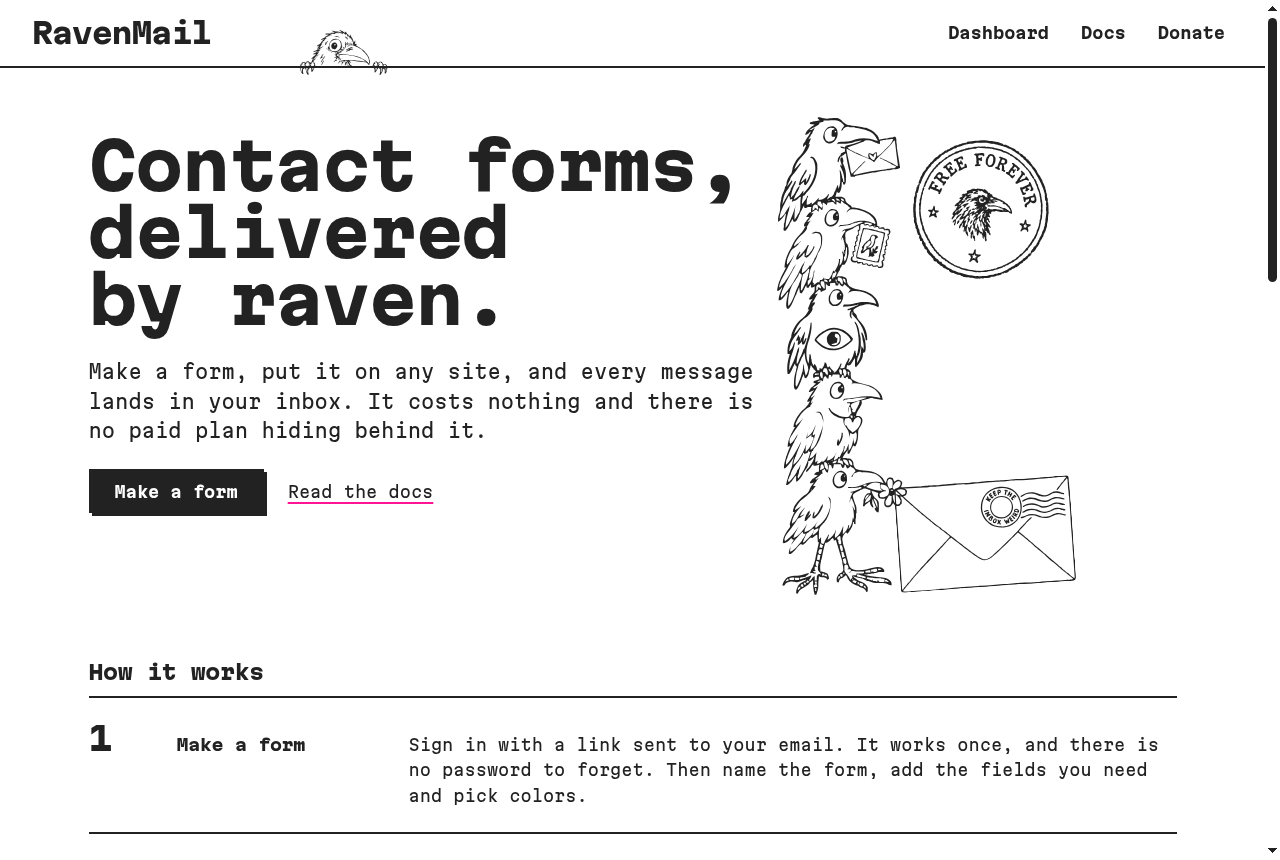
Each form works three ways at once: as a link for a bio, as an embed with one script tag, or as the target of a plain HTML form with no JavaScript at all. Sign-in is a link sent by email, so there's no password to forget.
What comes with it, all free: up to 10 forms, custom fields, attachments, webhooks to JSON, Discord or Slack, custom colors for light and dark mode, and labels in English, Portuguese or Spanish. Spam gets stopped without sending visitors to anyone else: a small proof of work solved in their browser, a hidden trap field and a few limits. There's no upgrade screen. It's funded by donations.
theraven.my, a town of letters #
theraven.my is a blog you write by email. Each resident has a house and a secret address. An email sent to that address becomes a post. Attach photos, and they become the pictures. Signing up, editing, deleting and changing settings all happen by email. The site is only for reading.
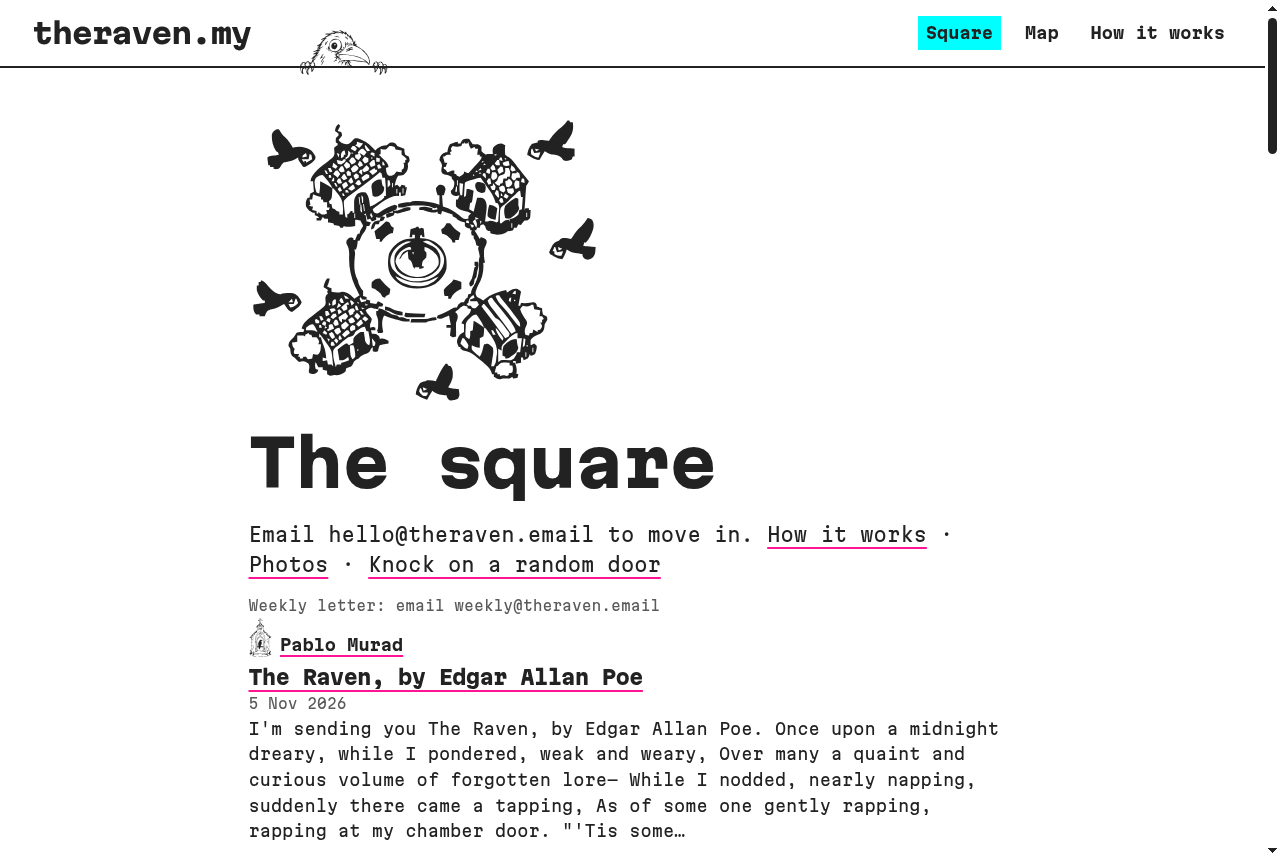
Everybody's posts meet in the town square, and there's a button to knock on a random door. It's a nice place to send a poem, a photo from your walk or a "we arrived" to the family. The last thing I posted there was Poe's The Raven. To move in, email hello@theraven.email.
theraven.social, good company delivered #
theraven.social is the newest raven. It's a small post office for people who write letters.
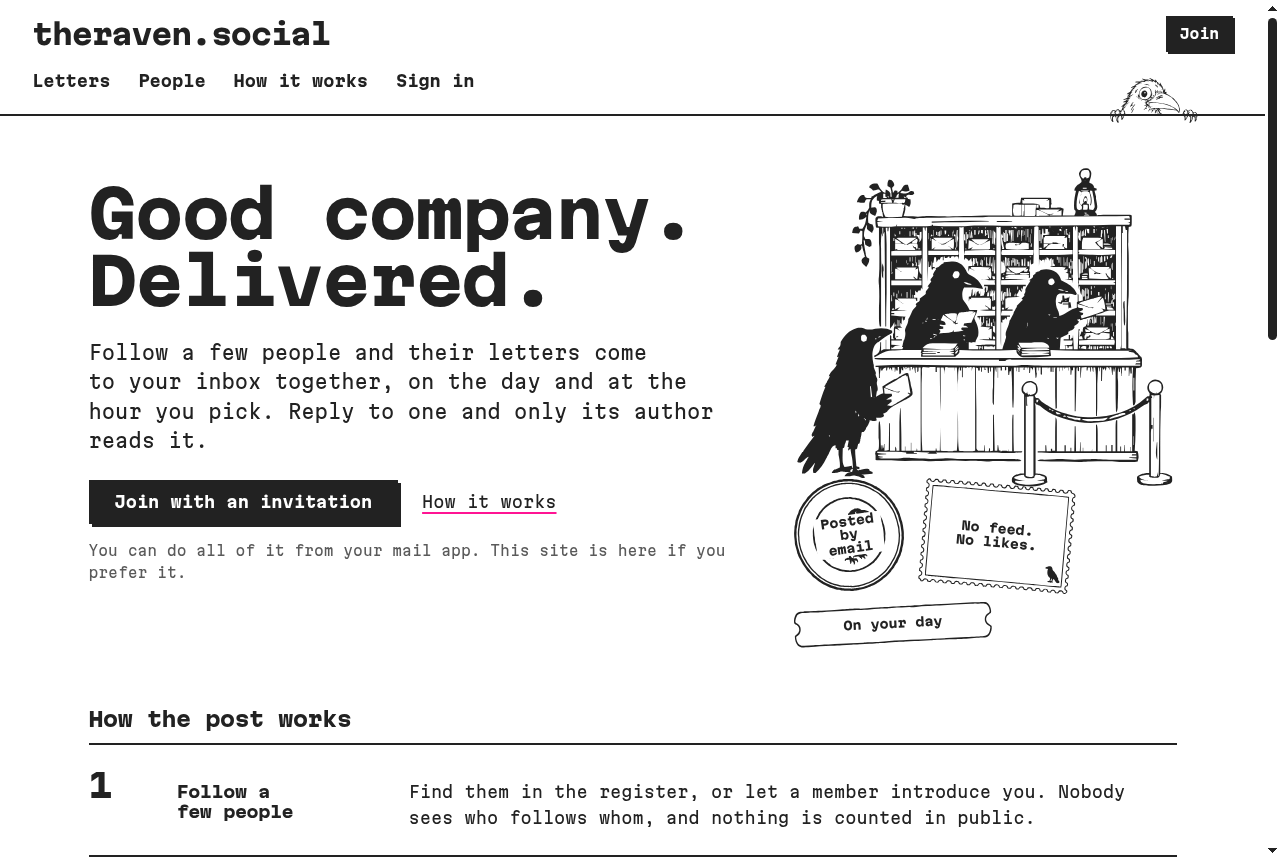
Members follow a few people, and their new letters arrive together in a single email, daily, twice a week or weekly, at a chosen hour, in the member's time zone. Each delivery has an end. Every letter has its own reply address, so a reply reaches only the author, and the email address stays hidden. Nobody sees who follows whom.
Just as important is what it doesn't have: no endless feed, no likes or rankings, no public follower counts, no read receipts or tracking pixels, no ads, no recommendations tuned to keep you scrolling, no AI writing or summarizing letters, and no app to install. All of it works from a mail program. Independent servers can even federate with each other.
It's open by invitation, and the archive of public letters is still empty.
Why small #
None of these is trying to be big. Each one does one thing, keeps words and pictures where they were put and lets people leave whenever they want.
Try one, or all eight. And anyone who makes something with them can write to me. A raven will find me.