Candomblé, or the Houses That Kept the Gods
2026-11-17, originally published on pablo.space.
← all Chamber of Reflections texts
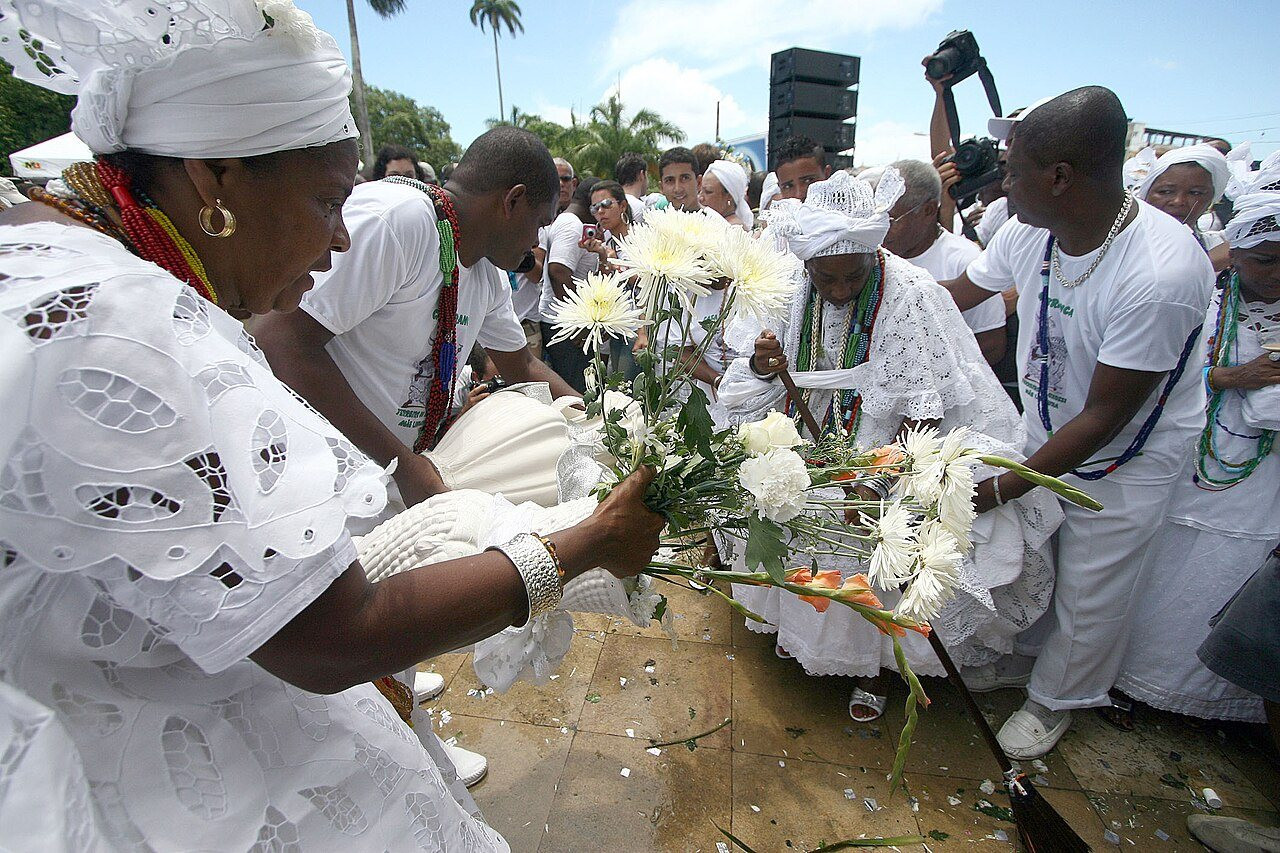
Adenilson Nunes, Lavagem do Bonfim, Salvador, 14 January 2010. Bahian women wash the steps of the Church of Nosso Senhor do Bonfim during the annual festival. Photograph for AGECOM, Government of Bahia. CC BY 2.0, via Wikimedia Commons.
« Já passamos do tempo de ter que esconder nossa religião. »
(“We are past the time when we had to hide our religion.”)Mãe Stella de Oxóssi, interview in the Jornal da Bahia, 1983
How enslaved Yoruba, Fon and Bantu peoples rebuilt their gods in Bahia, and how a religion the police licensed until 1976 became a monument of Brazil.
Water on the steps
Every January, on a Thursday, a procession walks about eight kilometres through the lower city of Salvador, from the church of Conceição da Praia to the hill of Bonfim. At its head go some two hundred women in white lace and white turbans, each carrying on her shoulder a jar of water perfumed with flowers. When they reach the church they find its doors closed. They wash the steps and the churchyard instead, to the sound of drums and songs in a language most of the crowd does not speak.
This is the Lavagem do Bonfim, one of the postcard images of Bahia, with the acarajé and the flowers thrown into the sea for Iemanjá on the second of February. Guidebooks call it a symbol of Bahian syncretism. The church honours a Portuguese image of the crucified Christ, and the white the women wear is also the colour of Oxalá, the Yoruba lord of creation.
Behind the postcard is a much harder story. It runs through slave ships and sugar mills, through police stations and courtrooms, through the notebooks of doctors who believed Africans were a lower race, and through the houses of a few women who kept a religion alive in a city that arrested its priests.
Candomblé is a religion that enslaved Africans and their descendants rebuilt in Bahia in the nineteenth century, from the cults of several African peoples, and for most of its history the Brazilian state treated it as a police matter. Its survival was the work of organized communities, most of them led by women.
This is the second post in a small series on Brazilian religions. The first was about Umbanda, born in the twentieth century in Rio de Janeiro and the subject of its own story; the third will be about Quimbanda. Candomblé is older than both, and it is a different religion. It is also distinct from Cuban Santería, a cousin of Yoruba descent, and from Haitian Vodou, which I wrote about in Vodou, or the Gods Who Crossed the Atlantic.
As on every page of this blog, I write as a historian, from the outside. The rites of initiation belong to those who have passed through them, and nothing here describes them or tells anyone how to make an offering.
A million and a third
Salvador was the capital of Portuguese America until 1763, and its port was one of the busiest slave markets the Atlantic ever saw. According to the estimates of the Trans-Atlantic Slave Trade Database, more enslaved people passed through Bahia than through any other port in the New World except Rio de Janeiro. The historian David Eltis and his colleagues put the number of Africans landed in Bahia between the sixteenth century and 1851 at more than 1.3 million.
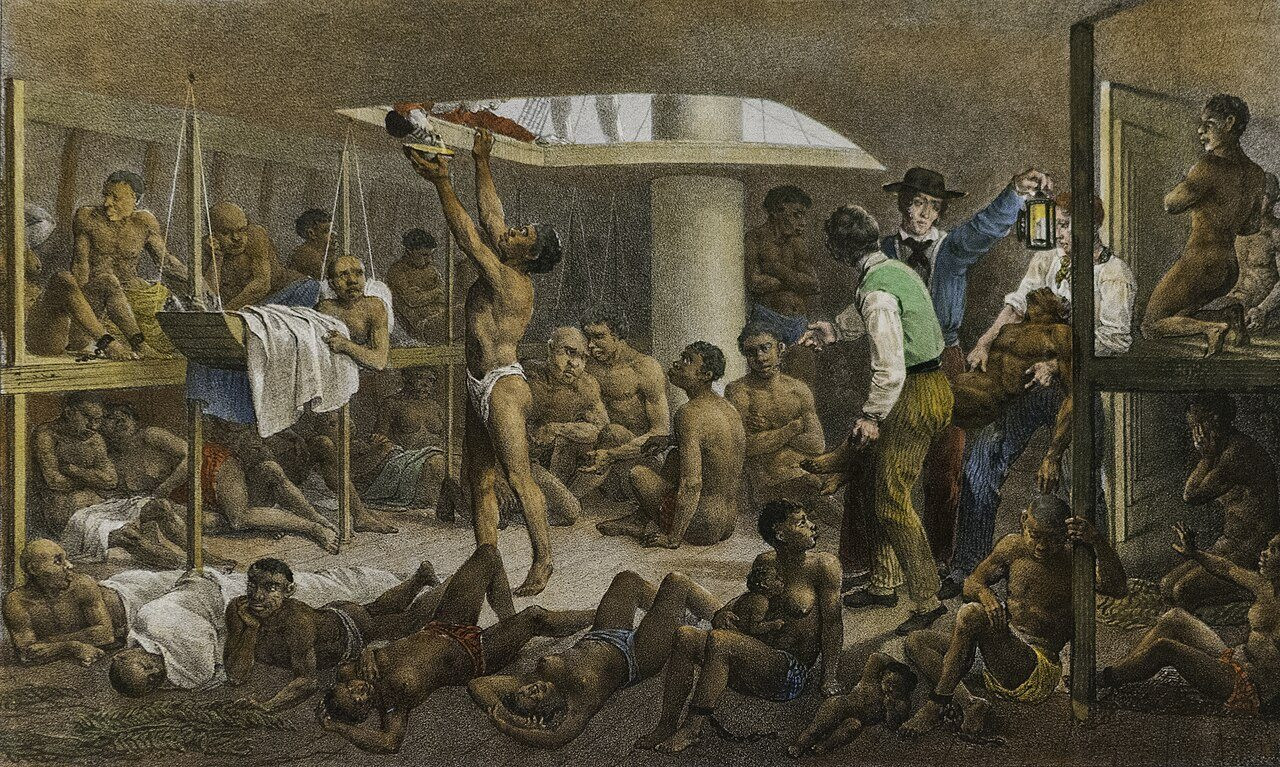
Johann Moritz Rugendas, Nègres à fond de cale (Africans in the hold of a ship), lithograph from Voyage pittoresque dans le Brésil, Paris, 1827 to 1835. Public domain, via Wikimedia Commons.
Most of them came from two regions. One was West Central Africa, the lands of Kongo and Angola, where people spoke Bantu languages; Portuguese ships had traded there since the sixteenth century. The other was the Bight of Benin, the coast of present-day Benin, Togo and western Nigeria, where Bahian merchants exchanged tobacco for captives from the eighteenth century onward. In the last decades of the trade this second current grew stronger, because the wars that broke the Yoruba empire of Oyo filled the coastal markets with prisoners.
So the Africans of nineteenth-century Salvador included many Yoruba speakers, whom Bahians called nagôs; Fon and Ewe speakers from Dahomey, called jejes; Muslims from the Hausa and other peoples; and the older, very large population of Central African origin. Brazil banned the trade in 1831, ignored the ban for twenty years, and only enforced it after 1850. Slavery itself lasted until 13 May 1888.
A word written in 1807
Colonial documents speak of calundus: gatherings of Africans with drums, dances, healing and possession, which the Inquisition and the bishops treated as witchcraft. The word candomblé, probably of Bantu origin, appears later. The first known mention, found by the historian João José Reis, is in a document of 1807 about a plantation near Santo Amaro, in the sugar country of the Recôncavo. It names an enslaved man called Antônio, from Angola, as “president of the terreiro of the candombleis”.
A terreiro, literally a piece of open ground, would become the word for a Candomblé temple and its community.
Between 1807 and 1835 Bahia saw a series of slave revolts, the largest of them the uprising of African Muslims in Salvador in January 1835, known as the Malê revolt. After it, the authorities watched every gathering of Africans with suspicion, and drums were enough to bring a patrol.
Nations without flags
Candomblé grew up divided into nações, “nations”. In Candomblé the word names a ritual tradition: the language of the songs, the rhythms of the drums, the names of the deities and the way the house is run.
Ketu, often called nagô, is the tradition of Yoruba descent. It worships the orixás, from the Yoruba òrìṣà, and sings in a liturgical Yoruba that has been passed down for two centuries. The great historic houses of Salvador belong to it, and so does most of what outsiders imagine when they hear the word Candomblé.
Jeje descends from the Fon and Ewe world of Dahomey, the same world that gave Haitian Vodou its name. Its deities are the voduns. The Terreiro do Bogum, in the Engenho Velho da Federação neighbourhood of Salvador, is its best known house in Bahia.
Angola and Congo come from the Bantu peoples of Central Africa. They call their deities inquices, from the Kikongo nkisi, and the supreme god Zambi. The Terreiro do Bate Folha, founded in Salvador in 1916 by Manoel Bernardino da Paixão, still keeps a large patch of Atlantic forest inside the city.
The nations borrowed from each other from the start, so much that scholars long wrote of a “Jeje-Nagô” model. They share a structure: a supreme and distant creator (Olorum in Ketu, Mawu-Lissá in Jeje, Zambi in Angola), and below him the deities who receive worship, feed on offerings and come to dance among the living.
Three women behind a church
Every account of Candomblé arrives, sooner or later, at a hill above the Avenida Vasco da Gama in Salvador, at the Ilê Axé Iyá Nassô Oká, better known as the Casa Branca do Engenho Velho, the White House of the Old Sugar Mill.
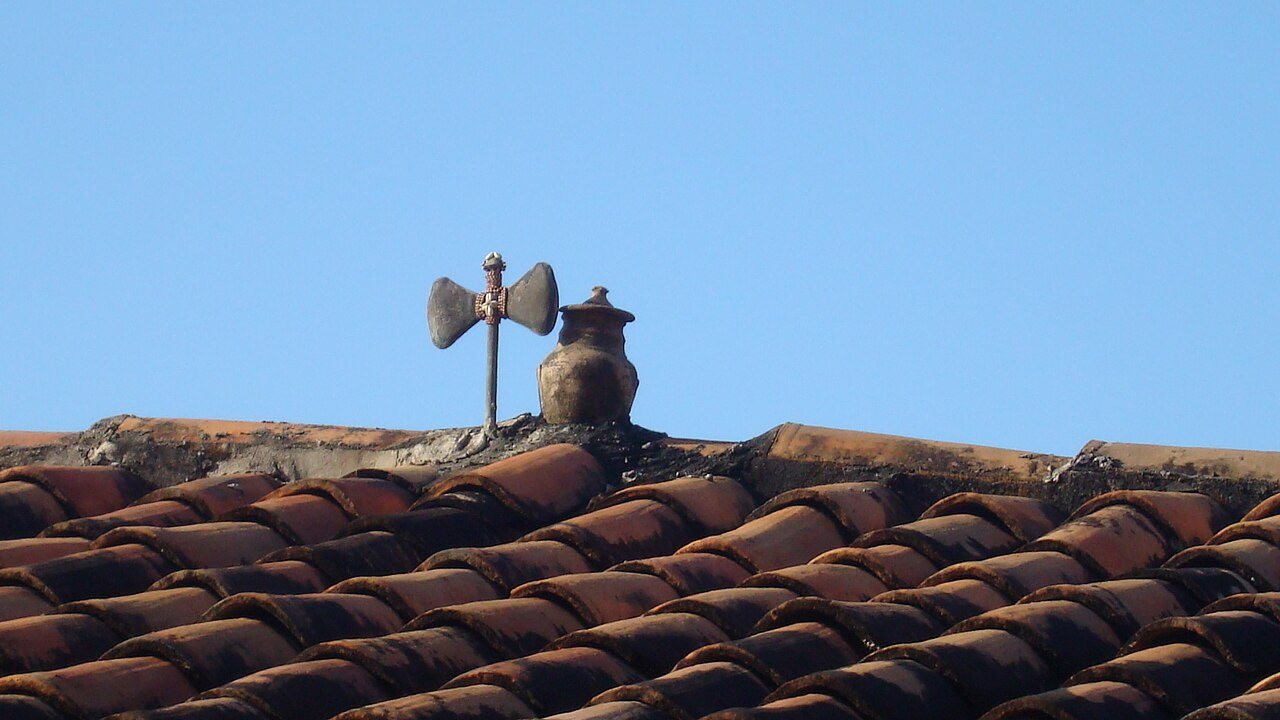
Toluaye, the roof of the Casa Branca do Engenho Velho, Salvador, May 2008. The double axe on the ridge is an emblem of Xangô, patron of the temple. Released into the public domain by the photographer, via Wikimedia Commons.
Its origin is a story told by the community itself. According to this oral tradition, three African freedwomen, remembered as Iyá Detá, Iyá Akalá and Iyá Nassô, founded a cult house near the church of Barroquinha, in the centre of Salvador, in the early nineteenth century. Some versions add other names, an African woman called Iyalussô Danadana and a babalaô called Assiká. The temple’s Yoruba name, “house of Mother Nassô”, keeps the memory of the one who gave it its form. Scholars connect Iyá Nassô with a title in the cult of Xangô at the court of Oyo, and popular accounts have made her a princess, a detail no document supports.
Archival research by the historians Lisa Earl Castillo and Luis Nicolau Parés has since found documents behind part of the tradition. The temple probably dates from around 1830 and first worked out of a townhouse in the Pelourinho. After the revolt of 1835, in which her sons were accused, Iyá Nassô left for Africa with her household. One of the women who went with her, Marcelina da Silva, called Obatossi, came back to Bahia in 1839 and led the community until her death in 1885.
At some point in the second half of the century the house moved to land it leased on the old Engenho Velho estate, then thick forest outside the city. The distance offered some protection. Newspapers of the period still record police raids there.
The houses that came from the house
Succession disputes at the Casa Branca produced two daughters that became famous in their own right.
The first was the Ilê Iyá Omin Axé Iyamassê, the Gantois, named after Édouard Gantois, who owned the land. The house dates its foundation to 1849, under Maria Júlia da Conceição Nazaré; other historians place it in the 1850s. The Gantois passes from mother to daughter by blood, which is unusual among the great houses.
The second was the Ilê Axé Opô Afonjá, founded in 1910 on a farm in São Gonçalo do Retiro by Eugênia Ana dos Santos, known as Mãe Aninha (1869 to 1938), with a man remembered as Tio Joaquim, Obá Sanyá. Aninha was born in Salvador to parents of Gurunsi origin and initiated at the Casa Branca. She made her living in trade and became a skilful politician of her religion. In the 1930s she created at the Opô Afonjá the Obás de Xangô, a council of twelve honorary ministers chosen among men of standing in the city, which tied the temple to them.
The houses tell a further story about her. According to Mãe Stella, who would later lead the same temple, Aninha met President Getúlio Vargas in Rio de Janeiro with the help of his minister Oswaldo Aranha, and obtained the decree of 1939 that forbade the states to hinder religious worship. The decree is real; the meeting is known only from the memory of the temple.
Orixás, axé and a head
The orixás of Bahia are a reduced and reorganized version of a much larger Yoruba pantheon. In Africa each deity tended to belong to a town or a lineage. Xangô was the king of Oyo, Oxum was the river of Oshogbo, Oxóssi was the hunter of Ketu. In Salvador, people from many towns put their gods into the same house, so that a single temple came to serve deities who in Africa had belonged to different places.
Today a Ketu house will usually worship Exu, the messenger who opens every ritual; Ogum, iron and war; Oxóssi, the hunt; Ossaim, the leaves; Omolu or Obaluaiê, disease and its cure; Oxumarê, the rainbow serpent; Xangô, thunder and justice; Iansã, wind and storms; Oxum, fresh water, love and wealth; Iemanjá, the mother whose waters became the sea in Brazil; Nanã, the old mud of creation; and Oxalá, the father, dressed in white.
The force that runs through all of this is axé, from the Yoruba àṣẹ: power, life, the capacity to make things happen. A temple has axé, a sacred object holds it, an offering renews it, and a house that loses it, people say, dies. The word also names the temple itself and its lineage. People say they belong to a given axé the way others name their parish.
Each person, in this theology, has an orí, a head in the spiritual sense, and belongs to an orixá who is their “owner of the head”. Discovering which orixá that is, and caring for the relationship, is much of what Candomblé life is about.
Sixteen shells
In Yoruba country, the great system of divination is Ifá, practised by male priests called babaláwo, “fathers of the secret”, with palm nuts or a divining chain and an immense body of verses learned by heart. Ifá came to Brazil, and the nineteenth century had its babalaôs, among them Martiniano Eliseu do Bonfim, who had studied in Lagos and would preside over a congress in 1937. But the lineage of Ifá priests thinned out in Bahia during the twentieth century.
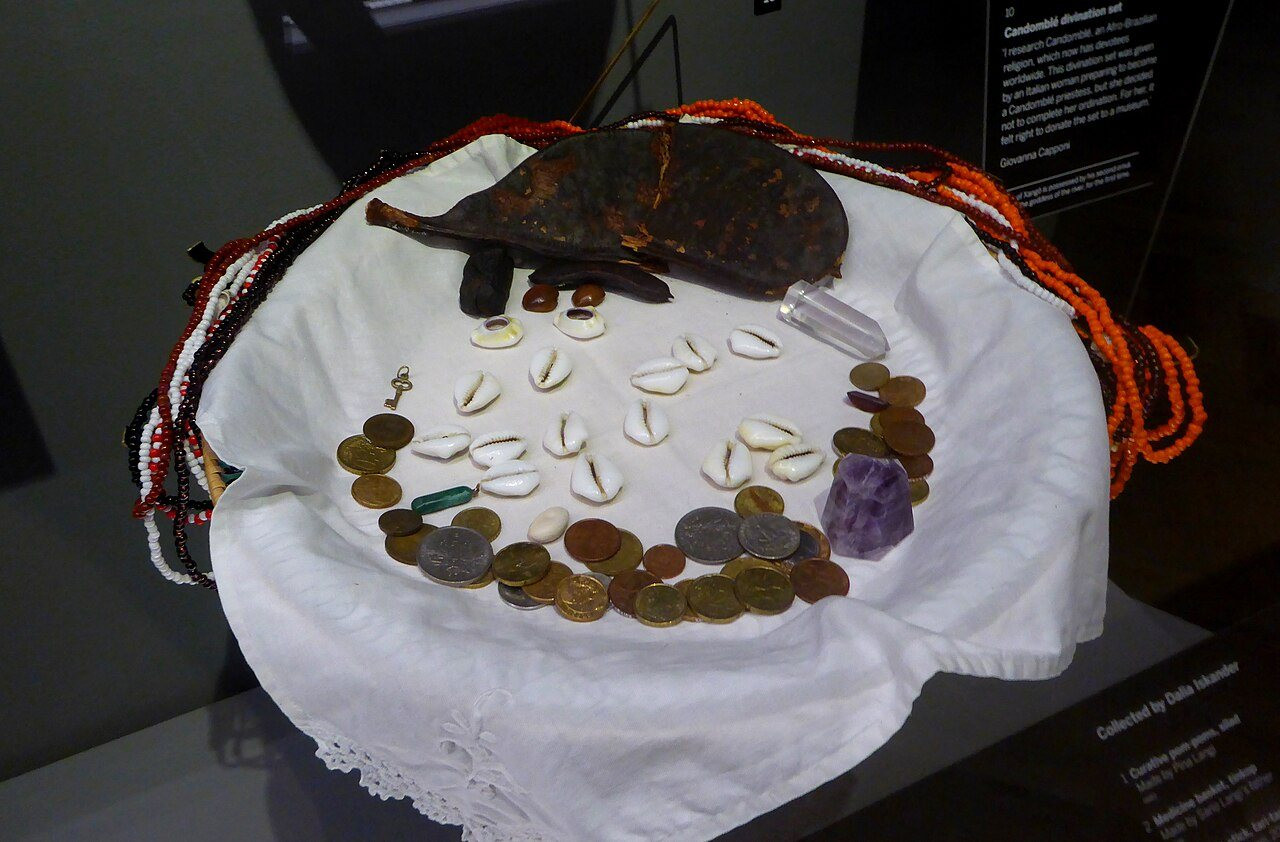
Ethan Doyle White, Candomblé divination set, Horniman Museum, London, 2018. The set was collected in 2015. CC BY-SA 4.0, via Wikimedia Commons.
What survived everywhere was the jogo de búzios, divination with cowrie shells, related to the Yoruba mẹ́rìndínlógún, “sixteen”. In the hands of an ialorixá or a babalorixá, the shells answer who owns a person’s head, what an orixá wants, whether a crisis has a spiritual cause. The method of reading is taught inside the religion.
The French photographer Pierre Verger, who settled in Salvador in 1946, crossed the ocean the other way. In 1953, in Ketu, then in Dahomey, he was initiated into Ifá and received the name Fatumbi, and for decades he carried messages and photographs between the temples of Bahia and the Yoruba towns.
Who does what in a terreiro
A Candomblé house is organized by office and by seniority, counted in years since initiation.
At the top is the ialorixá, “mother of orixá”, or the babalorixá, “father of orixá”, known in Portuguese as mãe-de-santo and pai-de-santo. In the historic Ketu houses of Salvador the leadership has been female since the beginning. Below them come the senior women, among them the iakekerê, the “little mother”, and the elders of the house.
Two groups serve without going into trance. The ogãs are men who protect the temple, play the drums, or support it with money and influence. The ekedes are women who attend the orixás when they manifest, wiping a face, adjusting a cloth, leading a dancer. Both are chosen by the orixás, as the houses put it, and confirmed in their posts.
At the base are the initiates who go into trance. A novice in the Ketu tradition is an iaô, from the Yoruba ìyàwó, “bride”, whatever the novice’s sex. The initiation takes place in seclusion, involves a long period of learning and ends with a public festival in which the new initiate is presented and the orixá dances. Seven years later an iaô may become an ebomi, an “elder sibling”. The inner content of the initiation is precisely what the religion keeps closed, and I leave it closed here.
Saints at the door
Enslaved Africans in Brazil were baptized as Catholics, often in bulk, and the colonial church organized them into lay brotherhoods, such as those of Our Lady of the Rosary. Over time the orixás came to be paired with Catholic saints. Oxalá became the Senhor do Bonfim; Iansã, Santa Bárbara, who also commands lightning; Ogum, Saint Anthony in Bahia and Saint George in Rio; Omolu, Saint Lazarus; Xangô, Saint Jerome or Saint John; Iemanjá, Our Lady of the Conception.
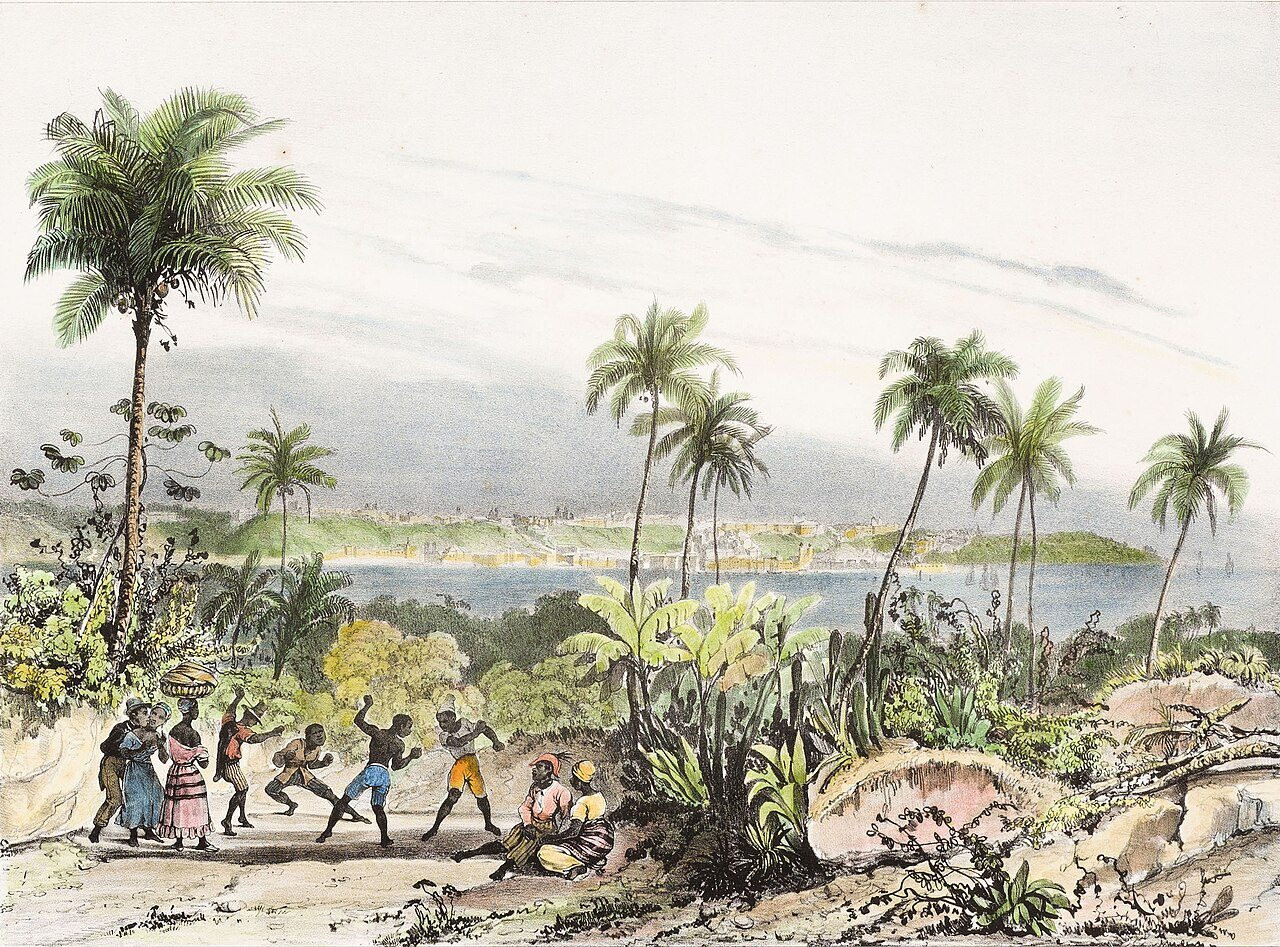
Johann Moritz Rugendas, San-Salvador, hand-coloured lithograph from Voyage pittoresque dans le Brésil, Paris, 1827 to 1835. Africans gather in a clearing on the outskirts of Salvador. Public domain, Brasiliana Iconográfica, via Wikimedia Commons.
The usual explanation is camouflage, the saint as a mask for the god. Some historians find this too simple: many devotees seem to have treated the two pantheons as related powers, and went to Mass as sincerely as to the terreiro. Some houses still open their festival cycle with a Mass. At the Casa Branca, the ritual year begins on Corpus Christi with what the community calls the Mass of Oxóssi.
The Lavagem do Bonfim shows how the two calendars grew into each other. According to the history of the festival, in the eighteenth century the lay brotherhood of the Senhor do Bonfim had the church washed by enslaved people before the feast. Over time, for people of Candomblé, the washing joined the cycle of the Waters of Oxalá, when water is carried in procession for the father of the orixás. The archdiocese eventually moved the washing out of the nave and onto the steps, which is why the doors are shut.
A licence until ten at night
The Brazilian Republic of 1889 separated church and state and promised freedom of worship. The penal code of 1890 also punished “spiritism”, “magic and its spells” and the illegal practice of medicine, and these articles were used for decades against Candomblé. Bahian newspapers of the early twentieth century ran campaigns against the “candomblés” of the city, and the police invaded temples, arrested priests and carried off drums and sacred objects.
From the late 1930s the control became bureaucratic. In Bahia, temples had to register with the Delegacia de Jogos e Costumes, the police department for gambling and public morals, and ask for a licence for each festival. One such licence, found in 2024 by a museology student at the Federal University of Bahia, was issued on 31 May 1961 to Maria Escolástica da Conceição Nazaré, who was by then the most famous priestess in Brazil. It allowed her a festival “of an Afro-Brazilian character” on 1 and 2 June, with no alcohol, no minors, and no drums after ten at night.
The obligation ended on 15 January 1976, when the governor of Bahia, Roberto Santos, signed Decree 25,095 freeing the Afro-Brazilian cults from registration, fees and police licences. The next day the newspaper A Tarde quoted Antônio Monteiro, president of the Bahian association of the cults, who called it “a victory, after 32 years of struggle”. The anthropologist Jocélio Teles dos Santos counted 46 new terreiros founded in Salvador that year.
Doctors, communists and the congresses
The first man to study Candomblé systematically was a professor of legal medicine. Raimundo Nina Rodrigues (1862 to 1906), of the Bahia medical school, visited the Gantois in the 1890s and published O animismo fetichista dos negros baianos, the “fetishist animism of the Bahian Blacks”. He documented names, rites and houses with care, and he interpreted all of it through the racial science of his day, which held Africans to be an inferior stage of humanity and possession to be a form of hysteria. The Bahian police institute of legal medicine still bears his name.
A generation later the tone changed. In November 1934, in Recife, the sociologist Gilberto Freyre organized the First Afro-Brazilian Congress, with scholars sitting beside cooks and priests. On 11 January 1937, in Salvador, the Second Afro-Brazilian Congress opened in the Geographical and Historical Institute of Bahia under the presidency of the babalaô Martiniano Eliseu do Bonfim. Its organizer was a young Bahian journalist and ethnographer, Edison Carneiro (1912 to 1972), a member of the Communist Party, who treated the priests as colleagues and the religion as a culture with rights. In the same year he helped found the União das Seitas Afro-Brasileiras da Bahia, an association meant to defend the houses against the police.
In 1958 the French sociologist Roger Bastide published Le candomblé de Bahia (rite nagô), which read the religion as a philosophy. By then the great Ketu houses of Salvador were the most studied religious communities in Brazil.
The city of women
In 1938 an American anthropologist arrived in Salvador. Ruth Landes, trained at Columbia under Ruth Benedict and Franz Boas, spent about a year in Bahia, much of it guided by Edison Carneiro. Her book The City of Women came out in 1947.
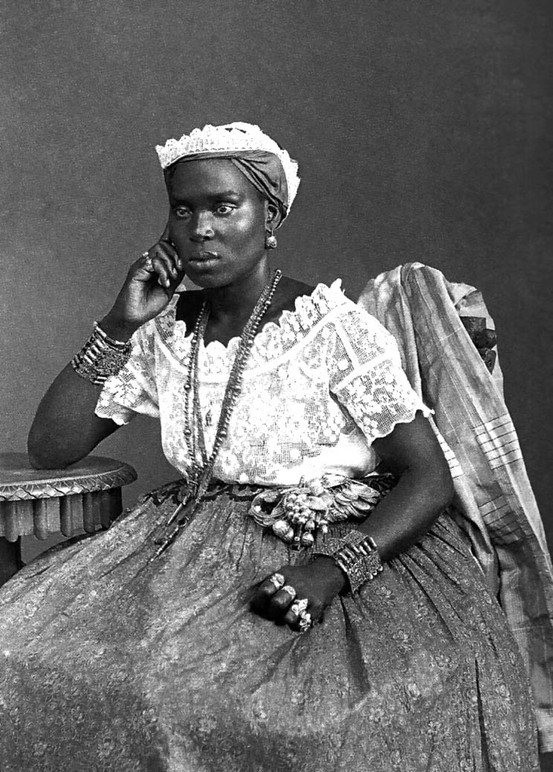
Marc Ferrez, Negra da Bahia (Black woman of Bahia), c. 1885. Ferrez did not record her name. The cloth over her shoulder is a pano da costa, the striped “coast cloth” woven in West Africa. Public domain, via Wikimedia Commons.
Landes was struck by what she saw in the old Ketu houses: women at the head of every important temple, men in supporting roles, a sacred authority that in Bahia belonged to Black women. She wrote openly about the men who did go into trance in other houses, many of them homosexual, and her frankness cost her. Arthur Ramos, then the most powerful name in Afro-Brazilian studies, attacked her work, and her career in the United States never recovered fully. Later scholars have argued about whether she generalized from a few houses. The book remains one of the first portraits of Candomblé as a world run by its women.
The most famous of those women was the one the police licensed in 1961. Maria Escolástica da Conceição Nazaré, Mãe Menininha do Gantois (1894 to 1986), great-granddaughter of the founder of the house, took office on 18 February 1922 and led the Gantois for sixty-four years. Politicians, writers and singers climbed the hill of the Gantois to ask for her blessing, and in 1976 a samba school of Rio paraded with her life as its theme. Her death, in August 1986, was national news.
Iansã is not Santa Bárbara
In July 1983 Salvador hosted the Second World Conference on Orisha Tradition and Culture, promoted by the Nigerian scholar Wande Abimbola, rector of the University of Ifẹ. During that week five of the most senior priestesses of the city put their names to a manifesto. They were Mãe Stella de Oxóssi of the Opô Afonjá, Mãe Menininha do Gantois, Tetê de Iansã of the Casa Branca, Olga de Alaketu and Nicinha do Bogum. The document asked the people of the houses to abandon the pairing of orixás and saints, and to stop treating Candomblé as folklore. Its slogan was “Iansã não é Santa Bárbara”, Iansã is not Saint Barbara. The Jornal da Bahia published it at the end of that month.
Maria Stella de Azevedo Santos (1925 to 2018), the author of the idea, had been initiated at the Opô Afonjá in 1939, at fourteen, and chosen in 1976 as its fifth ialorixá. In the interview with the Jornal da Bahia quoted at the top of this post, as it circulates in transcription, she called Saint Barbara “an elevated spirit, without doubt”, and added: “we know that Iansã is another energy”. Her point was that the pairing had been a strategy of survival under slavery, and that the strategy had done its work.
The manifesto belongs to a wider movement that scholars call re-Africanization: Brazilian priests studying Yoruba, travelling to Nigeria, recovering rituals that had been forgotten. It had critics inside the religion. Many houses kept their saints, and some practitioners saw Catholic elements as part of their own history. Others noted that the return to Africa appealed strongly to white middle-class initiates. In 2013 Mãe Stella was elected unanimously to the Academy of Letters of Bahia.
A gas station by the spring
In the early 1980s the Casa Branca nearly lost its land. Part of the estate it had leased for a century was sold, and a gas station went up beside the spring of Oxum. The community organized. Its iakekerê, Tetê de Iansã, and the president of its civil society, the ogã Antônio Agnelo Pereira, led a campaign joined by Mãe Menininha, Jorge Amado, the painter Carybé, Dorival Caymmi, Pierre Verger and the architect Oscar Niemeyer.
The city of Salvador declared the site municipal heritage in 1982. On 31 May 1984, at a meeting held in Salvador, the advisory council of the federal heritage service, then called SPHAN, voted to list the Casa Branca, with the anthropologist Gilberto Velho as one of the rapporteurs. The minister of culture, Celso Furtado, ratified the decision in June 1986, and in August of that year the “Terreiro da Casa Branca”, about 6,800 square metres “with the buildings, trees and main sacred objects”, entered the national registers.
It was the first Afro-Brazilian temple to be listed as national heritage in Brazil, and a federal institution had for the first time recognized the history of a Black religion as part of the nation’s history. Niemeyer designed the new plaza of Oxum with its boat-shaped shrine. The Opô Afonjá followed in 2000, the Gantois in 2002 and the Bate Folha in 2003.
The second of February
On 2 February the beach of Rio Vermelho, in Salvador, fills with people dressed in white and blue. They bring flowers, perfumes, mirrors and combs for Iemanjá, and at the end of the day fishing boats carry the gifts out to sea.
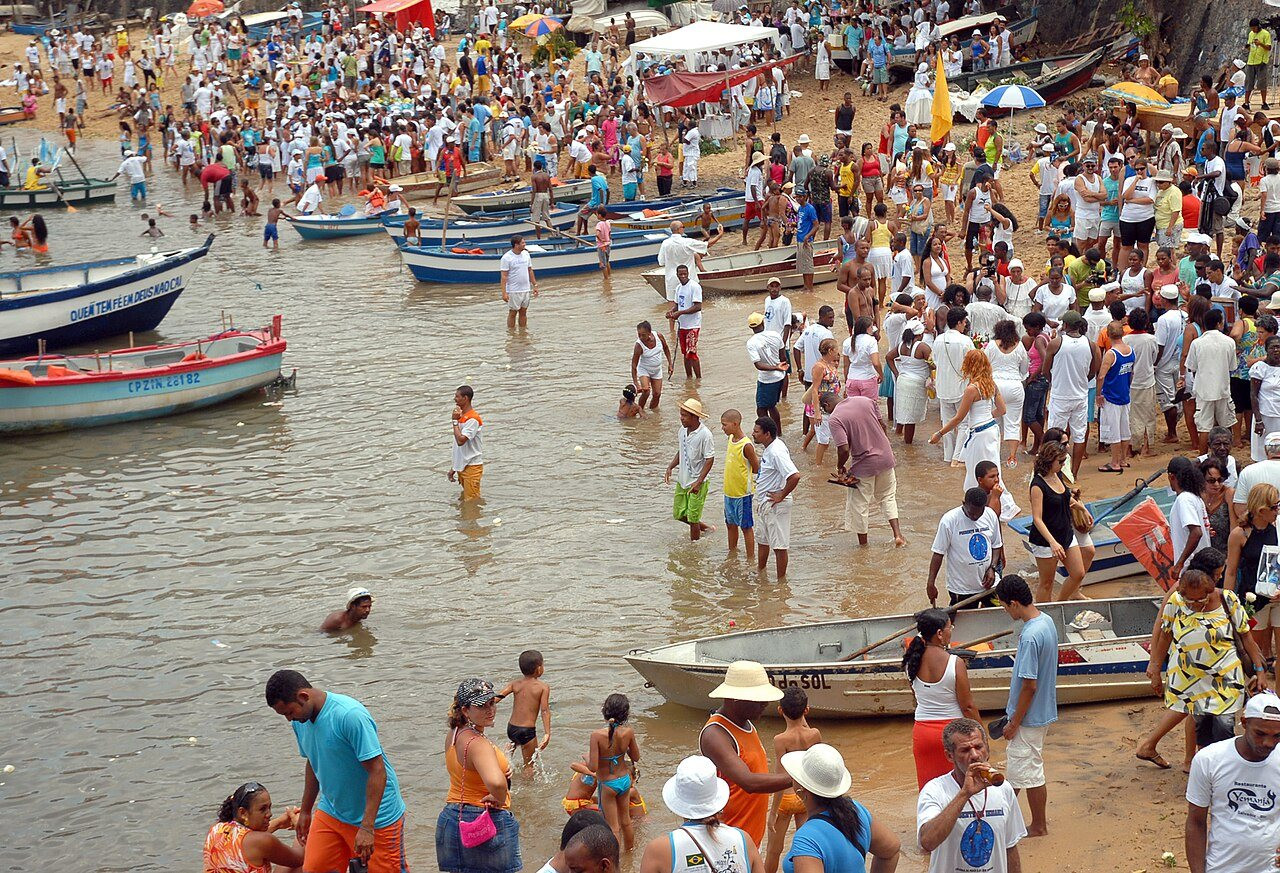
Fabio Rodrigues Pozzebom, Festa de Iemanjá at Rio Vermelho, Salvador, 2 February 2008. Agência Brasil, CC BY 3.0 BR, via Wikimedia Commons.
The festival is younger than it looks. It is organized by the fishermen of the neighbourhood, who had an older feast of Saint Anne, and local tradition dates the gift to Iemanjá in the sea from 1924. Edison Carneiro wrote that the offerings had first been made at the Dique do Tororó, a lake in the city. Pierre Verger thought the date came from Oxum’s pairing with Our Lady of Candles, whose feast falls on the same day. In Yorubaland, Yemọja is the goddess of the Ògùn river; in Brazil she became the mother of the sea.
The Festa de Iemanjá is the most public face of Candomblé, and it is shared. Umbanda, the subject of the first post in this series, honours her on other beaches and other dates, in Rio on the last night of the year.
Mãe Gilda’s photograph
In October 1999 the Folha Universal, the newspaper of the Universal Church of the Kingdom of God, a neo-Pentecostal church, printed a photograph of an ialorixá of Salvador, Gildásia dos Santos e Santos, known as Mãe Gilda de Ogum. The headline above it read “Macumbeiros charlatões lesam o bolso e a vida dos clientes”, “Macumba charlatans damage their clients’ pockets and lives”. Her temple in Itapuã was attacked, and on 21 January 2000 she died of a heart attack. In 2004 a court in Salvador ordered the church to pay her family damages. In 2007 Federal Law 11,635 made 21 January the National Day for Combating Religious Intolerance.
Police raids on terreiros ended in the 1970s. Attacks did not: temples are still stoned, burned or closed, and in some neighbourhoods of Rio de Janeiro armed groups that call themselves evangelical have driven terreiros out by force. The 2022 census, published in 2025, counted 1,849,824 Brazilians aged ten or over who declared Umbanda, Candomblé or another Afro-Brazilian religion, about one per cent of that population and three times the share of 2010.
Water on the steps, again
Let us go back to the women on the steps of Bonfim.
The tourist sees a picturesque Catholic festival with African music. A member of the brotherhood of Bonfim sees a feast of Christ. A woman of Candomblé sees water carried for Oxalá, the father of the orixás. All three are looking at the same steps.
Behind that scene are a ship’s hold, three women near the church of Barroquinha, a freedwoman who came back from Africa to lead a temple, a doctor’s notebook, a police licence with a curfew for the drums, a manifesto that sent the saints back to their altars, and a gas station by a spring.
Candomblé is what enslaved Africans rebuilt in Bahia from the gods of several peoples, and its houses lasted through slavery, racial science and the police because communities, most of them led by women, organized them and kept their succession.
The state that once issued their festival licences now keeps their names in the Livros do Tombo.
Original: https://pablo.space/posts/candomble-or-the-houses-that-kept-the-gods