Tupã, or the Thunder the Missionaries Baptized
2026-11-17, originally published on pablo.space.
← all Chamber of Reflections texts
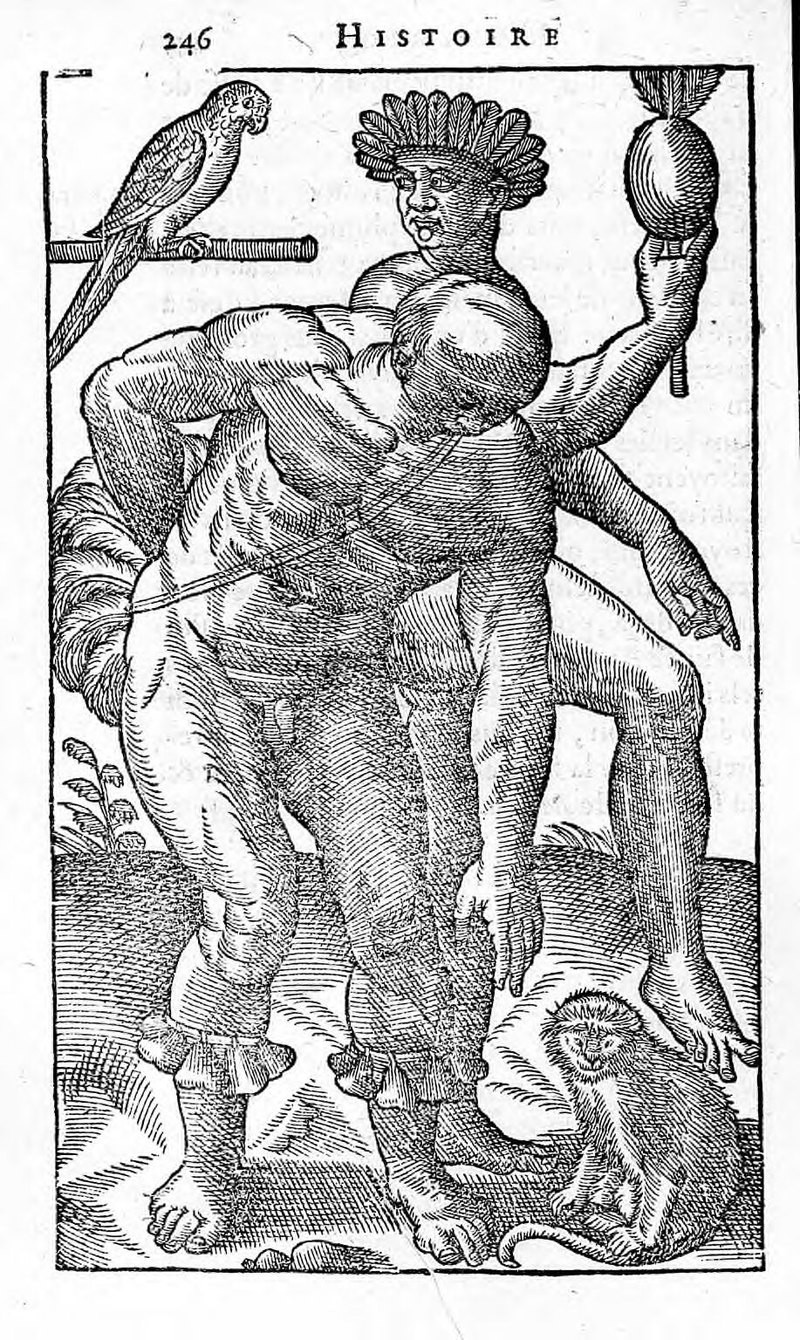
Tupinambá dancers with a maracá, woodcut from Jean de Léry, Histoire d’un voyage faict en la terre du Brésil, 1580 edition, p. 246, in the chapter on “what may be called religion” among the peoples of the Brazilian coast. Bibliothèque nationale de France. Public domain, via Wikimedia Commons.
“I stood there utterly ravished; and every time I remember it, my heart trembles, and it seems to me that I still have them in my ears.”
Jean de Léry, on a Tupinambá ceremony in the village of Cotiva, Histoire d’un voyage faict en la terre du Brésil, 1578, chapter XVI (translated from the French)
Caminha saw no belief, Léry heard songs he never forgot: Tupã, the caraíbas, a Land without Evil and Jurupari, read through the papers of the colony.
A people without belief
In Brazil almost every schoolchild meets one sentence from the letter that Pero Vaz de Caminha wrote to King Manuel of Portugal on 1 May 1500, after ten days on the coast of what is now southern Bahia. The people on the beach, he wrote, seemed so innocent that if the Portuguese could understand them, and they the Portuguese, “they would soon be Christians, because, as it seems, they neither have nor understand any belief”. Any stamp the Portuguese wished to give them, he added, would be easily impressed upon them.
The letter stayed in the royal archive in Lisbon until it was printed in 1817, but its idea had long been at work. The Indians of Brazil, in this picture, were a blank page: no gods, no temples, no priests, nothing to undo. A second picture came later, with the Romantic poets and the textbooks: Tupã as a native god of thunder, a Jupiter of the forest, and the Land without Evil as a Guarani paradise at the end of a long walk. Both pictures are still in circulation.
The documents tell a stranger story.
Almost everything we know about the old religion of the Brazilian coast was written down by men who were sure it hardly existed. Their pages are a long quarrel about belief, and inside that quarrel, often against their own intentions, they kept the prophets, the creator who burned the world, the dead who dance behind the mountains and the songs that a Calvinist could still hear twenty years later.
This post opens a short sub-series and continues the series on Brazilian religions that began with Umbanda. It is a panorama drawn from colonial papers; later texts will go further into individual peoples and their own words. As always on this blog, I write as a historian, from the outside: documents, the people who wrote them, and no rituals or instructions of any kind. The peoples in this story are living peoples, and what their traditions keep from outsiders stays closed here.
A few distinctions will help. The Tupinambá and their neighbours on the sixteenth-century coast spoke closely related Tupi languages. The Guarani of the Paraguay and Paraná basins are their linguistic cousins, with a history of their own. The peoples of the upper Rio Negro, where the name Jurupari belongs, are not Tupi at all. Over all of them lie the categories of Catholic missionaries and, much later, the caboclos of Umbanda.
Three missing letters
The most famous verdict came from a grammarian. In 1576 Pero de Magalhães de Gândavo, author of a treatise on Portuguese spelling, printed a short História da Província Santa Cruz. The language of the coast, he wrote, “lacks three letters, namely, there is no F in it, nor L, nor R, a thing worthy of astonishment, because thus they have no Faith, nor Law, nor King”.
Fé, Lei, Rei. The pun works only in Portuguese, and as the literary scholar Sérgio Alcides has shown, Gabriel Soares de Sousa repeated it in 1587, the friar Vicente do Salvador in 1627 and António Vieira in 1662. It set the terms for every later discussion: did these people have a religion at all?
Monan, who burned the world
The first European to answer at length was a Franciscan friar, André Thevet, who sailed to Guanabara Bay in 1555 with Nicolas Durand de Villegagnon, founder of a short-lived French colony, the France Antarctique. Thevet stayed only a few months. In 1557 he published Les Singularitez de la France Antarctique, and his chapter on religion opens with a verdict: “We have said that these poor people lived without religion and without law, which is true.”
Then he keeps writing. The people of the coast speak of a great lord called Toupan who, “being up there, makes it rain and thunder”, though they have no prayers and no place to honour him. They remember a charaïbe, a prophet, who gave a young girl the roots of manioc and taught her to plant them. The souls of those who fought well go to gardens and orchards; the others go with Agnan. Thevet says where much of this came from: “a French interpreter who had lived there ten years and understood their language perfectly”.
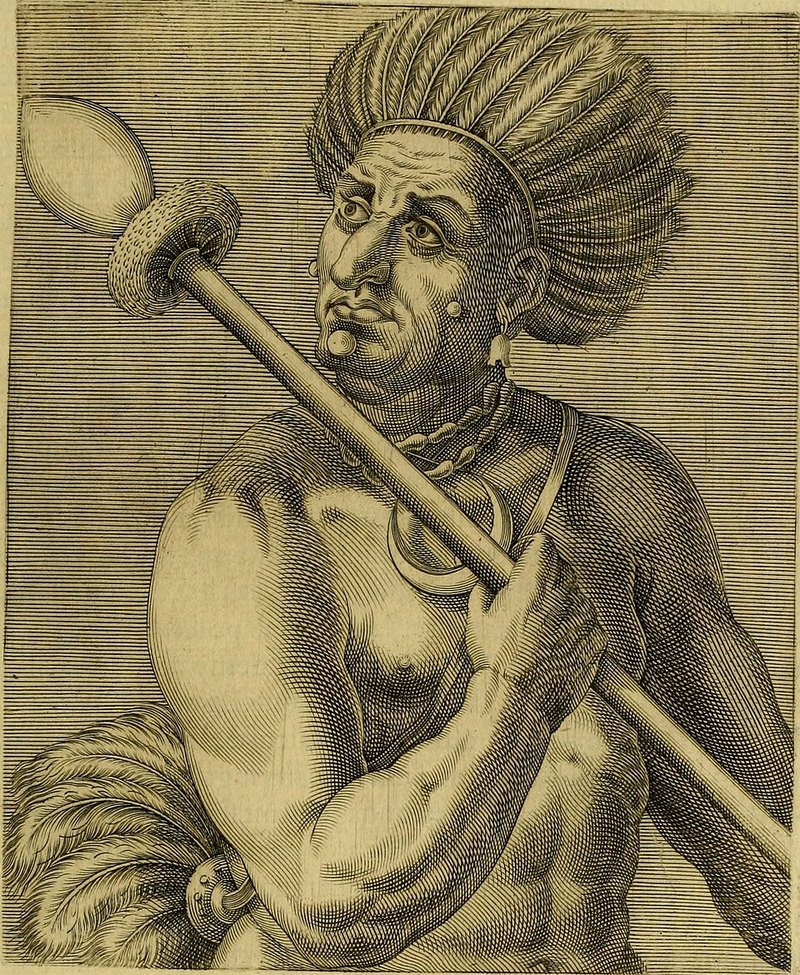
“Quoniambec”, the Tupinambá chief Cunhambebe, engraving in André Thevet, Les vrais pourtraits et vies des hommes illustres, Paris, 1584, fol. 661r. Cunhambebe was a leading chief of the coast between Rio de Janeiro and São Vicente in the 1550s; the portrait was engraved in Paris three decades later. Public domain, via Wikimedia Commons.
In his Cosmographie universelle of 1575 Thevet told a fuller story. A creator called Monan made the sky and the earth and lived among the first people. When they forgot him, he sent tatá, fire from the sky, which burned the face of the world. One man, Irin-Magé, was spared, and at his plea Monan sent a rain so great that its waters became the rivers and the sea.
Frank Lestringant, Thevet’s modern editor, calls the friar’s own experience of Brazil “rather limited” and shows that much of his material came from the truchements, Norman interpreters who lived for years in Tupinambá villages. Even so, in 1928 the Swiss anthropologist Alfred Métraux made Thevet, including his unpublished manuscripts, the backbone of La religion des Tupinamba, the first systematic reconstruction of that religion. Most modern accounts of Monan go back to that book.
One detail stands out. Thevet says the Tupinambá called the Europeans Mahire, “the name of one of their ancient prophets”, and Jean de Léry recorded them addressing the French as mair. A culture hero and a nation of bearded foreigners shared a word. What the Tupinambá meant by it, the sources do not say.
The thunder that was worth nothing
Léry was a young Calvinist who reached Villegagnon’s colony in 1557 with a group sent from Geneva and left in 1558, after the colony split over theology. In 1578 he published at La Rochelle his Histoire d’un voyage faict en la terre du Brésil.
His chapter XVI is titled “What may be called religion among the American savages”. When the French learned that the Tupinambá feared the thunder, which they called Toupan, they told them this was the God they preached, who made heaven and earth tremble to show his power. The answer, Léry reports, was that since this god frightened them so much, “he was worth nothing”.
He also recorded what they did believe. The souls of those who had lived bravely, which meant those who had avenged their kin and eaten their enemies, went “behind the high mountains” to dance in beautiful gardens with the souls of their grandfathers. The souls of cowards went to Aygnan, a tormenting spirit the living also feared. Léry heard men cry out that Aygnan was beating them, and he gives their words: Mair atou-assap, acequeiey Aygnan atoupavé, “Frenchman, my friend, I fear Aygnan more than anything”.
In the 1580s the Portuguese Jesuit Fernão Cardim drew the conclusion that would shape the vocabulary of Brazilian Christianity. The Indians, he wrote, had no proper name for God, “but they say that Tupã is the one who makes the thunder and lightning, and that he gave them hoes and food, and because they have no other more proper and natural name, they call God Tupã”.
A song through a hole in the roof
Léry’s chapter also holds the passage at the top of this post. With another Frenchman, Jacques Rousseau, and an interpreter, he spent a night in a village called Cotiva. In the morning five or six hundred people gathered and divided into three houses: men, women, children. Léry was placed with the women, and the interpreter warned him that in six or seven years in the country he had never dared attend such a feast.
Léry went anyway. He made a small hole in the thatch of the men’s house and looked in.
The men stood in three circles, bent forward, moving only the right foot. In the middle of each circle stood three or four caraíbas in robes and bonnets of feathers, shaking a maracá in each hand “so that, they said, the spirit would afterwards speak in them”. Léry could compare them only to the friars who carried the relics of Saint Anthony from town to town, a Calvinist never missing a chance at the Catholics, and then the singing began, and the fear he had felt among the women turned into the joy of the epigraph.
Afterwards the interpreter told him what they had sung. They had mourned their brave grandfathers and consoled themselves that they would join them behind the mountains; they had threatened their enemies; and they had sung that the waters once rose over the whole earth and drowned everyone except their ancestors, who escaped to the tops of the highest trees. Léry took it for a garbled memory of Noah.
The gourd that spoke
Hans Staden, a German gunner, had been a prisoner of the Tupinambá for about nine months in 1554. His Warhaftige Historia, printed at Marburg in 1557, gave Europe most of its images of the coast, many of them sensational. His chapter on belief is calmer.
Every man, he says, had a gourd rattle with a slit like a mouth, which he called tammaraka. Once a year the paygi, the prophets, went from village to village, saying that a spirit from a distant land had given them the power to make every rattle speak. The rattles were painted red, decorated with feathers and brought into a house cleared of women and children. The prophet held each to his mouth, shook it and said, in Staden’s rendering, “Speak and let yourself be heard, if you are inside”, then spoke so softly that Staden could not tell whether the gourd or the man was talking. Each man took his rattle home, gave it a small house, called it his dear son and brought it food. Staden ends: “That is all their religion”, at the close of a chapter that describes travelling prophets, an annual ceremony and a cult kept in every house.
Two figures appear in all these accounts, and the chroniclers did not always separate them. The pajé was the healer of a village, who blew tobacco smoke over the sick and dealt with spirits. The caraíba, karaí in Guarani, was the wandering prophet, honoured enough to pass even between enemy villages.
Manuel da Nóbrega, who led the first Jesuits to Bahia in 1549, described them that same year: “every so many years sorcerers come from very distant lands, pretending to bring holiness”. The paths were cleared for them, the women confessed their faults to one another, and the prophet, in a dark house, made a gourd shaped like a human figure speak in a child’s voice. Nobody need work any longer, it said: the crops would grow by themselves, the hoes would dig alone, the arrows would go hunting for their owners, and the old women would become young.
Nóbrega’s word for the event, santidade, holiness, stuck. The historian Ronaldo Vainfas notes that his description borrows the tone of the European witches’ sabbath, though Nóbrega never uses the word, and reads in its promises the oldest description of the Land without Evil.
Words for God
To preach, the Jesuits needed words, and every word they borrowed came with a world attached.
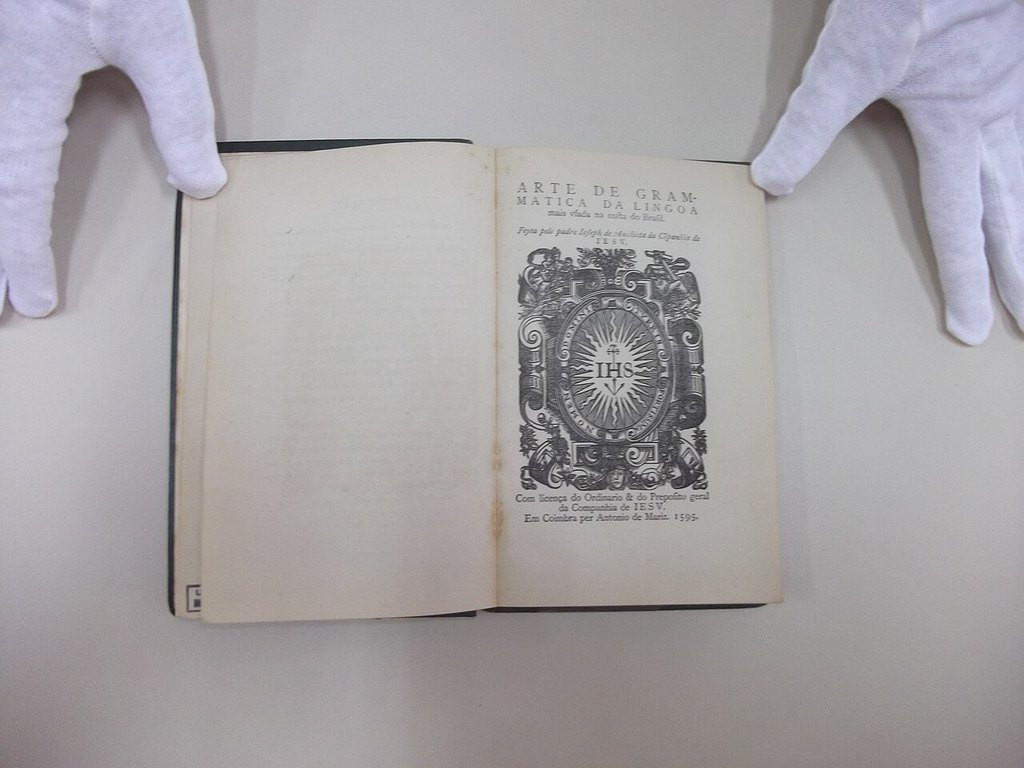
Title page of José de Anchieta, Arte de grammatica da lingoa mais usada na costa do Brasil, Coimbra, Antonio de Mariz, 1595, in the facsimile printed by the Biblioteca Nacional in 1933. Photograph by the Biblioteca Central of the Universidade Federal do Rio Grande do Sul, 2013. CC BY-SA 2.0, via Wikimedia Commons.
José de Anchieta, who arrived in 1553 and became the great Jesuit writer in Tupi, composed the grammar above, catechisms, songs and plays. In this Christian Tupi, God was Tupã, as Cardim explained, and the Virgin became Tupansy, mother of Tupã. The prophets’ title travelled furthest. A manuscript vocabulary of the Jesuit language, compiled in the late sixteenth or early seventeenth century and printed only in 1938, translates “holy or blessed thing” as caraíba, and an angel as caraibebe, a flying caraíba. An eighteenth-century Tupi dictionary from the Amazon gives caraíba for a white Portuguese.
The devil needed a name too. The early vocabulary gives Anhanga, then lists other “species”: Curupira, Taguaíba, Jurupari and more. Cardim says the Indians feared “the demon, whom they call Curupira, Taguaigba, Macachera, Anhanga”, so much that some died merely from imagining him. Each was a being of the forest or the night with its own character; the catechism made them one enemy. The official catechism of 1618, by the Jesuit Antônio de Araújo, called the devil Anhanga.
Anchieta also wrote for the stage. In his play for the feast of Saint Lawrence, performed at the village of São Lourenço in Niterói, probably in 1587, the devils who try to corrupt the Christian village speak Tupi and bear the names of Guaixará and Aimbirê, Tamoio chiefs who had fought the Portuguese alongside the French.
A church in the cane fields
The santidades outlived the arrival of the Jesuits and became one way of answering them. In Bahia, Vainfas notes, the Jesuits counted some 40,000 Christian Indians in their villages in 1564 and barely 10,000 in 1585, after smallpox, war and slaving.
In those years a movement gathered in the backlands of Jaguaripe, south of Salvador. Its leader was a caraíba named Antônio, raised by the Jesuits in their village at Tinharé, who had run away. Around him gathered several hundred people, many of them runaways from the sugar mills and the missions. The movement had its own “church”, a stone idol and its own clergy, among them a woman prophet whom the Portuguese called Santa Maria or Mother of God. Its message, as far as hostile witnesses let us see it, joined the old promises of the prophets to Christian words, and the colonists feared it as the beginning of a general rising.
Manuel Teles Barreto, governor of Brazil from 1583 to 1587, wrote that runaways were flocking to it and setting fire to the estates, and that “everything was born of this abuse that they called santidade”.
Then Fernão Cabral de Taíde, a nobleman and one of the richest planters of the Recôncavo, persuaded part of the movement to settle on his own estate at Jaguaripe. For some months the santidade had its church on a Portuguese plantation. Fernão Cabral supplied candles and cloth for the idol, ordered white visitors to show it reverence and, according to some witnesses, was called Tupã by its followers. The governor finally sent men who burned the church and seized the idol. Gabriel Soares de Sousa, describing the same estate in 1587, admired it as “very beautiful work, adorned with noble buildings”, and said nothing of the church.
The visitor from Lisbon
In 1591 the Inquisition of Lisbon sent its first visitor to Brazil, Heitor Furtado de Mendonça. He had come for Judaizers, bigamists and blasphemers; in Bahia he found the santidade. On 2 August 1591 Fernão Cabral confessed before him that he had helped the Indians of the “heresy”, and he was arrested and tried.
The depositions of that visitation are the reason we know about Jaguaripe at all, and they are the words of frightened colonists trying to save themselves. As Vainfas points out in his study of the movement, A heresia dos índios (1995), no Indian testified before the visitor about the santidade, which had been theirs.
Jaguaripe was not alone. Anchieta reported a santidade in 1590 at the Jesuit village of Pinheiros, near São Paulo, where a caraíba entered the church, beheaded the statue of the Virgin and placed himself on the altar as Santa Maria. He and his followers were killed.
Marble and myrtle
In a sermon of 1657 António Vieira compared nations to garden statues. Some are marble, hard to carve and lasting. “There are other nations, on the contrary, and these are those of Brazil, which receive everything they are taught with great docility and ease, without arguing, without replying, without doubting, without resisting; but they are statues of myrtle”, which return to forest when the gardener lowers his shears. Vieira also wrote that other heathens are unbelievers until they believe; “the Brazilians, even after believing, are unbelievers”.
Léry had seen the same thing. After a long night of debate in one village, the Tupinambá knelt with the French and promised to eat no more human flesh; then, from their hammocks, they sang that they must take and eat more enemies than ever. “Behold the inconstancy of this poor people,” he wrote.
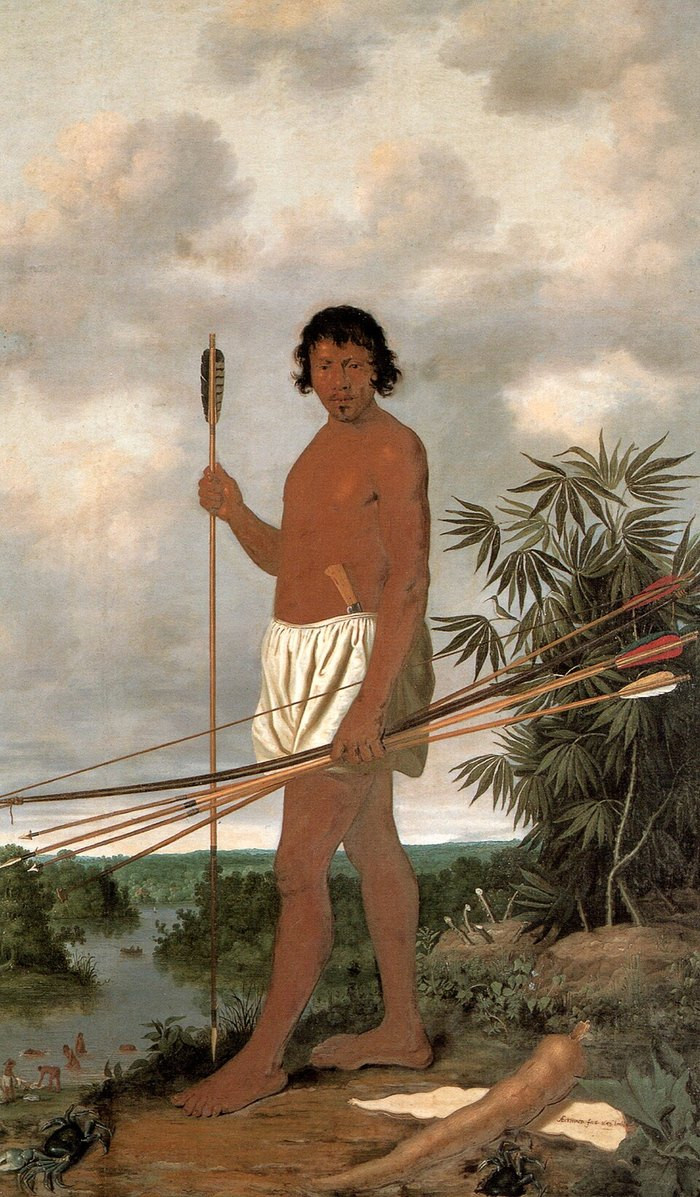
Albert Eckhout, Tupi Man, 1643, oil on canvas, 272 × 163 cm. Painted in Dutch Brazil almost a century and a half after Caminha’s letter; the man belongs to a Tupi people allied with the colony and wears European cloth and a European knife. Nationalmuseet, Copenhagen. Public domain, via Wikimedia Commons.
In 1992 the anthropologist Eduardo Viveiros de Castro took Vieira’s image for the title of an essay, “O mármore e a murta: sobre a inconstância da alma selvagem” (“The marble and the myrtle: on the inconstancy of the savage soul”). Put briefly, his argument is that the Jesuits looked for religion where they expected it, in idols, priests and doctrine, while the centre of Tupinambá life lay in warfare and vengeance. Enemies were captured, kept for months, killed in a public ceremony and eaten, and the killer took new names. Through the enemy, a person and a people became what they were.
On this reading the openness that exasperated Vieira and the stubbornness that exasperated Léry were one thing. “Constancy and inconstancy, openness and stubbornness,” Viveiros de Castro writes, “were two faces of a single truth: the indispensability of others.” A people that made itself out of strangers could welcome the strangers’ god, and let him go. In his phrase, the Tupinambá were “admirably constant in their inconstancy”.
It is an interpretation, and a debated one. It is also why this post gives the subject one paragraph and leaves out the woodcuts of feasts that made it famous in Europe.
A land without evil
The phrase most people know comes from the twentieth century.
Curt Unckel, born in Jena in 1883, went to Brazil as a young man. Among the Apapocúva, a Guarani group in São Paulo state, he received in 1906 the name Nimuendajú, which he kept for life. In 1914 he published in the Zeitschrift für Ethnologie a long study of their myths of the creation and destruction of the world. There he described a movement he had witnessed and heard about: since the early nineteenth century, Guarani groups had been leaving the interior and walking east towards the Atlantic, led by their shamans, in search of yvy marã e’ỹ. He translated it as Land ohne Schlechtes, the land without evil, a place in the east, beyond the sea, where nobody died.
Some groups reached the coast of São Paulo and stayed. Others were turned back by rivers, enemies or hunger. Nimuendajú read these journeys as flight from a world the shamans believed was about to end. He went on to work with dozens of peoples across Brazil and died in 1945 among the Tikuna of the upper Solimões.
A paradise built by readers
The next step was taken in libraries. In 1927 and 1928 Métraux joined Nimuendajú’s Guarani to the Tupinambá of the chronicles: the prophets of Thevet and Nóbrega, the migrations noted by the Portuguese, and a Tupinambá journey to Maranhão recorded by French Capuchins in the early seventeenth century. All of it, he proposed, was one search for one land.
In 1975 Hélène Clastres gave the idea its fullest form in La Terre sans Mal: le prophétisme tupi-guarani. In her reading the prophets preached a refusal of society itself, an exit from the rules of kinship and authority. Her husband, Pierre Clastres, built part of his political anthropology on the same material, and the idea travelled from ethnology into theology and poetry.
Then came the critics. The Jesuit linguist Bartomeu Melià, who worked for decades among the Guarani of Paraguay, pointed in 1990 to the Tesoro de la lengua guaraní of Antonio Ruiz de Montoya, printed in 1639, where yvy marã e’ỹ means intact soil, land never cultivated. In colonial times, Melià argued, looking for it could mean looking for good forest to clear and plant, and the prophetic meaning Nimuendajú recorded belonged to a later history. The anthropologist Cristina Pompa, in Religião como tradução (2003), showed how Métraux had read Tupi and Guarani movements across three centuries as a single body. The archaeologist Francisco Noelli argued from pottery and settlement that the old Tupi had expanded along the coast over long periods.
None of them denies that Guarani prophets led people east, or that yvy marã e’ỹ is a living idea among the Guarani. The quarrel is over time and scale: whether a nineteenth-century movement can explain the sixteenth century, and whether the scholars’ paradise is the land the walkers had in mind.
Jurupari on the Rio Negro
Far to the north west, on the upper Rio Negro and the Uaupés, the same colonial machinery produced a different devil.
The peoples of this region, among them the Tukano, Desana, Tariana and Hupd’äh, speak languages of several families, marry across them and share much of their ritual life, including sacred flutes and trumpets that women must not see. The língua geral of the Amazon, a colonial Tupi carried up the rivers by missionaries, traders and soldiers, gave these traditions a Tupi name: Jurupari. In eighteenth-century missionary dictionaries from Pará, the word for “devil” is Juruparî, where the Jesuits of the coast had written Anhanga.
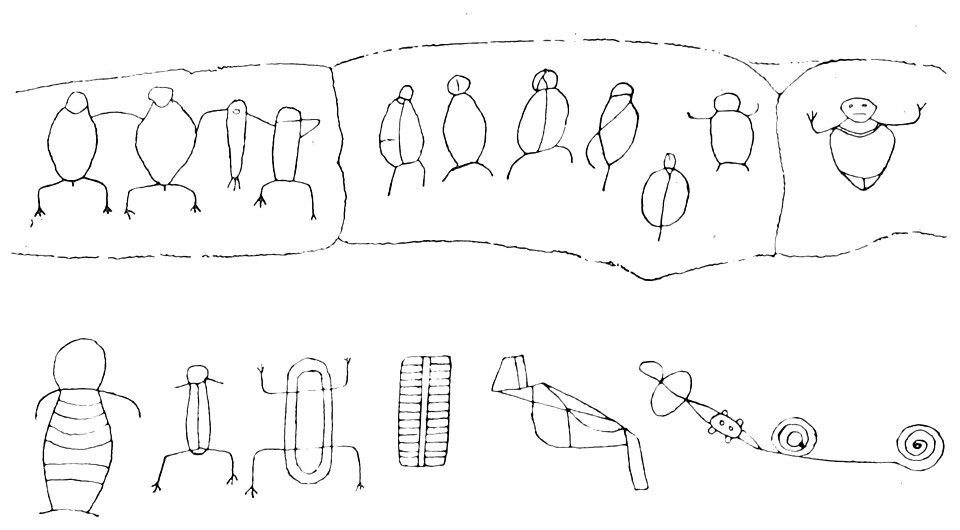
“Figures on the granite rocks of the River Uaupés”, drawn by Alfred Russel Wallace on his journey of 1850 to 1852, plate 15 of A Narrative of Travels on the Amazon and Rio Negro (first published 1853), here from the 1889 edition. Public domain, via Wikimedia Commons.
In 1890 the Italian count Ermanno Stradelli, who had travelled the Uaupés for years and learned the língua geral, published in the bulletin of the Italian Geographical Society a long “Leggenda dell’Jurupary”. It begins: “At the beginning of the world a terrible epidemic raged among the inhabitants of the Serra de Tenuí, and struck only the males.” From that catastrophe comes Jurupari, born of a woman, who becomes a lawgiver, giving men new laws and the sacred instruments and excluding women from them. Stradelli worked from a version in the língua geral, and scholars still debate how much of its literary polish belongs to the Rio Negro and how much to its Italian editor.
In this tradition Jurupari is an ancestor and a legislator. To the missionaries the same name meant Satan.
A mask on a pole
The clearest record comes from the missionaries themselves. In the early 1880s Italian Franciscans opened missions on the Uaupés. One of them, Father Illuminato Giuseppe Coppi, wrote a report that the Italian Geographical Society later published in summary. He had learned that the people believed in a good god called Tupana, who received no cult and to whom they attributed the figures on the rocks of the Uaupés and the Papuri, and that the sound of the sacred instruments was held to be the word of God. He had also obtained a ceremonial mask.
On 21 October 1883, at the mission of Ipanoré, Coppi had a boy wear the mask among the schoolchildren, to prove to the girls that seeing it would not kill them. The next day he hung it on a tall pole in his yard and called the women one by one to look. They fled to their houses. On Sunday 28 October, after Mass, while a second friar, Matteo Canioni, preached “against the diabolical cult”, he showed the mask to the whole village in the church.
His own account describes what followed: husbands searching for their wives, children crying, the pajés trying to push the women out and to seize the mask, the friars barricaded in the mission house with weapons. The missionaries withdrew to the mission at Taraquá. There, the next morning, the chiefs and pajés kept the women out of church until the friars promised never to show them the sacred things.
In 2006 IPHAN, the national heritage institute, registered the Cachoeira de Iauaretê, a set of rapids on the Uaupés, as a sacred place of the peoples of the Uaupés and Papuri rivers. What is sacred there is described in the register by those peoples, and what they keep from view remains theirs.
From the forest to the terreiro
In the nineteenth century the poets and novelists of Romantic Indianism made the Tupi into ancestors of the young empire: a noble Indian of the past, usually dying, with a vocabulary of Tupã, pajés and warriors that schoolbooks repeated for a century, while the living peoples kept losing their lands.
In the twentieth century another image appeared in the cities. As the post on Umbanda told, that religion’s founding spirit was a caboclo, the Caboclo das Sete Encruzilhadas, described in 1933 with a loincloth of feathers and “the other attributes of the forest pajés”. The caboclos are spirits of Indians as Brazilians in Rio de Janeiro imagined them, honoured in a religion built from African, Kardecist and Catholic materials, and their history belongs to Umbanda’s.
Three hundred and ninety-one peoples
Caminha expected a blank page. The census of 2022, whose results on peoples and languages IBGE published in October 2025, counted 1,694,836 Indigenous people in Brazil, belonging to 391 peoples and speaking 295 Indigenous languages. In 2010 the figures were 896,917 people, 305 peoples and 274 languages; IBGE attributes the growth both to changes in the census and to more people declaring who they are. The largest peoples today are the Tikuna, the Kokama and the Makuxi, and the second most spoken Indigenous language is Guarani Kaiowá.
In 1928 a French review of Métraux’s book called the Tupinambá “a tribe now extinct”. In July 2024 a Tupinambá cloak of scarlet ibis feathers, first recorded in the Danish royal collections in 1689, came home from the National Museum of Denmark to the Museu Nacional in Rio de Janeiro, after a request from the Tupinambá people of Olivença, in southern Bahia.
Every name in this post, Monan, Toupan, Aygnan, the caraíbas, yvy marã e’ỹ, Jurupari, reached us through somebody else’s pen: a Franciscan cosmographer with marvels to sell, a Calvinist mocking relics, Jesuits looking for words to preach in, an inquisitor looking for heresy. The later texts in this series will turn from the colony’s papers to particular peoples, and to what they have said and written about themselves.
The colonial record is a quarrel about belief, kept by men who were certain the Indians had almost none. They wrote down the thunder, the prophets, the flood, the dead dancing behind the mountains and the land where nobody dies, mostly in order to refute them, and in refuting them they preserved them.
Léry, who thought the Tupinambá had almost no religion, could still hear them singing twenty years later.
Original: https://pablo.space/posts/tupa-or-the-thunder-the-missionaries-baptized