Jurema, or the City Inside the Tree
2026-11-19, originally published on pablo.space.
← all Chamber of Reflections texts
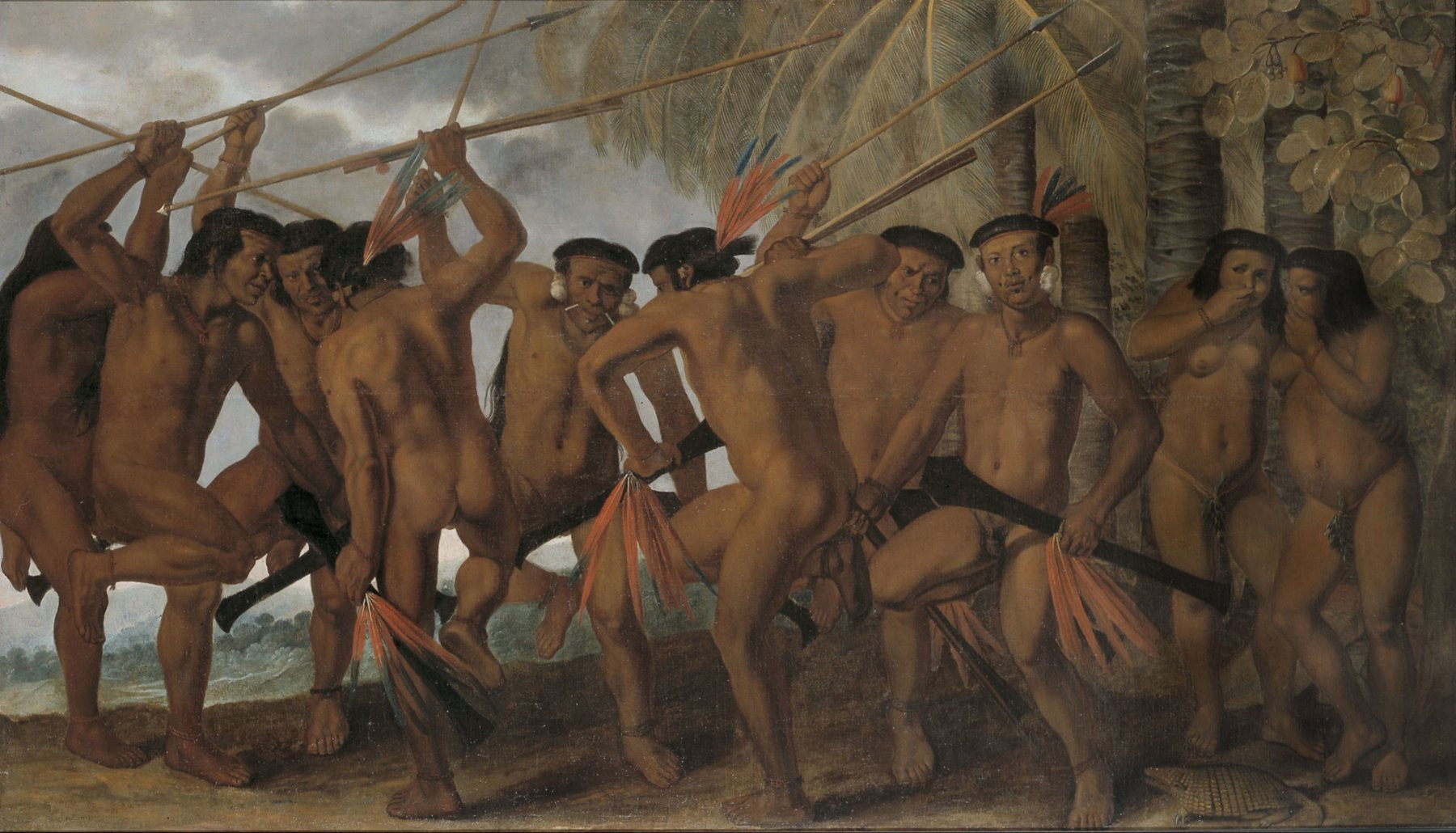
Albert Eckhout, Dance of the Tarairiu (also called Dança dos Tapuias), oil on canvas, 168 × 294 cm, painted in Dutch Brazil in the 1640s. National Museum of Denmark, Copenhagen. Some historians assign the Canindé and Xucuru of the first known document on jurema, of 1739, to the Tarairiú group; nothing in the painting shows jurema. Public domain, via Wikimedia Commons.
“Throughout the entire Amazon region, and specifically along the Pindaré River, there are medicine men, or pagés, as they are called by Brazilians, in almost all rural districts.”
Charles Wagley and Eduardo Galvão, The Tenetehara Indians of Brazil: A Culture in Transition, 1949, p. 181
A Tupi word and a tree of the caatinga, followed through inquisitors, a chemist, an SPI inspector, a modernist poet and the police of Recife.
A word everybody uses about somebody else
When the anthropologist Raymundo Heraldo Maués began to work in Itapuá, a fishing village in the municipality of Vigia, on the Atlantic coast of Pará, every household told him it was Catholic. He had come to study ideas about food and illness. Only after about a month in the village did anyone mention the local healers, and he was invited to watch a night session of curing by one of the most respected of them. He later understood the delay. The practice had been repressed in the Amazon, he wrote, “since at least the eighteenth century”, and the villagers had learned to keep it from strangers.
The healers did not use the word that outsiders used for them. In the Salgado region, Maués found, pajé carried a pejorative sense. Everyone said it, the healers included, as long as they were speaking of somebody else. They called themselves curadores, healers.
Pajé is a Tupi word. Missionaries wrote it for the healers of the Tupinambá, Brazilians in the Amazon used it for the Catholic curers of the river villages, and in the Northeast it names the spiritual leader of several Indigenous peoples who hold rites with the drink called jurema. The tree took a similar road: from the caatinga of the sertão to the papers of a colonial council, a chemist’s laboratory, a police station in Recife and the altars of Umbanda in Rio de Janeiro.
The pajé and the jurema have passed through at least four distinct traditions, and nearly everything outsiders know about them was written by people who were trying to suppress, convert, measure or collect them: inquisitors, bishops, a chemist, an SPI inspector, a modernist poet, the police. Read one at a time, the traditions keep their own names, their own dead and their own closed doors. The single mystical blend that later readers sometimes made of them is hard to find in the sources.
This post continues the Indigenous sub-series that began with Tupã and the Pirahã, and it crosses the series on Brazilian religions that ran through Umbanda, Candomblé and Quimbanda. As always here, I write as a historian, from the outside: documents and the people who wrote them, and no rituals, preparations or instructions of any kind. Translations from Portuguese are mine unless stated.
Four traditions appear below, kept apart: the shamanism of Indigenous peoples; the caboclo pajelança of the Amazon, practised by rural Catholics; the jurema of the Indigenous peoples of the Northeast; and the Jurema of the coastal cities, long called catimbó, with its mestres, which later found a place inside Umbanda.
The pajé the chroniclers saw
The panorama post followed the pajé of the sixteenth-century coast through the Jesuits and the travellers: the healer of a village who blew tobacco smoke over the sick, distinct from the wandering prophet, the caraíba. Those sources were written by men who wanted the pajés gone. A closer picture came four centuries later, from people who lived in the villages.
In the early 1940s the American anthropologist Charles Wagley and his young Brazilian colleague Eduardo Galvão lived among the Tenetehara, a Tupi-Guarani people of the Pindaré river in Maranhão. Their book, The Tenetehara Indians of Brazil (1949), put the shaman at the centre of village life: “the Tenetehara depend upon the shaman to defend them from sorcery and from malevolent supernaturals, and the shaman is the central figure in most ceremonials.” They were told that in the past almost all family leaders had been shamans. Tobacco, they wrote, “is the only traditional stimulant for shamans”.
One of their main informants, a young man known as Vaqueiro, had travelled for months with a Brazilian conjurer who passed for a pajé in the villages. He had watched cures among Indians and Brazilians alike, and he “frequently compared the methods of Tenetehara and Brazilian shamans” for the two anthropologists. The passage quoted at the top of this post goes on to describe the caboclo healers of the Amazon, who cured “by massage and sucking”, used tobacco, danced to a gourd rattle and were possessed “in the manner described for Tenetehara Indian shamans”. Their spirit familiars, the authors added, “are both Christian saints and such pagan spirits as Zuruparí”.
Indigenous shamanism in Brazil is as varied as the peoples who practise it, and the Tenetehara stand for no one but themselves. They matter here because Galvão carried what he had learned on the Pindaré to a small town on the Amazon.
An inquisitor in Belém
In 1763 the Holy Office of Lisbon sent a visitor to the State of Grão-Pará, Giraldo José de Abranches, who stayed until 1769. It was the last visitation of its kind in Portuguese America, four years after Pombal expelled the Jesuits. The historian José Roberto do Amaral Lapa published its book of denunciations in 1978, and the trial papers survive, digitised, in the Torre do Tombo in Lisbon.
Among the people denounced was an Indian woman called Sabina, a married woman of Belém known for finding and undoing spells. On 17 October 1763 a man named Manoel de Souza Novais came before the visitor to clear his conscience. His family had suffered a run of deaths that he took for sorcery, and Sabina had been part of his search for the cause. In 1767 Raymundo José de Bitencurt, who had sent for her when his eyes were diseased, described her blowing tobacco smoke over him from a pipe.
The historian Gilmara Cruz de Araújo, who studied the case (Memorias, 2022), shows Sabina working with the cross, the Virgin and the Trinity alongside the pipe, the smoke and a language the witnesses called “strange”. Long before the folklorists wrote about caboclo pajelança, Sabina’s file already shows its outline in a Portuguese city: an Indian healer, consulted by Christians, who used tobacco and Catholic symbols together.
Saints above, enchanted ones below
In 1948 Wagley and Galvão went to Gurupá, a small town on the lower Amazon in Pará, for a UNESCO project. Galvão turned his share of the fieldwork into a doctorate at Columbia University in 1952, the first earned there by a Brazilian anthropologist, and published it in Portuguese in 1955 as Santos e Visagens, saints and apparitions. To protect the people who talked to him he gave the town an invented name, Itá.
The religion Galvão described was Catholic in the townspeople’s own eyes, centred on the saints and their festivals. Beneath it lived another population. The bichos visagentos, or bichos do fundo, the creatures of the bottom, inhabit an enchanted kingdom under the rivers and the igarapés, the narrow channels of the forest. They show themselves as snakes, fish, dolphins and caimans. The boto, the river dolphin, “frequently appears as an attractive young man who seduces women” (Galvão, p. 94). In the stories, he may come dressed in white or in the shape of a woman’s husband, and a woman who goes on meeting him wastes away.
The pajé was the person who could deal with these beings, and in Galvão’s Itá he belonged to the same religious life as the saints’ processions.
The healers who would not be called pajés
Maués worked in the Salgado, the coastal region of north-eastern Pará, from December 1975 to 1986 (one sentence of his article dates his arrival in Itapuá to 1995, which must be a slip). His curadores described a calling. A healer needs a gift, a dom, which comes either from birth, de nascença, or de agrado, when an enchanted being takes a liking to someone. A child with the birth gift is said to cry in its mother’s womb, and the sign must be kept quiet, or the power will be lost.
The beings who come to the healers are the caruanas. Public sessions are held at night, often for one sick person, with others coming to consult. The first caruanas to arrive only dance and sing their songs, called doutrinas. Later a more important one asks for the sick to be brought.
Maués compared the whole system with the classic Siberian model, in which the shaman travels to the world of the spirits. In the Salgado the spirits come to the healer, and possession sits at the centre of the cure. He traced its roots to the Tupi and concluded that the villagers had been right to call themselves Catholic. Their pajelança was one part of their Catholicism.
A king on the beach at Maiandeua
The encantados, in Maués’s account, are people who did not die. Other enchanted beings drew them to the encante, a place “at the bottom”, under rivers and lakes, in cities below the earth or the water. Someone is carried off when an encantado takes a liking to him or her, and anyone who visits must refuse the food offered there or stay for good. The great pajés, people say, are taken to the bottom to learn their art and come back to the surface to heal.
In the water, as snakes, fish, dolphins and caimans, the encantados are bichos do fundo, dangerous to ordinary people, able to cause the evil eye or the flechada de bicho, the animal’s arrow. On beaches and in the mangroves, in human form, they are called oiaras.
Two of the encantados are known all over Brazil. Cobra Norato, a boy born as a snake, gave his name to Raul Bopp’s modernist poem of 1931. The other is a king. Dom Sebastião of Portugal disappeared at the battle of Alcácer-Quibir, in Morocco, in 1578, and a Portuguese legend held that he had been enchanted and would return to free his people. In the Salgado he is king of all the encantados. A king of Portugal lost in Morocco has found steady work curing fishermen in Pará. His residences include the island of Maiandeua, in the municipality of Maracanã, with the beach and lake of his daughter the princess, and the island of Fortaleza, in São João de Pirabas, where a rock is called the stone of King Sabá. In many sessions, Maués’s informants told him, the king himself comes down into the most notable pajés to cure their patients.
Maués traced the idea of enchantment to the enchanted princes and princesses of Portuguese stories, shaped by Indigenous ideas of places “at the bottom” and probably by African ideas of beings distinct from the dead.
Bishops, newspapers and the police station
The Church never accepted the arrangement. Maués names two prelates of Pará, Dom Antônio de Macedo Costa in the nineteenth century and Dom Antônio de Almeida Lustosa in the twentieth, who used their pastoral visits to the interior to attack every pajé they heard of. The historian Aldrin Moura de Figueiredo, in A cidade dos encantados (1996), followed pajés and feiticeiros through the newspapers and police records of Belém between 1870 and 1950, where they appear as figures of ridicule and as defendants charged with charlatanism and the illegal practice of medicine. The Penal Code of 1890, discussed in the Umbanda post, supplied the articles. Until quite recently, Maués wrote, pajés in the interior had to ask the local police station for permission to work.
Some pajés have answered in print. Zeneida Lima, trained on the island of Marajó, published O mundo místico dos caruanas da Ilha do Marajó, one of the very few accounts in this story written from inside.
A drink first written down in 1739
The Northeast had a different tradition, and a different plant. Jurema is the popular name of several trees of the caatinga, above all Mimosa tenuiflora, also classified as Mimosa hostilis, the jurema preta. The same word names a drink made from the tree, a body of knowledge its practitioners call a ciência, and, in catimbó, a place where the dead live.
No sixteenth-century chronicle names it. The Jesuits, the inquisitorial visitations of 1591 to 1595 and the travellers quoted in the Tupã post wrote at length about tobacco, gourd rattles and santidades, and none of the passages usually cited mentions jurema. Rodrigo de Azeredo Grünewald, the anthropologist who has written most about it, finds no historical record of its use in the semi-arid interior before or during the early colonial period, and knows of no archaeological study that shows it (Religião & Sociedade, 2018).
The oldest document known to refer to it with certainty is dated 16 September 1739. That day the Junta das Missões of Pernambuco, the colonial council for the affairs of mission Indians, met under governor Henrique Luís Pereira Freire de Andrade and the bishop, Frei Luís de Santa Teresa. Their subject was the aldeia of Boa Vista, near Mamanguape in Paraíba, where Canindé and Xucuru Indians were drinking something they called jurema. The bishop blamed the devil, who, he said, appeared to the Indians through the drink and turned them from the catechism, and he asked for exemplary punishment of its leaders. The affair had a second edge. The Discalced Carmelites who ran the mission were accused of drinking it as well, and the capitão-mor of Paraíba, Pedro Monteiro de Macedo, denounced them to the king as sorcerer priests. The papers are in the Arquivo Histórico Ultramarino in Lisbon, and historians of the Inquisition in Pernambuco have studied them since.
One phrase of the council, about “errors” “introduced” among these Indians, has been read to mean that jurema was new to them; a single phrase in a hostile document cannot carry much weight.
Four years later a Capuchin friar, José de Calvatam (the spelling varies), denounced the practice to the Inquisition of Lisbon. His letter describes a mestre in charge, songs, maracás and people afraid to drink. “Those who drink jurema fall as if dead,” he wrote, and they rise again only when the mestre touches them with the maracá and they hear a song. In 1758, according to Câmara Cascudo, an Indian of the aldeia of Mepibu, in Rio Grande do Norte, was arrested for holding an adjunto de jurema, a jurema gathering.
An enchanted wine at Pedra Bonita
Jurema also left the aldeias. In the backlands of Pernambuco in the 1830s a sebastianist movement gathered around two great rocks called Pedra Bonita, waiting for Dom Sebastião, the same king who rules the encantados of Pará, to return with his kingdom. Its leader, João Ferreira, was treated as a holy man, and the movement ended in killings in 1838. According to the historian Francisco Augusto Pereira da Costa, João Ferreira gave his followers a vinho encantado, an enchanted wine of jurema and manacá. Pereira da Costa wrote decades after the events, and his account of the wine cannot be checked against an eyewitness.
A chemist among the Pankararu
The twentieth century brought observers with notebooks and test tubes. In 1938 Carlos Estêvão de Oliveira recorded the feast of the Ajucá, with jurema, among the Pankararu of Pernambuco; his account appeared in 1942. In 1946 the chemist Oswaldo Gonçalves de Lima published his “Observações sobre o ‘vinho da jurema’ utilizado pelos índios Pancarú de Tacaratu”. He had been allowed to watch the ritual, identified the plant as jurema preta and isolated from its root bark an alkaloid he named nigerina. He tested it on rats and never on himself, and he could not determine its structure.
Others finished the work. In 1955 M. S. Fish and his colleagues identified N,N-dimethyltryptamine, DMT, in the seeds of Anadenanthera peregrina, the first unequivocal identification of the compound in a plant. In 1959 Irwin Pachter and his colleagues, working with jurema bark that Gonçalves de Lima had supplied, isolated DMT from it and showed that nigerina was the same substance in impure form.
Pharmacologists have argued since about the drink itself, since DMT taken by mouth is usually thought to need a second substance to act, and none is reported in the Indigenous jurema of the Northeast. Jonathan Ott argued in 1998 that it works on its own; in 2005 a Finnish team described a new compound in the bark, yuremamine, whose role remains unknown. The question belongs to the laboratory, and this post leaves it there.
Proving you are Indian by dancing
In the same decades jurema acquired a new function in the Northeast: proof. From the 1930s the Serviço de Proteção aos Índios, the SPI, began to recognise communities of the Northeast as Indigenous, peoples who had lost most of their land and, often, their languages, and whom their neighbours called caboclos. As Grünewald has shown, the SPI asked them to perform the toré, a circle dance with maracás, as evidence of Indianness. The toré spread from group to group, and jurema, which many peoples drink in the toré and in the more discreet rites around it, spread with it.
The case of the Atikum of the Serra do Umã, in Pernambuco, is told in detail by Nivaldo Aureliano Léo Neto and Grünewald (Tellus, 2012), from the Atikum’s own oral history. In the 1940s, with ranchers invading their land, some leaders went to Recife to ask the SPI for recognition. Raimundo Dantas Carneiro, head of the SPI’s Fourth Regional Inspectorate, required them to demonstrate the toré, which in his view would attest their “ethnic consciousness”.
The “caboclos” of the Umã did not know the toré. Tuxá Indians from Rodelas, in Bahia, spent six months on the mountain teaching it. During the preparations for the SPI’s visit, the Atikum say, a spirit called Atikum came down into one of those present and explained their descent; he is honoured today as Mestre Atikum, patron of the village. An SPI official watched the toré in the mid-1940s and certified that the people of the Umã were Indians, and an indigenist post was set up on their land.
Across the region, in Grünewald’s summary, jurema became emblematic of Indigenous identity in the Northeast, and among the Atikum it gathered Catholic elements and others from catimbó and Umbanda along the way.
What the Ouricuri keeps
Some peoples keep part of their religious life entirely to themselves. The Fulni-ô of Águas Belas, in Pernambuco, who have kept their own language, Yaathe, withdraw for a season each year to a separate village called Ouricuri. Outsiders may not enter, and the Fulni-ô do not tell what happens there. The Kariri-Xocó of Porto Real do Colégio, in Alagoas, near the mouth of the São Francisco, also keep an Ouricuri.
The anthropologist Clarice Novaes da Mota worked with the Kariri-Xocó and their neighbours the Xocó in the 1980s. Her dissertation of 1987 is called As Jurema Told Us, a study of how the two peoples used medicinal plants “in the context of modern northeast Brazil”, and her book Jurema’s Children in the Forest of Spirits (1997) is about healing, ritual and the survival of the two groups. This post stops at the Ouricuri’s door.
A poet closes his body in Natal
The coast and its cities belong to the fourth tradition. Mário de Andrade, the São Paulo modernist, travelled through the Northeast from late November 1928 to early 1929, collecting songs and dances. In Natal he stayed with the folklorist Luís da Câmara Cascudo and went looking for the sorcerers of catimbó. He found two mestres, Manuel dos Santos and João Germano, and wrote down their songs.
On 28 December, the last Friday of the year, he had his body “closed”, made safe against harm, in the catimbó of a Dona Plastina in the Alecrim district. His diary entry ends: “Os mestres da cerimônia foram os feiticeiros Manuel dos Santos e João Germano. Noite inesquecível.” The masters of the ceremony were the sorcerers Manuel dos Santos and João Germano. An unforgettable night. Cascudo, telling the story half a century later in the preface to the second edition of Meleagro (1978), remembered the mestre as a regular visitor to his own house and recalled that Mário paid twenty mil-réis.
Mário’s private notes were harder on his hosts. João Germano “seemed to believe in his own sorceries”; Manuel was “um farsante de marca maior”, a farceur of the first order. In 1933 he turned the material into a lecture, “Música de feitiçaria no Brasil”, read at the Escola Nacional de Música in Rio. It was published only in 1963, edited by Oneyda Alvarenga. There he explained that in catimbó the word mestre serves both for the living practitioners, the “masters in matter”, and for the spirits they invoke, the “dematerialized masters”.
Five years after the lecture, Mário, by then director of the Department of Culture of São Paulo, sent the Missão de Pesquisas Folclóricas to the North and Northeast to record music. On 19 May 1938, in João Pessoa, Luís Saia photographed a catimbó session of the mestre Luiz Gonzaga Angelo, with Sebastiana Maria Angelo; a 1979 survey of the mission’s films in the São Paulo Discoteca also lists a short film of the same session.
Cities inside a tree
Catimbó has its own geography. Its spirits, the mestres, were men and women who in life knew healing and herbs, and after death they live in the enchanted kingdoms and cities of the Jurema. A city, as one historian of the Paraíba missions puts it, can be a single jurema tree or several. Later authors, citing Roger Bastide, list kingdoms with names such as Vajucá, Juremal and Fundo do Mar. The sessions take place around a mesa, a table, with the maracá and the pipe. The Quimbanda post told how one of these mestres, Zé Pelintra, went south and changed his clothes.
Its traditional centre is Alhandra, on the south coast of Paraíba. The aldeia of Aratagui, a mission of Tabajara Indians, became the vila of Alhandra in 1765 under Pombal’s policies, and Indians of several groups were settled there. Grünewald, following the researcher Sandro Guimarães de Salles, suggests (his word is insinuar) that catimbó took shape among the family of Inácio Gonçalves de Barros, the last regent of the aldeia’s Indians. Inácio passed his knowledge of the jurema to his sister, Maria Gonçalves de Barros, known as Maria do Acais after the family’s land. His daughter Maria Eugênia, “the second Maria do Acais”, moved between Alhandra and Recife, and from there the cult spread. Accounts of the family differ in detail, and the story is as much the tradition’s memory of its origins as a documented history.
Cascudo wrote the first study. His “Notas sobre o catimbó” appeared in 1937 in Novos estudos afro-brasileiros, the second volume of papers from the Afro-Brazilian Congress held in Recife in 1934. He finished his research on the catimbó of Natal in 1949 and published the book, Meleagro, in 1951. The title, which he admitted was “pedantic”, refers to the Greek prince whose life was bound to a burning brand, an emblem for Cascudo of the logic of all magic. The catimbozeiros themselves he described as people “living in little houses of straw and swaying mud”, “fleeing, trembling at police visits, dragged like curious animals before the cameras for criminal identification”. He called catimbó the greatest example of the convergence of African, white and Indigenous Brazil, “the three waters running down to a common slope”.
A historian writing in the journal Esboços in 2010 pointed out the oddity: Cascudo said the oldest mestres had been Black and most were still of mixed descent, and he gave their religion a Greek ancestor. The first monograph by an academic, René Vandezande’s Catimbó, came only in 1975.
From the police file to a state law
The police of Cascudo’s description had their counterparts in Recife. In Pernambuco, under the Estado Novo interventor Agamenon Magalhães, from 1937 to 1945, the police and the newspaper Folha da Manhã treated followers of catimbó and the Afro-Brazilian religions as police cases, and the political police kept files on them, as the historian Zuleica Dantas Pereira Campos has shown (Revista Brasileira de História das Religiões, 2009).
In Paraíba the change came by law. Law 3.443 of 6 November 1966, signed by governor João Agripino, freed the practice of “African cults” in the state, a category under which Umbanda, Candomblé and Jurema could now work in the open, and a federation of these cults was organised soon after. The freedom was supervised: according to historians of the law, houses needed authorisation from the state’s Secretariat of Public Security, and their leaders had to prove their moral standing and their mental sanity.
The most recent chapter concerns the Acais itself. In 2009 groups from outside Alhandra, among them a Paraíba federation of Umbanda, Candomblé and Jurema and a society from Rio de Janeiro, asked the state heritage institute, IPHAEP, to register the Sítio Acais as cultural heritage, and the institute approved the request in November of that year. The juremeiros of Alhandra, according to Grünewald and the anthropologist Francisco Lima Segundo, do not accept these outside bodies as representatives of what they call the Jurema Sagrada.
Cabocla Jurema goes south
When Umbanda took shape in Rio de Janeiro, as the Umbanda post told, its Indian spirits came as much from Romantic novels as from the North and Northeast, and among them is Cabocla Jurema. In the Northeast the meeting ran the other way as well. Grünewald describes how, in the twentieth century, catimbó, “transmuting into a religiosity simply called jurema”, was reached by Umbanda, which reshaped it, while the older catimbó and the Indigenous rites went on beside it. Luiz Assunção’s O reino dos mestres (2006) follows the mestres into the Umbanda terreiros of the sertão, where they kept their own songs and plant knowledge.
The traditions also borrow from one another. Grünewald describes conductors of jurema rites in Indigenous villages who work with Zé Pelintra and the mestres of the coast, and an Umbanda temple in the sertão of Pernambuco that keeps the Indigenous jurema.
“There is no authentic jurema,” Grünewald writes, and he means it as a description: every jurema known to us comes from after the colonial contact, and each has changed with the people who keep it. The same could be said of the pajé.
What survives are papers. Abranches wanted heresy, Gonçalves de Lima an alkaloid, Raimundo Dantas Carneiro a dance, Mário de Andrade songs and Cascudo a Greek ancestor. Through them we can still see Sabina with her pipe in Belém, the Canindé and Xucuru of Boa Vista, the Tuxá teaching the toré on the Umã, Dona Plastina’s house in the Alecrim and Maria do Acais at Alhandra.
The four traditions share a word, a tree and a long history of suspicion, and the sources show them apart: the Tenetehara shaman, the Catholic curadores of the Salgado with their caruanas, the toré and the closed Ouricuri of the Northeastern peoples, and the mestres who live in the cities of the Jurema. Each kept its own names for itself, and those names are the best guide through the record that outsiders left.
In Itapuá, in the years Maués spent there, the healers answered to the name of curadores and left the word pajé to everyone else.
Original: https://pablo.space/posts/jurema-or-the-city-inside-the-tree