Quimbanda, or the Devil Made of Borrowed Parts
2026-11-18, originally published on pablo.space.
← all Chamber of Reflections texts
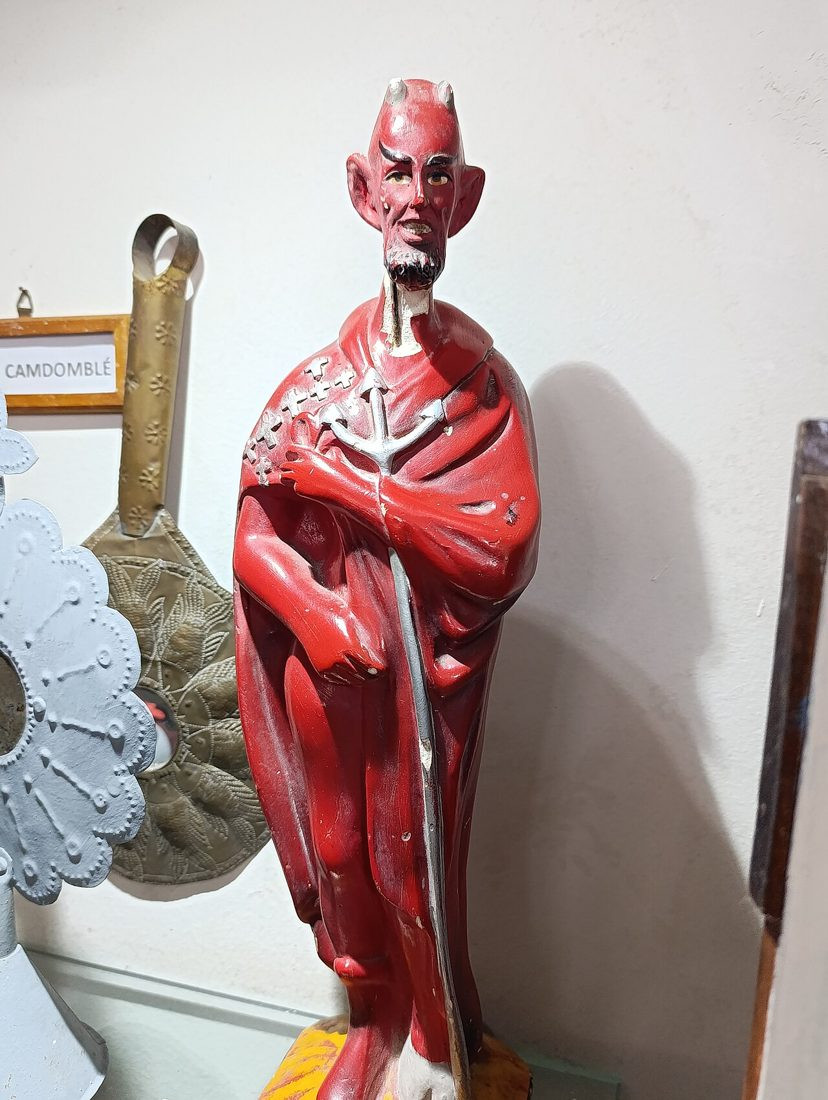
Statue of Exu Caveira, Instituto Histórico e Geográfico da Vitória de Santo Antão, Pernambuco. Painted plaster, undated. Photograph by Luiz79, 2024, CC BY 4.0, via Wikimedia Commons. The horns and the trident came to this figure from European art.
“I am inclined to believe that this identification is merely the product of the influence of Catholic teaching.”
Raimundo Nina Rodrigues, on Exu and the devil, O animismo fetichista dos negros baianos (first published in French in 1900; Portuguese edition 1935, p. 40)
In Angola the word meant a healer. In Brazil it became the name for everything Umbanda refused, and its spirits were given horns taken from European grimoires.
A red figure with horns
In shops of religious goods in Rio de Janeiro or São Paulo he stands on the shelf: a red man with small horns, a goatee, a black cape lined in red and a trident. Next to him stands a woman in red and black, sometimes also horned. The labels say Exu Tranca-Ruas, Exu Caveira, Maria Padilha. To many Brazilians who have never entered a terreiro, they are the devil and his wife, and the word that goes with them is quimbanda, black magic.
The documents tell a stranger story.
The word quimbanda comes from Angola, where it named a healer. The red man takes his name from Èṣù, a Yoruba god who carries messages and sacrifices between people and the divine. His horns and trident came from Christian art. His most famous companion carries the name of a fourteenth-century Castilian noblewoman. Several of his titles were copied in the 1950s from a French book of black magic. And the first people to use quimbanda as the name of a dark twin were the codifiers of Umbanda, who needed a place for everything they had decided Umbanda was not.
Quimbanda began as an accusation. In the 1940s the codifiers of Umbanda took an old Angolan word for a healer and used it to name everything they wanted to leave behind, and the devil of that accusation was assembled in Brazil from European parts: a missionary’s dictionary, a Castilian royal mistress, a French grimoire. The religion that carries the name today grew inside the accusation and learned to wear it.
The first part of this series followed Umbanda; the second, Candomblé. This last part goes to the side of the street that both kept at a distance. As in the posts on Vodou and Marie Laveau, I write as a historian: no rituals, no offerings, no pontos, nothing anyone could use. Quimbanda is a living religion with its own discretion, and what follows is the history of a name and of the images attached to it.
A note on words. I write Èṣù for the Yoruba òrìṣà in Africa and Exu for the figure in Brazil, where the name has no diacritics and, as we will see, more than one meaning. The translations from Portuguese and Spanish are mine.
A healer in Angola
In 1894 the Swiss missionary and linguist Heli Chatelain published Folk-Tales of Angola, stories in Kimbundu, the language of the Mbundu people around Luanda, with an English translation and long notes. In the stories, when a hunter cannot kill game or a message must be carried to the land of the dead, someone says: call the kimbanda. Chatelain’s index has an entry that reads, in full, “Medicine-man. See Kimbanda.”
His note 180 is more precise. The word umbanda, he explains, “is derived from ki-mbanda, by prefix u-.” It means the faculty, science and art “of healing by means of natural medicines (remedies) or supernatural medicines (charms)”, of “divining the unknown by consulting the shades of the deceased”, and of inducing spirits “to influence men and nature for human weal or woe.”
The person was kimbanda. The art was umbanda.
Two Brazilian religions would later take their names from those two words, and they would be presented to the public as opposites. The Brazilian scholar Nei Lopes, in his Novo dicionário banto do Brasil (2003), defines quimbanda first as a ritual line of Umbanda that works mainly with exus, and second as the priest of Bantu cults, the equivalent of the Kikongo nganga. Then he adds: “Strangely, in Brazil, quimbanda is held to be a line of harmful practices.”
Eight nights in October 1941
In Rio de Janeiro, from 19 to 26 October 1941, the Federação Espírita de Umbanda held the First Brazilian Congress of the Spiritism of Umbanda. Its organisers wanted to “study, debate and codify” the religion. The proceedings, printed in 1942, are on the Internet Archive.
They make uncomfortable reading. In the opening session, the delegate Diamantino Coelho Fernandes spoke of “the semi-barbarous ritual under which Umbanda was known among us, and considered by many to be black magic or candomblé.” He went on to argue that “Umbanda cannot have originated on the Black Continent.” Another thesis accepted an African origin, but placed it in Egypt. Speakers praised the police for the recent campaign against “baixo espiritismo”, low spiritism, and regretted only its “excesses”.
The word quimbanda does not appear in the digitised text of the proceedings, which print only some of the papers. According to a later study, one of the theses presented to the congress became a book the following year, Lourenço Braga’s Umbanda (magia branca) e Quimbanda (magia negra): Umbanda, white magic, and Quimbanda, black magic. Its first chapter divides Spiritism into laws. The Law of Umbanda is “Spiritism, White Magic”. The Law of Quimbanda is “Spiritism, Black Magic.”
The American anthropologists Diana Brown and Mario Bick put it plainly: for the early umbandistas, “Quimbanda represented a repository for all the opprobrious associations from which they wished to escape.” Brown called it “a crucial negative mirror image against which to define Umbanda.” A saying she reported among umbandistas sums up the arrangement: if it were not for Quimbanda, Umbanda would have no reason to exist.
The anthropologist Reginaldo Prandi, writing in 2001, gave the same history a sharper image: “Like someone hiding the devil, Umbanda hid Exu in Quimbanda.”
The messenger at the crossroads
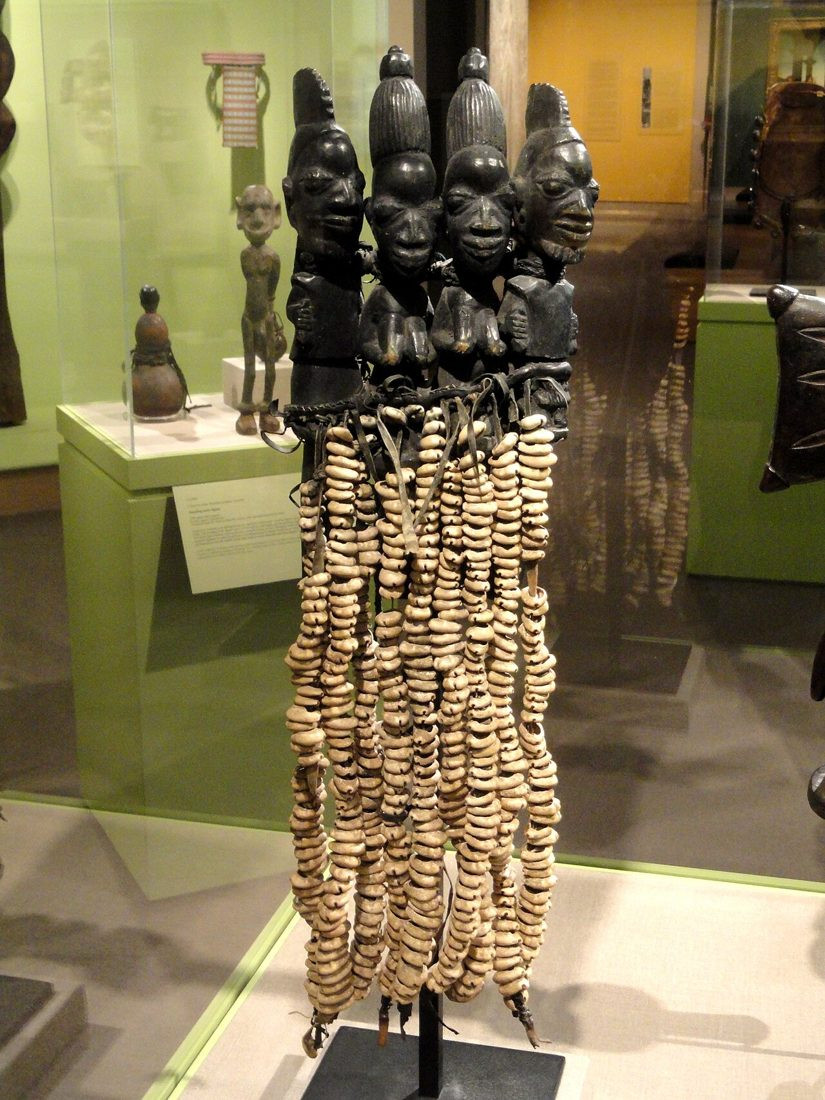
Figures representing Èṣù Ẹlẹ́gbára, Igbomina Yoruba peoples, Nigeria, nineteenth century. Wood, cowrie shells, hide and fibre. Hood Museum of Art, Dartmouth College. Photograph by Daderot, 2013, released into the public domain (CC0), via Wikimedia Commons.
The Exu of Brazil has an ancestor, and the ancestor is a god.
Among the Yoruba of what is now Nigeria and Benin, Èṣù, also called Ẹlẹ́gbára, is the òrìṣà who carries sacrifices to the other gods and messages between the human world and the divine. He serves Ifá, the oracle, and in some myths he is its founder. He guards crossroads, markets and doorways. He is a trickster, quick to punish anyone who forgets him, and so he receives his share first. The Encyclopaedia Britannica calls him “an essentially protective, benevolent spirit.” Among the Fon of Dahomey the corresponding vodun is Legba, who crossed to Haiti and became the Papa Legba of the post on Vodou, the old man who opens the gate.
In Candomblé, the subject of the second part of this series, Exu kept much of that identity. He is an orixá, honoured in the ceremony called padê. Prandi describes him as movement itself, multiplied without end: every house, street, city and market has its guardian, and every initiate has a personal Exu linking him to his own orixá.
Prandi notes that no known Yoruba myth identifies Èṣù with the devil. A Christian devil needs a Christian cosmos, with a God who is wholly good and an adversary who is wholly evil, and the Yoruba gods were not arranged in such a pair. Èṣù’s ambiguity, his appetite and his tricks belonged to a god who kept the roads open.
Priapus, then Satan
In 1789 a French traveller, Pruneau de Pommegorge, wrote that the people of Dahomey kept, a quarter of a league from the fort, “a god Priapus” made of earth, because of its enormous phallus. The second identification came from missionaries. In 1857 the American Baptist Thomas Bowen wrote that in Yoruba the devil is called Èṣù. In 1884 Father Baudin, of the Society of African Missions of Lyon, published Fétichisme et féticheurs, the first systematic book on Yoruba religion, and described Èṣù as the chief of all the evil spirits. Prandi summarises the double verdict: “Priapus and Demon, the two qualities of Exu for the Christians.”
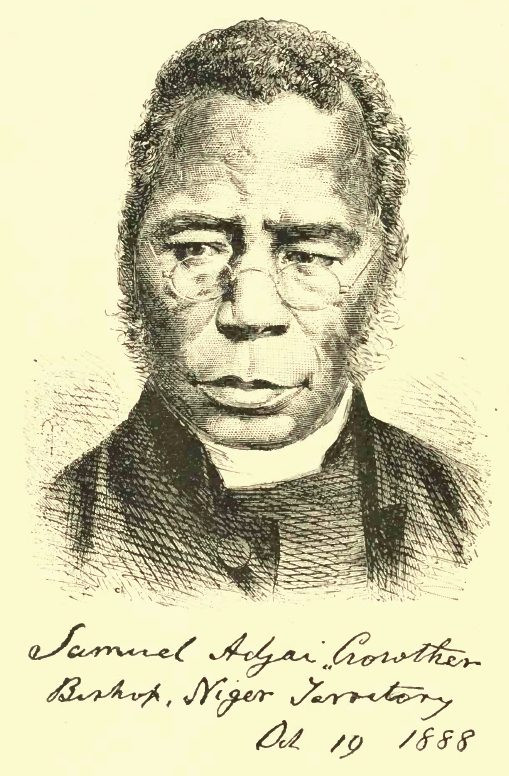
Samuel Ajayi Crowther, Bishop of the Niger Territory, engraved portrait with his signature dated 19 October 1888. From Jesse Page, The Slave Boy Who Became Bishop of the Niger (c. 1892). Public domain, via Wikimedia Commons.
The decisive step was taken by a Yoruba man. Samuel Ajayi Crowther was captured as a boy in 1821, sold to Portuguese slavers, freed by a British naval patrol, educated in Freetown and in England, and became the first African bishop of the Anglican Church. He also compiled one of the first printed vocabularies of his language. In his Vocabulary of the Yoruba Language, published by the Church Missionary Society in 1843, he chose Èṣù as the Yoruba word for “Satan” and “Devil”. The edition of 1852 puts it in five words: “Esu, s. devil; Satan.”
The translation passed into the Yoruba Bible, completed in 1884, and from the Bible into hymns, sermons and ordinary speech, where ọmọ Èṣù, child of Èṣù, still works as an insult. The Nigerian writer Kọ́lá Túbọ̀sún, who worked on Yoruba for Google Translate in 2015 and 2016, recalled in a British Library blog in 2020 that the software rendered Èṣù as “Satan”, “devil” or “demon”, following the dictionaries, until the fix he worked on kept the name untranslated.
A tendency to confuse him
In Brazil the same equation arrived by another road, through the Catholic Church that had baptised the enslaved, and later through Kardecist Spiritism, which divided the spirit world into the evolved and the backward.
Around 1900 the physician Raimundo Nina Rodrigues, of the Faculty of Medicine of Bahia and a pioneer of Afro-Brazilian studies, wrote about Candomblé in Salvador. He held the racial theories of his time about African inferiority. On this point, however, he was a careful witness: “Exu, Bará or Elegbará is a saint or orixá whom the Afro-Bahians have a great tendency to confuse with the devil.” In any quarrel, he wrote, the more prudent would shout “So-and-so, mind Exu!”, “precisely as old church ladies would say: Mind the devil’s temptation!” And he concluded with the sentence at the top of this post: the identification was a product of Catholic teaching.
Prandi describes what happened next to the image. In a society that repressed any sexual reference, the Priapus disappeared and the devil remained. Exu’s Brazilian statues lost the phallic splendour of the African Ẹlẹ́gbára. “In exchange,” Prandi writes, “he gained horns, a tail and even the goat’s feet of the ancient and medieval demons of the Catholics.”
From one god to many dead
Umbanda made a further change. As the first part of this series described, it is a religion of spirits who once lived on earth, the caboclos and the pretos-velhos, who come down into their mediums to advise and heal. The orixás are honoured, but the guides do the work. In that system Exu changed category. He stopped being one god and became a multitude of dead men, spirits who had lived badly and were working, through service, toward their own evolution.
Prandi lists who they had been, in the imagination of the terreiros: robbers, smugglers, vagrants, malandros, pimps. Their names describe places and powers of the street and the cemetery: Tranca-Ruas, who closes the roads; Sete Encruzilhadas, of the seven crossroads; Caveira, the skull; Veludo, velvet. Together they are called povo da rua, the people of the street, and in Umbanda they belong to the esquerda, the left, whose sessions were long held late at night, behind closed doors.
The rest of the story depends on this line. The Exu of Candomblé is an orixá in the Yoruba sense. The exus of Umbanda and of Quimbanda are spirits of the dead who share his name. Many houses keep the two apart with great care, and popular books and websites mix them constantly.
The woman at the crossroads
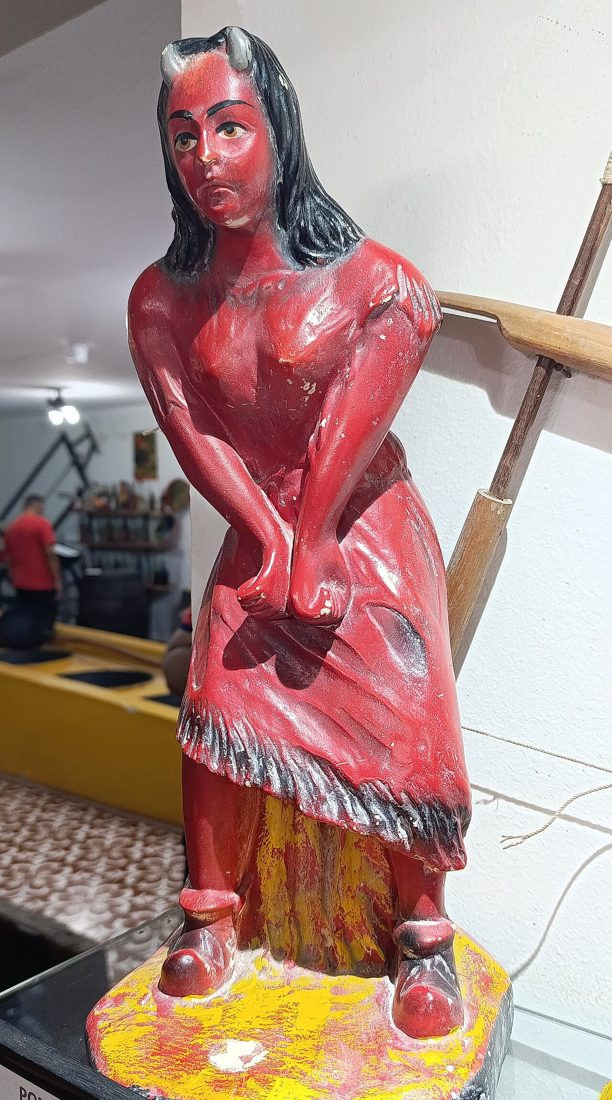
Statue of a pombagira, Instituto Histórico e Geográfico da Vitória de Santo Antão, Pernambuco. Painted plaster, undated. Photograph by Luiz79, 2024, CC BY 4.0, via Wikimedia Commons.
The female exus are called pombagiras. In the terreiros they are the spirits of women who lived outside the rules: courtesans, cabaret artists, gamblers, lovers, women of the street. In trance they laugh, drink, smoke and give advice, much of it about love. They wear red and black. Their most famous name is Maria Padilha.
The word pombagira probably comes from Central Africa. In Kimbundu, pambu-a-njila means the crossing of roads, the crossroads, and the Angola nation of Candomblé honours a nkisi of the roads called Pambu Njila, Bombojira or Bombogira, whom many scholars of the Bantu cults describe as the female side of the lord of the crossroads. The historian Luiz Antônio Simas, writing in 2021, traces the pombagira to that name, and the psychologist Monique Augras proposed the same derivation earlier. The change from Bombogira to pombagira produced a Portuguese word that sounds like “dove” and “turning”, and pomba is also slang for the female sex in the south of Brazil. Practitioners of Candomblé Angola insist that their nkisi and the Umbanda pombagira are different beings that share a sound.
So the pombagira has an African name. Her most famous title came from Spain.
A mistress of the King of Castile
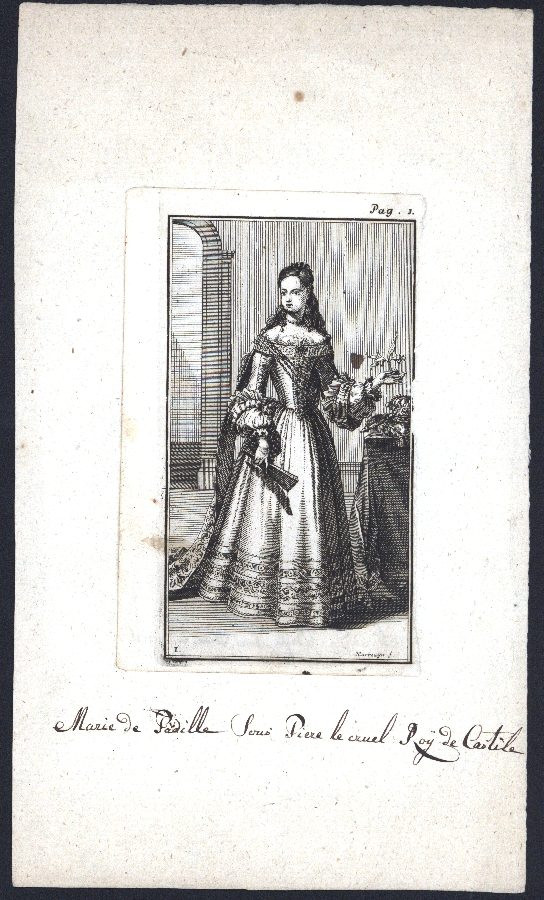
Jacobus Harrewijn, María de Padilla, engraving, late seventeenth or early eighteenth century. Wissenschaftliche Bibliothek der Stadt Trier. Public domain, via Wikimedia Commons. An imagined portrait: she wears the fashion of the 1690s, more than three centuries after her death.
María de Padilla was a noblewoman of Castile and the mistress of King Pedro I, who reigned from 1350 to 1369 and is remembered as Pedro the Cruel by his enemies and Pedro the Just by his friends. In 1353 he married a French princess, Blanca de Borbón, and abandoned her within days to return to María. Blanca spent the rest of her short life as a prisoner and died in 1361, the same year as María. Pedro later declared before the Cortes that María had been his lawful wife, and she lies with him in the royal chapel of Seville Cathedral.
The chronicle of Pedro López de Ayala, written by a man who changed sides to Pedro’s enemies, fixed the hostile version. The Spanish ballads, the romances, did the rest. In one of them, collected by Agustín Durán in the nineteenth century, the imprisoned Blanca tells her story. She had given Pedro a belt strewn with a thousand diamonds. María obtained it and gave it “to a sorcerer of ungrateful Hebrew blood”, who made the jewels look like snakes: “hizo parecer culebras / las que eran prendas del alma.” The ballad joins three fears in one image: the seductive woman, the sorcerer and the Jew. The post on Maleficium followed the same marriage of misogyny and magic through the courts of early modern Europe.
The literary scholar Marlyse Meyer, of the University of São Paulo, followed the name across six centuries in Maria Padilha e toda a sua quadrilha (1993), through Iberian love magic, Gypsy tradition and, eventually, French literature. In Prosper Mérimée’s Carmen (1845), Don José surprises Carmen at work with lead and water, singing “magic songs in which they invoke Marie Padilla, the mistress of Don Pedro, who was, they say, the Bari Crallisa, or the great queen of the Gypsies.”
With all her gang
Meyer’s research began with a trial of the Portuguese Inquisition, studied earlier by the historian Laura de Mello e Souza. A Portuguese woman called Antónia Maria, from Beja, was sentenced to exile in Recife, in Pernambuco, after a passage through Angola; Meyer dates the case to 1718. The records describe her as small, fair-skinned, with “black and beautiful eyes”, and accuse her of love magic. In her invocations, among Barabbas, Satan and Lucifer, she called on “Maria Padilha with all her gang”, Maria Padilha com toda a sua quadrilha. Meyer took the phrase for the title of her book.
Here Meyer’s reconstruction begins. She proposes, working from what she calls “possible likelihoods”, that the name travelled with condemned women like Antónia Maria, met African and Gypsy practitioners in prisons, ports and places of exile, and survived in Brazilian love magic until Umbanda gave it a body and a voice. No document shows the intermediate steps. The beginning and the end of the chain are documented, and the middle is Meyer’s reconstruction. At the end of it stands Maria Padilha, whom Meyer calls the queen of the pombagiras.
A malandro from Pernambuco
Zé Pelintra, whom Simas calls the iconic malandro of the terreiros, came from yet another tradition, and here the lines need to be kept especially clear.
By most accounts his first home is the Catimbó, or Jurema, of the Brazilian Northeast, a complex of practices that joins Indigenous rites, folk Catholicism and African influences around the sacred drink made from the jurema tree. Its spirits are mestres, men and women who in life were skilled in healing with herbs and who, after death, live in the enchanted kingdoms of the Juremá. As Simas recounts the stories told in the terreiros, Zé Pelintra was a man called José de Aguiar, who lived on the Rua da Amargura in Recife, wandered the Northeast after a disappointed love and was initiated into the Jurema. As a mestre of the Catimbó he comes barefoot, in a white shirt and rolled-up trousers, with a red scarf, a walking stick and a pipe.
In Rio de Janeiro, probably carried by the migrants who left the Northeast for the federal capital in the first half of the twentieth century, he changed clothes. The Umbanda of Rio received him in the line of the malandros, the hustlers and sambistas of Lapa, and he now arrives in a white linen suit, a red tie, polished shoes and a Panama hat. Some houses work with him beside the exus. Others treat him as a guide of his own line, and in the Jurema of the Northeast he remains a mestre. In 2016 the samba school Acadêmicos do Salgueiro brought him to the Sambódromo in its theme “Ópera dos Malandros”; at a rehearsal the drum queen appeared as a pombagira, and neo-Pentecostal critics accused her online of lending her body to the devil.
A book called Exu
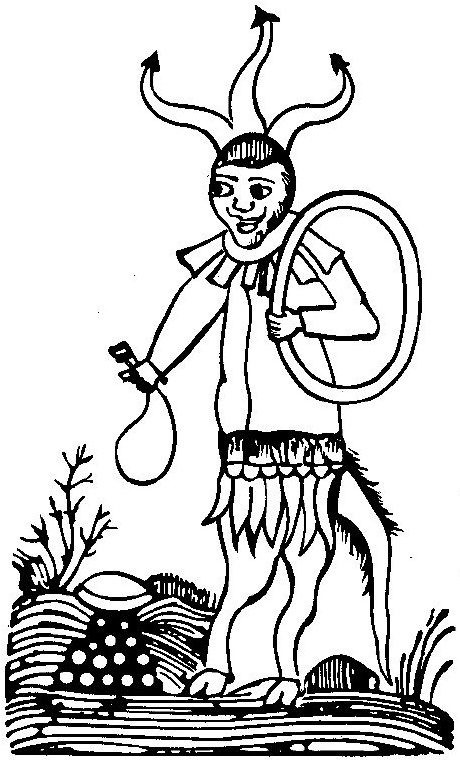
Lucifuge Rofocale, woodcut from an edition of the Grand Grimoire, nineteenth century. Public domain, via Wikimedia Commons. In the grimoire he is the prime minister of hell; in some Brazilian hierarchies of exus he appears as Exu Rei das Sete Cruzeiros.
In the early 1950s an umbandista writer called Aluízio Fontenelle published a book with a one-word title: Exu. The date is given as 1951, 1952 or 1954 depending on the source, probably because of reprints. Fontenelle is regarded as the first umbandista author to write about the line of the exus, and he gave each of them a European demon.
Fontenelle’s model was a French grimoire, the Grimorium Verum, which claims to date from 1517 and was probably composed in the eighteenth century, together with its relative, the Grand Grimoire. Both describe an infernal hierarchy ruled by three chiefs, Lucifer, Beelzebuth and Astaroth, each with officers beneath him. In the Brazilian version the three chiefs became the highest exus, the Maioral of the hierarchy, and the officers were distributed among the exus of the terreiros. Tranca-Ruas became Tarchimache. Exu Veludo became Sagathana. Exu Tiriri became Fleuruty. The pombagira received the name of a minor spirit of the Grimorium Verum, Klepoth. In 2001 Prandi reproduced the whole table as it had circulated in Umbanda books for half a century: a demonology with Brazilian names and French bones. A practitioner site of the modern Quimbanda Nagô, written by a priest who defends Fontenelle, states that the Grimorium Verum was “the bridge” that allowed the syncretism between exus and demons, and that from Fontenelle onwards the cult of exus and pombagiras “would be officially known as Quimbanda.”
The grimoires belong to another tradition, the European goetia: manuals of ceremonial magic descended from medieval necromancy and printed for a popular market in France. Their demons have no history in common with the dead malandros of Brazil or with the Yoruba messenger. The join was made in Rio in the 1950s, by readers of books, and it can be dated and attributed.
The horns came from Europe
By then the image of Exu as a devil was everywhere, and it was assembled from the same European sources.
The horns, the goat’s legs and the tail are the devil of medieval and early modern Christian art, the one that the witch trials put at the centre of the sabbath. In trance, Prandi writes, the Umbanda Exu came to wear a black and red cape, carry “the medieval trident of the devil”, twist his hands and feet to imitate a goat’s hooves and give the dark laughter that people imagined belonged to the lord of darkness.
The goat has a history of its own, told in the post on Baphomet: a European figure drawn by a French occultist in 1856 and later pushed into places where it had never been. Exu received the same kind of image by two roads, from missionaries in Africa and from umbandistas in Brazil, and it came back to the terreiros in painted plaster.
The houses that keep these statues did not invent the demon, and many have made the image their own, as devotees of Ezili Dantò in Haiti made their own of a Polish icon.
Seized by the police
The first Penal Code of the Brazilian Republic, of 1890, made it a crime, in Article 157, “to practise spiritism, magic and its spells, to use talismans and cartomancy to arouse feelings of hatred or love, to promise the cure of curable or incurable illnesses, in short, to fascinate and subjugate public credulity.” Under that article and the laws that followed it, the police raided terreiros, confiscated drums and images and arrested priests and priestesses.
Between 1891 and 1946 the police of Rio de Janeiro seized more than five hundred sacred objects of Candomblé and Umbanda. In 1938 the federal heritage service listed part of them under the name “Collection of the Museum of Black Magic”, and for decades they were exhibited in the Museum of the Civil Police as material seized from criminals. In 1999 they went into boxes. In 2017 the mãe de santo Meninazinha de Oxum and other religious leaders launched the campaign “Liberte Nosso Sagrado”, Free Our Sacred. On 21 September 2020 the 523 objects were transferred to the Museu da República, in the former presidential palace of Catete, under the name the communities chose: Acervo Nosso Sagrado, Our Sacred Collection.
The umbandistas of 1941 knew this pressure well. Their congress praised the police campaign against “low spiritism” and placed the practices it targeted outside Umbanda, under another name.
Demons in the pulpit
The neo-Pentecostal churches that grew in Brazil from the 1980s made the exus and pombagiras their principal adversaries. In deliverance services, pastors cast out exus and pombagiras from the faithful as demons, by their Umbanda names. Edir Macedo, founder of the Universal Church of the Kingdom of God, published Orixás, caboclos e guias: deuses ou demônios? (gods or demons?), which sold millions of copies and called Umbanda, Candomblé and Quimbanda demonic sects. In 2005 a federal judge in Bahia ordered it withdrawn for inciting discrimination. A year later the federal appeals court released it again, invoking freedom of expression.
The consequences have been concrete. In 2000 the ialorixá Gildásia dos Santos, Mãe Gilda de Ogum, of Salvador, died of a heart attack after her photograph appeared in the Universal Church’s newspaper, the Folha Universal, in a story about charlatans, and after her house and terreiro were invaded. The date of her death, 21 January, became Brazil’s National Day for Combating Religious Intolerance by Law 11.635 of 2007.
In the suburbs of Rio, the attacks have joined religion to armed control of territory. In March 2023 a court sentenced Álvaro Malaquias Santa Rosa, known as Peixão, the drug lord who in 2020 gave a cluster of favelas the name Complexo de Israel, to six and a half years in prison for ordering the destruction of a terreiro in Nova Iguaçu. According to the prosecution, the men who wrecked it shouted that the macumbeiros would be expelled “by order of the traffic”. In 2024 the federal human rights hotline, Disque 100, received 2,472 complaints of religious intolerance, 66.8 per cent more than in 2023; where the victim’s religion was recorded, Umbanda and Candomblé led the list.
Quimbanda says its own name
Prandi observed in 2001 that until one or two decades earlier the sessions with exus and pombagiras had been almost secret, held late at night behind closed doors, and that people who attended often denied that they existed.
That has changed. In the last decades a number of houses have begun to call themselves Quimbanda without apology: a religion in its own right, with its own priests, called tatas, its own initiations and its own lineages, of which the best known take the names Nagô, Mussurumim and Malê. Several of them accept Fontenelle’s hierarchy as part of their foundation, and some speak openly of Exu Maioral as the Devil. Their published histories differ from one another, and independent scholarship on them is still thin.
They have also crossed the sea. The Norwegian-Brazilian writer Nicholaj de Mattos Frisvold published Pomba Gira and the Quimbanda of Mbùmba Nzila in 2011 and Exu and the Quimbanda of Night and Fire in 2012, both aimed at readers of Western esotericism. In 2024 the Swedish historian of religion Fredrik Gregorius was baptised in a Quimbanda community on a farm on the East Coast of the United States, as part of his research. In a report for Harvard’s Center for the Study of World Religions in 2025 he described Exu Maioral as a deity “whose depiction at least resembles the Christian Devil”, and wrote that most North American seekers come from Thelema, traditional witchcraft or the New Age, that the number asking for baptism is “hundreds, not yet thousands”, and that what he found was “a cult of life, not maliciousness or perversion.”
The black magic that umbandistas assigned to others in the 1940s now has initiates of its own, some of whom learned its demonology from a book written in Rio by an umbandista, and some of whom read about it in English. In those houses the Grand Grimoire and the Angolan kimbanda share a roof. Western goetia, Umbanda and the orixá cult of Candomblé remain separate traditions, with separate histories, even where a particular house has chosen to join them.
The other side of the same word
This series began with Umbanda and continued with Candomblé. It ends with the name that Umbanda gave to what it refused.
The documents leave a clear outline. In Kimbundu, kimbanda and umbanda were the healer and his art, two forms of a single word. In Rio in the early 1940s, the same pair was cut in two and given opposite moral signs. The Yoruba messenger had already received the devil’s name from a missionary dictionary, his statues had received the devil’s horns from Catholic art, and in the 1950s his Brazilian successors received the devil’s officers from a French grimoire. A Castilian noblewoman, defamed as a witch by her enemies, gave her name to the queen of the women of the street.
The devil of this story was put together by Christians, Spiritists and umbandistas who needed to say where evil lived, and it was fastened onto a messenger god, the dead of the Brazilian street and an Angolan word for a healer.
The healer is still in the word, at the crossroads where this series ends.
Original: https://pablo.space/posts/quimbanda-or-the-devil-made-of-borrowed-parts