Umbanda, or the Spirits Sent Away from the Table
2026-11-16, originally published on pablo.space.
← all Chamber of Reflections texts
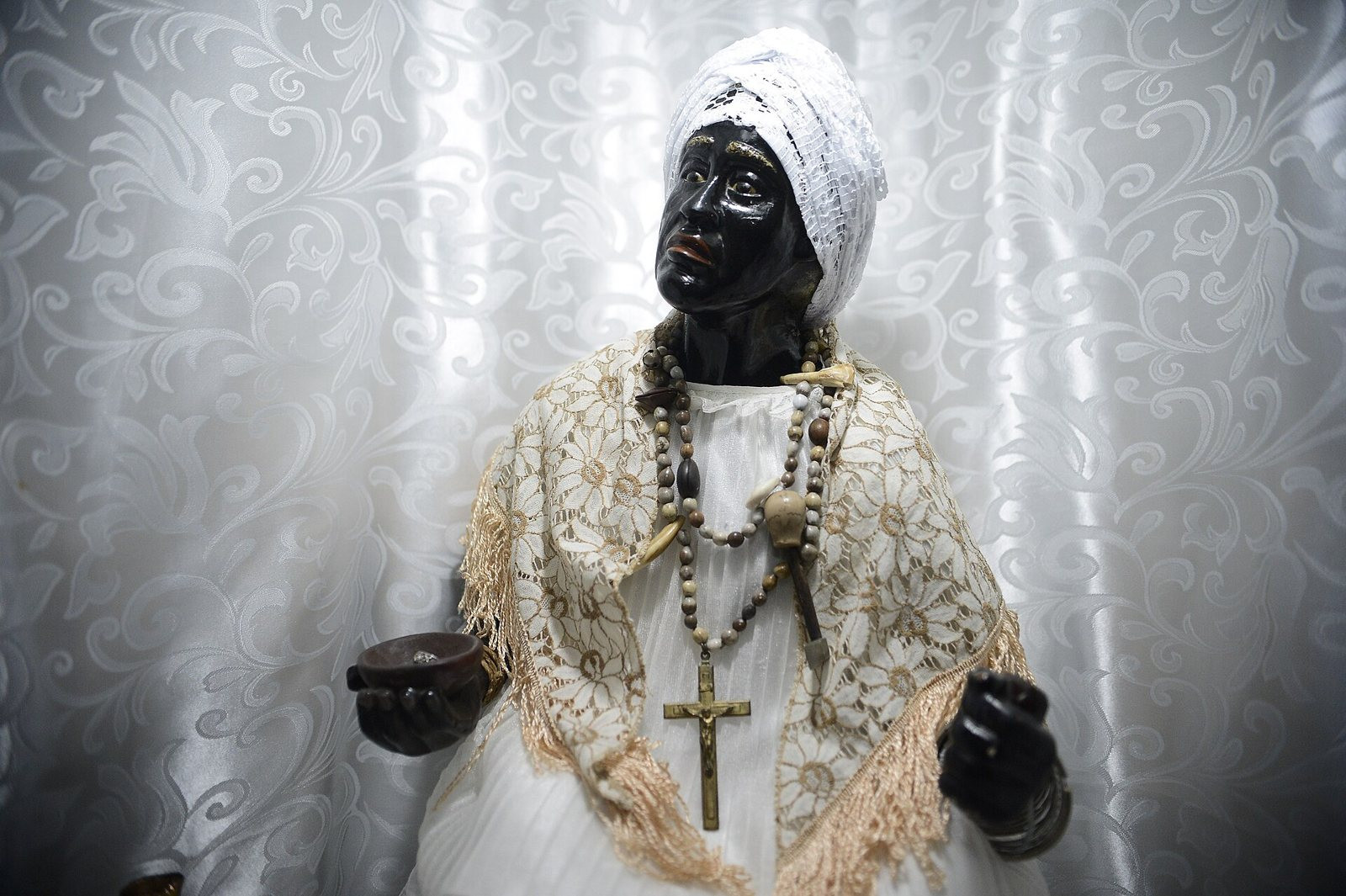
Statue of a preta-velha at the Tenda Espírita Vovó Maria Conga de Aruanda, Estácio, Rio de Janeiro, 8 November 2016. Photograph by Tânia Rêgo for Agência Brasil, taken on the day the city declared Umbanda part of its intangible heritage; this house was the first terreiro entered in the city’s new register. CC BY 2.0, via Wikimedia Commons.
“Umbanda is: (1) The faculty, science, art, office, business (a) of healing by means of natural medicines (remedies) or supernatural medicines (charms); (b) of divining the unknown by consulting the shades of the deceased…”
Heli Chatelain, Folk-Tales of Angola, 1894, note 180
A religion with a legal birthday, a Jesuit who returned as a caboclo, a Sanskrit etymology and a police museum: the history behind Umbanda’s founding story.
A grandmother with a crucifix
In Brazil almost everyone has an image of Umbanda, even people who have never entered a terreiro.
Usually it is a fearful one: a dead chicken at a crossroads, candles on a pavement, a word whispered as an insult, macumba. Or, on the cheerful side, a beach full of people dressed in white on New Year’s Eve, jumping seven waves and throwing flowers to the sea.
The statue at the top of this post comes from inside that story. She is a preta-velha, an old Black woman, the spirit of someone who lived and died enslaved and who now, in the belief of her devotees, comes back to counsel the living. Look at her chest: African beads and a Catholic crucifix hang from the same neck.
Umbanda has an official birthday. Since 2012 Brazilian federal law has celebrated it every 15 November, the anniversary of a night in 1908 when, according to the religion’s best known tradition, a spirit called the Caboclo das Sete Encruzilhadas announced a new religion through the mouth of a seventeen-year-old in Niterói.
Umbanda has two birth certificates. One records a single night in 1908, a story that was set down in print mostly from the 1960s onwards. The other is a long history of Central African healers, Kardecist séance tables, Catholic saints, newspapers and police files in Rio de Janeiro, written by many hands over half a century. Each one tells us something true about the religion, and neither is complete without the other.
This is the first part of a short series on Brazilian religions. Candomblé comes next, and Quimbanda closes the series. As always on this blog, I write as a historian: no rituals, no recipes and no instructions, only documents, the people who wrote them, and the respect owed to a living faith. I have tried to keep Umbanda, Candomblé, Kardecist Spiritism and Catholicism in separate rooms, even where they share a corridor.
A word from Angola
The word is older than the religion. In 1894 the Swiss missionary and linguist Heli Chatelain published Folk-Tales of Angola, a collection of stories in Kimbundu with an English translation, and in a long footnote he explained the word umbanda.
It derives, he wrote, from ki-mbanda, the healer and diviner, and it names his whole business: healing with remedies and with charms, divining by consulting the dead and other spirits, persuading those spirits to act on people and on nature, and also the forces and objects involved. Central Africans had carried that vocabulary across the Atlantic long before. Colonial sources from the seventeenth century onwards call their healing and divining ceremonies calundu.
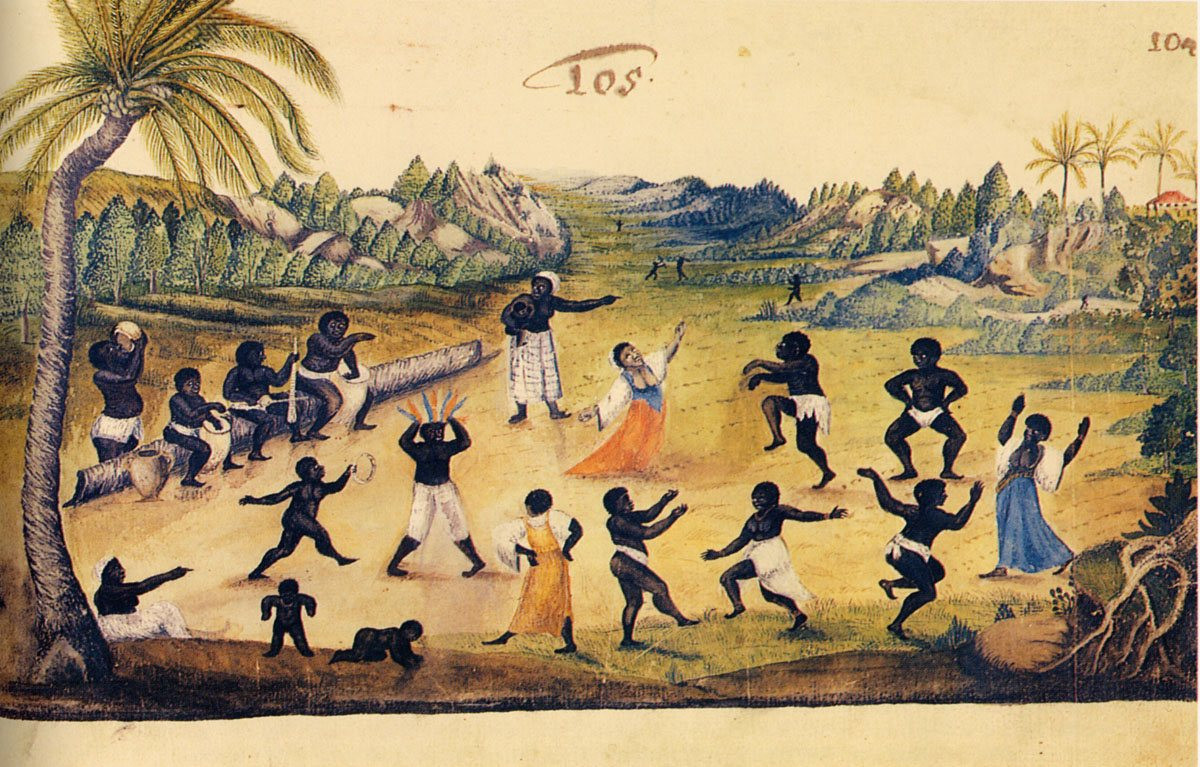
Zacharias Wagener, dance of enslaved Africans, watercolour from his Thierbuch, Dutch Brazil, 1630s. Wagener served the Dutch West India Company in Pernambuco from 1634 to 1641. The historian James Sweet reads this scene as a calundu, with possessed dancers at its centre. Public domain, via Wikimedia Commons.
Zacharias Wagener, a German soldier in Dutch Brazil, wrote beside this picture that the slaves, after weeks of hard labour, were allowed one Sunday to dance “from morning to night”. In Recreating Africa (2003), the historian James Sweet argues that the man with the feather crest and the woman at the centre are already possessed by ancestral spirits.
Almost three centuries separate that watercolour from the first tendas of Umbanda. The healer who consults the dead, the drum that calls them and the body that receives them were all in Brazil long before 1908.
The Rio of “low spiritism”
The religion took shape in Rio de Janeiro, capital of the Republic, under a hostile law.
The Penal Code of 1890, promulgated in the first year of the Republic, listed among the “crimes against public health” the practice of “spiritism, magic and its spells” (article 157) and the work of the curandeiro, the unlicensed healer (article 158).
The Kardecists answered first. Allan Kardec’s Spiritism had reached Brazil in the second half of the nineteenth century, and in 1884 its followers founded the Federação Espírita Brasileira in Rio. (I wrote about Kardec and the dead in the post on All Souls.) Their defence, as the anthropologist Emerson Giumbelli has reconstructed it, was that their mediumship was charity, with no magic in it. Whatever did not fit that description they called falso espiritismo or baixo espiritismo, “low spiritism”.
Between the 1910s and the 1930s the phrase spread to journalists, policemen and judges, and it guided their raids.
On the wrong side of the line stood macumba. In Rio, Giumbelli notes, the word meant several things at once: a musical instrument, a set of Afro-Brazilian ceremonies, a supposed degeneration of African religion, and very often a simple accusation.
Umbanda grew up in the space between those two words.
A night in Niterói
Here is the story as Umbanda tells it, in the version Zélio Fernandino de Moraes gave himself, in his eighties, to the journalist Lilia Ribeiro for the first issue of the magazine Gira da Umbanda in 1972. I follow the transcription reprinted by the Jornal de Umbanda Sagrada in 2008.
Zélio was born on 10 April 1891 in Neves, in the municipality of São Gonçalo, into a family of naval officers. In 1908 he was paralysed by an illness the doctors could not explain. On 14 November, he said, he sat up in bed and announced that he would be cured the next day, and on the 15th he woke up well.
His Catholic parents took him to the Federação Espírita in Niterói, where he was seated at the table, at the president’s right hand. Against the rules, he got up, fetched a flower from the garden and put it in the middle of the table. When the session began, the spirits who appeared to the seers as Indians and Black people were asked to withdraw. Zélio, “impelled by a strange force”, asked why these humble workers could not speak.
A seer asked who he was. “The brother is a Jesuit priest. Why do you speak this way, and what is your name?” The reply, as Zélio remembered it, came without his wanting it: “Tomorrow I will be in the house of this medium, as a symbol of the humility and equality that must exist among all brothers, incarnate and discarnate. And if you want a name, let it be this: I am the Caboclo das Sete Encruzilhadas.”
The Caboclo of the Seven Crossroads.
The next evening, Zélio said, relatives, strangers, his uncles who were Catholic priests and most of the members of the federation crowded into the family house at number 30, Rua Floriano Peixoto. The Caboclo came down, healed a paralysed man with a passe and left the end of the cure to a preto-velho, Pai Antônio, who appeared the same night. The first tenda received the name of Nossa Senhora da Piedade, “because just as the image of Mary holds her Son in her arms”, it would hold everyone who came to it.
Sessions were to be held every day from eight to ten in the evening, free of charge, under the Gospel motto “freely you have received, freely give”, with everyone in white and wearing tennis shoes.
By his date of birth Zélio was seventeen in November 1908; in the interview he says eighteen, a small slip of the kind memories make sixty years on.
The Jesuit under the feathers
One detail of the story is easy to pass over: the seer at the table took the speaker for a Jesuit.
In the tradition that grew around Zélio, the Caboclo das Sete Encruzilhadas is identified with Gabriel Malagrida, an Italian Jesuit born in 1689 who preached for decades in colonial Brazil, became a famous figure at the court in Lisbon, fell foul of the Marquis of Pombal and was strangled and burned by the Inquisition in 1761. According to this tradition, God granted him in a later existence the privilege of returning as a Brazilian caboclo.
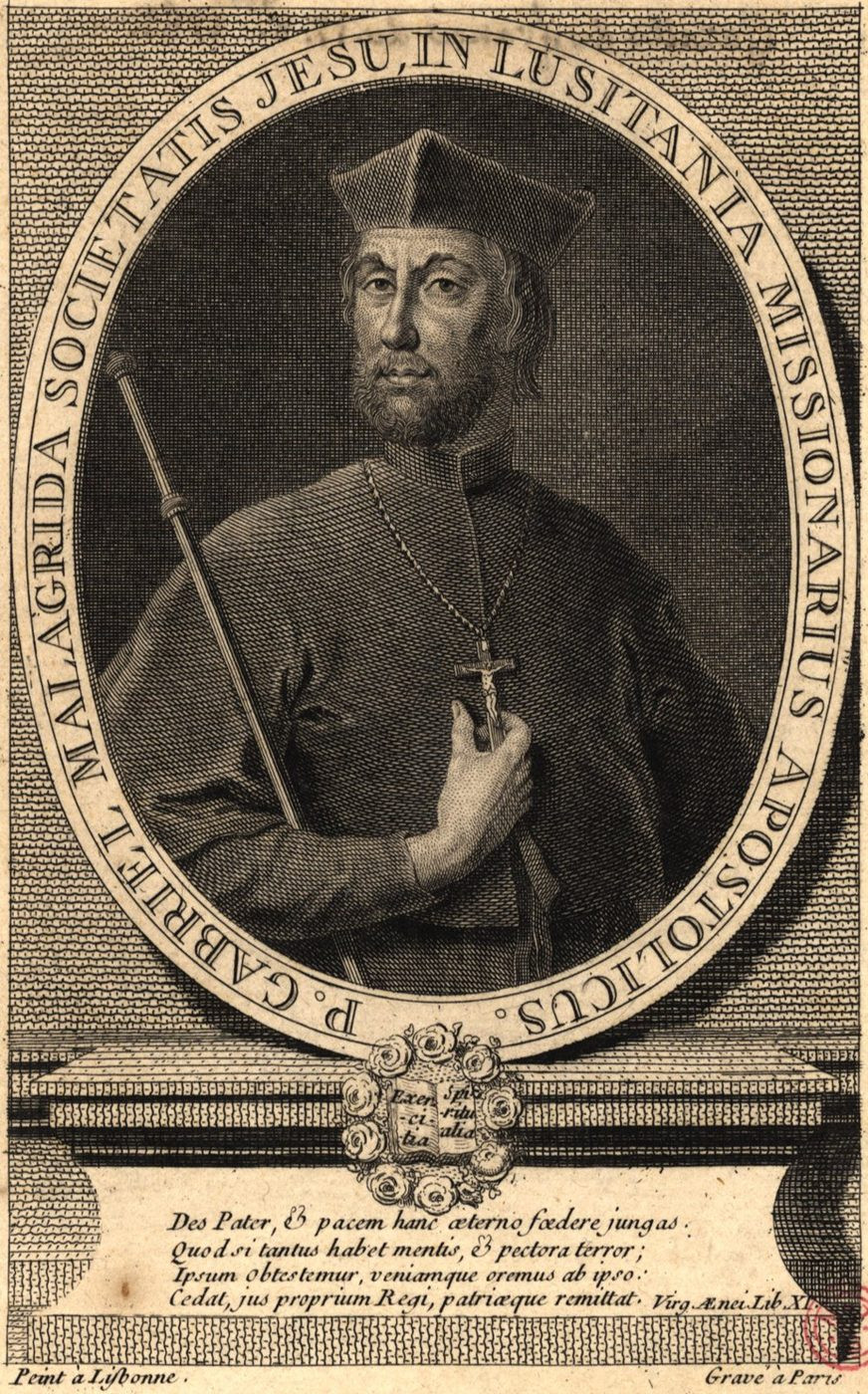
Portrait of Gabriel Malagrida, S.J. (1689-1761), engraving by an unknown artist, c. 1760s. Biblioteca Nacional de Portugal. Public domain, via Wikimedia Commons.
The earliest printed description of the spirit points the same way. In 1933 the journalist Leal de Souza published O Espiritismo, a Magia e as Sete Linhas de Umbanda, based on a series of articles in the Rio Diário de Notícias. It is often called the first book on Umbanda, and its author wrote of the Caboclo with open devotion.
In his account the seers first saw the spirit as a middle-aged man with bronze skin, wearing a white tunic crossed by a sash on which the word Caritas shone in letters of light. Only later did he show himself as a caboclo, with a feather loincloth and “the other attributes of the forest pajés”. His knowledge of the Bible and of the doctors of the Church, Leal de Souza added, suggested that “in some incarnation” he had been a priest.
An Indian spirit who had once been a priest, preaching Christian charity to Kardecists: the founding figure already holds the negotiation that Umbanda would conduct for the next fifty years.
Who wrote the story down
The historical problem lies in the dates of the sources.
Leal de Souza, writing in the early 1930s, says the Caboclo began his work “twenty-three years ago”, coming down “to a poor house in a very poor neighbourhood”. That points roughly to 1908-1910, and it shows the tenda in Neves already remembering its own beginning. It says nothing of a night at the Federação, of a flower or of a new religion announced for all of Brazil.
The full story, with the session in Niterói and the date of 15 November, reached print much later. According to the reporting of Edison Veiga for BBC News Brasil, Lilia Ribeiro first published this version in 1961, in Macaia, the newsletter of her own Tenda de Umbanda Luz, Esperança e Caridade. In December 1978 the magazine Planeta ran a long feature on the “70th anniversary of a Brazilian religion”, with every element of the story in place.
In 2002 Giumbelli published “Zélio de Moraes e as origens da umbanda no Rio de Janeiro”. His conclusion, as later scholars summarise it, is that Zélio as founder of all Umbanda is a late construction, consolidated around the time of the medium’s death in October 1975, in a period of doctrinal dispersion and institutional division.
The researcher David Dias of PUC-São Paulo, himself an Umbanda priest, told the BBC that the minutes of the Federação Espírita for 15 November 1908 record none of these events, that the president’s name in them does not match the story, and that Zélio’s name does not appear at all. I have not seen those minutes myself, and I report the claim as his.
Tancredo da Silva Pinto, the Rio priest of the Omolocô tradition, contested the Niterói story in print in 1972 and traced Umbanda to the Lunda and Chokwe peoples of Central Africa.
Zélio’s tenda existed, his Caboclo was revered in his own lifetime, and the houses founded from Neves shaped the religion in Rio. The sources show a man and a story whose importance grew decades after the event, as Umbanda went looking for a single founder.
White Umbanda
The American anthropologist Diana Brown, in Umbanda: Religion and Politics in Urban Brazil (1986), placed the formation of the religion, as a self-conscious movement, among “a group of middle sectors Kardecists” in Rio in the 1920s, who set out “to construct a blend of Kardecism and Afro-Brazilian religions” that would express their own preferences and “class values” (p. 37). Its founders called the result Umbanda Pura or Umbanda Branca, Pure or White Umbanda.
The Brazilian sociologist Renato Ortiz gave the same process a darker name in the title of his book of 1978, A morte branca do feiticeiro negro, “the white death of the black sorcerer”. In his reading, Umbanda was born where two movements crossed, in a society being reorganised into classes: Afro-Brazilian practice was being whitened, and Kardecism was being blackened. Lísias Nogueira Negrão, studying São Paulo, called his book Entre a cruz e a encruzilhada (1996), “between the cross and the crossroads”.
Artur Cesar Isaia observed that a religion presenting itself as the national faith of Brazil placed its birth on the anniversary of the Proclamation of the Republic, after the abolition of slavery in 1888 and the Republic in 1889.
Today some of the sharpest criticism comes from inside the religion. Umbanda priests and scholars interviewed by the BBC describe the Zélio story as a whitening of a religion that Black Brazilians and their ancestors had practised long before 1908; one, a historian and pai de santo in São Paulo, calls it “a great lie”. Other houses, especially those descended from Neves, keep Zélio’s memory with devotion.
Seven lines and a Sanskrit name
The first codifiers wanted order. Leal de Souza’s book of 1933 describes the “Linha Branca de Umbanda e Demanda” as seven lines of spirits, each under an orixá and a Catholic equivalent: Oxalá, who is Jesus as Nosso Senhor do Bonfim; Ogum, Saint George; Oxóssi, Saint Sebastian; Xangô, Saint Jerome; Iansã, Saint Barbara; Iemanjá, the Virgin as Our Lady of the Conception; and a seventh, transversal “Line of the Saints” or “of the Souls”.
Spirits are grouped into falanges, phalanxes, which Leal de Souza compares to brigades inside the divisions of an army.
In 1939 the Federação Espírita de Umbanda was founded in Rio. Zélio’s own account gives the date as 26 August and says the Caboclo ordered it. Two years later, from 19 to 26 October 1941, it held the First Brazilian Congress of Umbanda Spiritism. Giumbelli calls its proceedings, published in 1942, the main point of reference for that first effort at standardisation.
The organizers aimed “to study, debate and codify” Umbanda. Their conclusions named Jesus “Supreme Chief of Umbanda Spiritism”, affirmed reincarnation and spiritual evolution, and required mediums to appear “uniformed in white”. On history they were bolder. Umbanda, they concluded, “comes from the ancient religions and philosophies of India”, and “Umbanda is a Sanskrit word”.
One speaker, Diamantino Coelho Fernandes, argued that Umbanda “cannot have originated in the Dark Continent”, where it survived only as “a semi-barbarous ritual”, the degraded form of a wisdom that came from Hindu India. Another traced it to ancient Egypt. By then Chatelain’s footnote on ki-mbanda had been in print for forty-seven years.
Giumbelli, rereading these proceedings in 2010, warned against taking the whitening at face value. Africa, he showed, is everywhere in the texts that try to refuse it: in words such as terreiro, cambono (the ritual assistant), pemba (the chalk for drawn pontos), in the orixás that command the lines, and above all in the pretos-velhos, described in the congress texts as “the afflicted souls of slaves” who, out of sacrifice and renunciation, help even the descendants of their masters.
A file at the police station
The police, meanwhile, were at the door. Leal de Souza wrote in 1933 that they “frequently besiege and close spiritist centres” and arrest their members, and he advised the White Line to explain itself to the authorities. In 1934, according to the historian Marcos Paulo Amorim dos Santos, terreiros were required to register with the state security secretariats. From 1937, under the Estado Novo, a Section of Toxics and Mystifications inside the vice police, the Delegacia de Costumes, handled cases of sorcery and “exploitation of public credulity”. The anthropologist Yvonne Maggie, in Medo do feitiço (1992), argued that the judges themselves often believed in the sorcery they punished.
The new Penal Code of 1940 dropped the word espiritismo but kept charlatanismo and curandeirismo (articles 283 and 284). A healer who prescribed, “using gestures, words or any other means”, could still be arrested.
The objects survived longer than many of the cases. Between 1889 and 1945 the Rio police seized drums, images, clothing and altar pieces from terreiros of Candomblé and Umbanda. On 5 May 1938 the federal heritage service listed 126 of them under the name Museu de Magia Negra, the Museum of Black Magic. They stayed in police custody for eight decades. On 21 September 2020 the collection, by then counted at 523 pieces, was transferred to the Museu da República and renamed Acervo Nosso Sagrado, “Our Sacred Collection”.
Saints on the shelf
On most Umbanda altars, the congá, stand Catholic saints in plaster: Saint George on his horse, Saint Sebastian full of arrows, the Virgin in blue, Cosmas and Damian in their green and red.
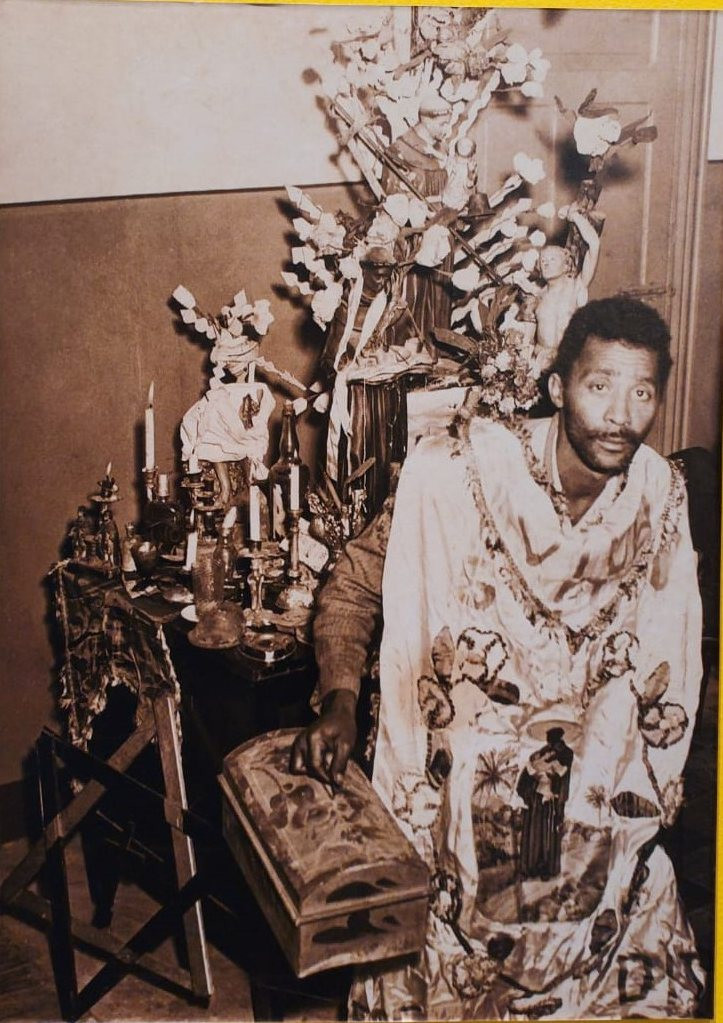
Raimundo Alves dos Santos, umbandista, and his altar, São Paulo, undated (1949 or later). Photographer unknown. Arquivo Público do Estado de São Paulo, public domain, via Wikimedia Commons.
Brazilians call this sincretismo, and Umbanda inherited it from older Afro-Brazilian practice. The sociologist Reginaldo Prandi lists the classic pairs: Xangô with Saint Jerome, Iansã with Saint Barbara for her power over lightning, Iemanjá with Our Lady for motherhood, Oxalá with Christ for his supreme place. The pairs change from city to city. In Rio, Ogum is Saint George; in Bahia he is usually Saint Anthony, and Saint George belongs to Oxóssi.
In Umbanda the orixás tend to stay at a distance. They head the lines and rarely come down in person. The spirits who actually speak to visitors are the dead: caboclos, pretos-velhos, children and others, who work under the orixás’ banners.
This is one of the clearest differences from Candomblé, where the orixás themselves are received in initiation and possession. That religion has its own history, its own nations and its own houses, and it is the subject of the next post. The Haitian lwa, with their saints and their own long persecution, are cousins of both; I told their story in Vodou, or the Gods Who Crossed the Atlantic.
The old ones who were enslaved
The pretos-velhos are the most loved figures in Umbanda, and the most painful.
They present themselves as Africans and Afro-Brazilians who lived in slavery and died old, with names like Pai Joaquim, Pai Antônio or Vovó Maria Conga, the last pointing back to the Congo. They sit on low stools, speak slowly in an old rural Portuguese, smoke a pipe, bless with a rosary, and listen.
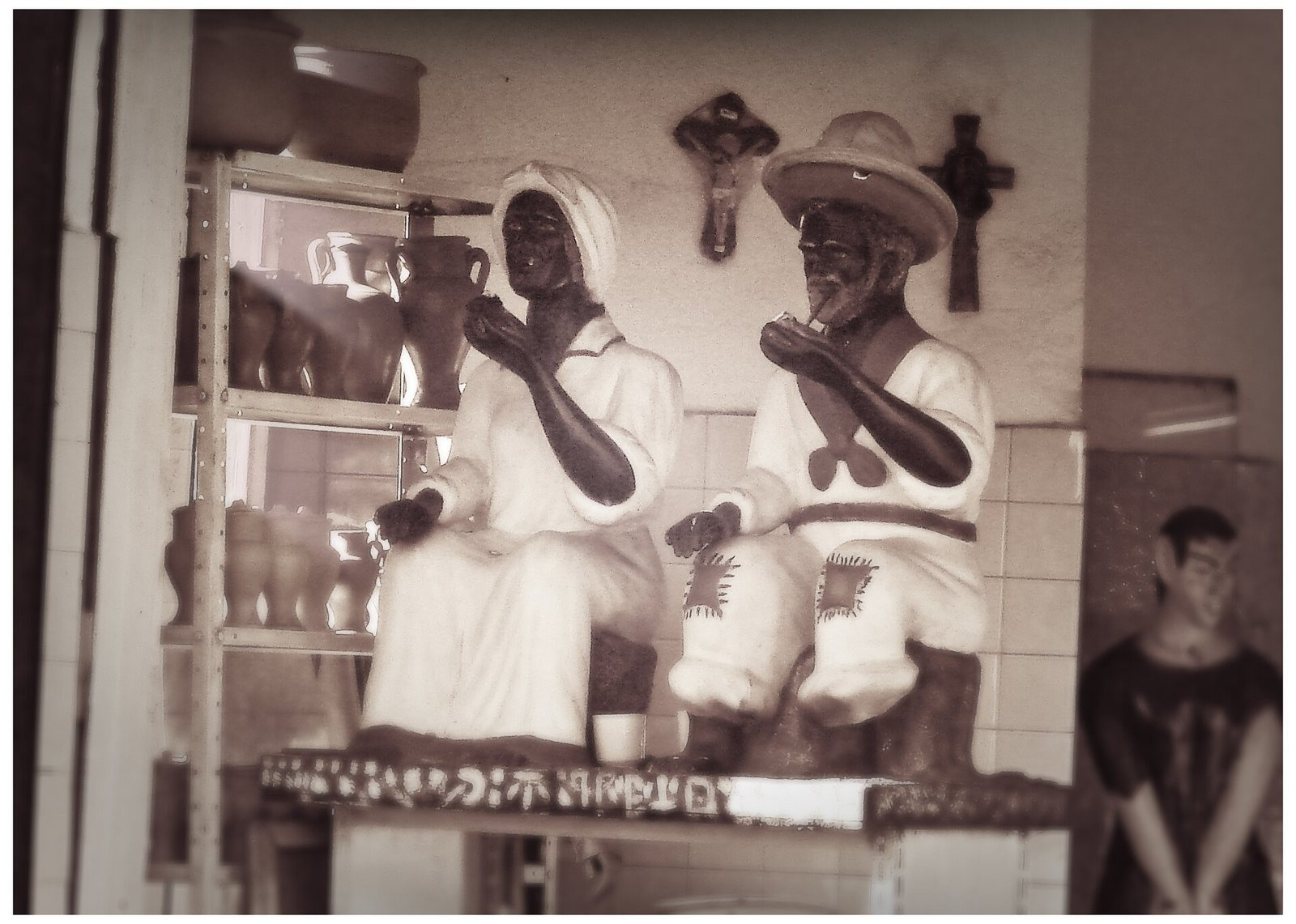
Statues of pretos-velhos, São Paulo, 29 August 2009. Photograph by Igor Giamoniano. CC BY 2.0, via Wikimedia Commons.
Leal de Souza described them in 1933 with a sentence that is hard to read today: the Black man “who groaned in the field under the overseer’s whip” cannot see a tear without weeping. The early codifiers made the preto-velho an emblem of humility. Today he is more often honoured as an ancestor, for his wisdom and for having endured.
Their feast falls on 13 May, the date of the Lei Áurea that abolished slavery in Brazil in 1888.
Caboclos and the novel
The caboclos are their counterpart: the spirits of Indigenous people, proud, direct, often severe, who arrive with arrows, feathers and a cry. Their names evoke the forest and the warrior: Caboclo Pena Branca, Caboclo Tupinambá, Cabocla Jurema.
The historian Artur Cesar Isaia has pointed out how closely this figure follows the Indian of Brazilian Romantic literature. In José de Alencar’s novel O Guarani (1857), the noble savage Peri wins his master’s full trust only after he is baptised. Leal de Souza’s caboclo, for his part, arrives “with the intolerant enthusiasm of a new Christian” and softens with time, as he grows to pity the poor who consult him.
Older Indigenous and mestizo healing traditions, the pajelança of the North and the catimbó and jurema of the Northeast, with their own spirit-guides, smoke and herbs, fed the figure too.
Children, cowboys and sailors
The crianças, also called erês or ibejadas, are the spirits of children. They arrive laughing, ask for sweets and soft drinks, sit on the floor and play. Leal de Souza placed them in the line of Oxalá, together with Saints Cosmas and Damian, the twin physicians of the early Church whom Afro-Brazilian tradition joined to the Yoruba twins, the Ibeji.
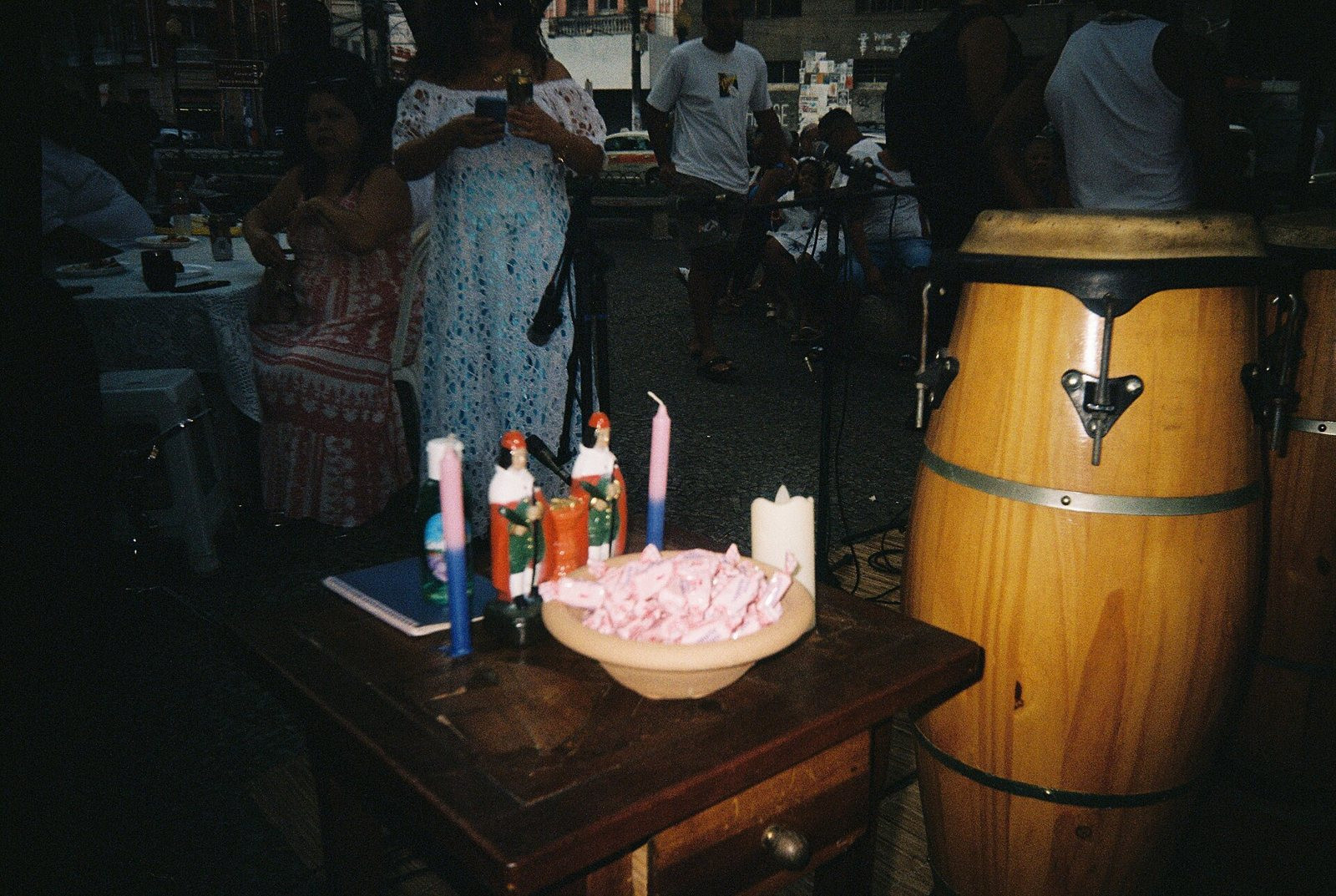
A small altar for the Festa de Cosme e Damião, Brazil, 27 September 2024. Photograph by Ifenomenal. CC BY-SA 4.0, via Wikimedia Commons.
On 27 September, in the suburbs of Rio, terreiros and Catholic families alike hand out small paper bags of sweets to children in the street. The anthropologist Morena Freitas described one centre in the North Zone that gave out almost a thousand bags in 2016, delivered by the child-spirit of its own leader.
Many houses today also receive other lines: the baianos, migrants from the Northeast; the boiadeiros, cattle drovers of the backlands; the marinheiros, sailors who sway as if the floor were a deck; and the malandros, hustlers of old Rio in white suits, of whom Zé Pilintra is the best known.
The people of the crossroads
Then there are the spirits of the street: exus and pombagiras.
In 1933 Leal de Souza placed them outside the White Line altogether. Exu, for him, belonged to the “Black Line”, the “people of the crossroads”, whose powers had to be propitiated or held off. By the 1970s Zélio de Moraes gave a different picture. The Caboclo, he told his interviewer in 1972, taught that Exu is “like the soldier in the police”: the chief does not make the arrest, the soldier does. Exu is a spirit “awakened from darkness” who, by working for others, gains light.
Between those two texts Exu changed sides. In Umbanda houses today exus and pombagiras usually work under the discipline of the house. The older, more independent traditions of Exu and Pombagira, and the line of practice that Umbanda’s codifiers called Quimbanda and defined as their opposite, are the subject of the third post in this series.
A gira on a weeknight
Practice varies enormously from house to house, so what follows is only an outline.
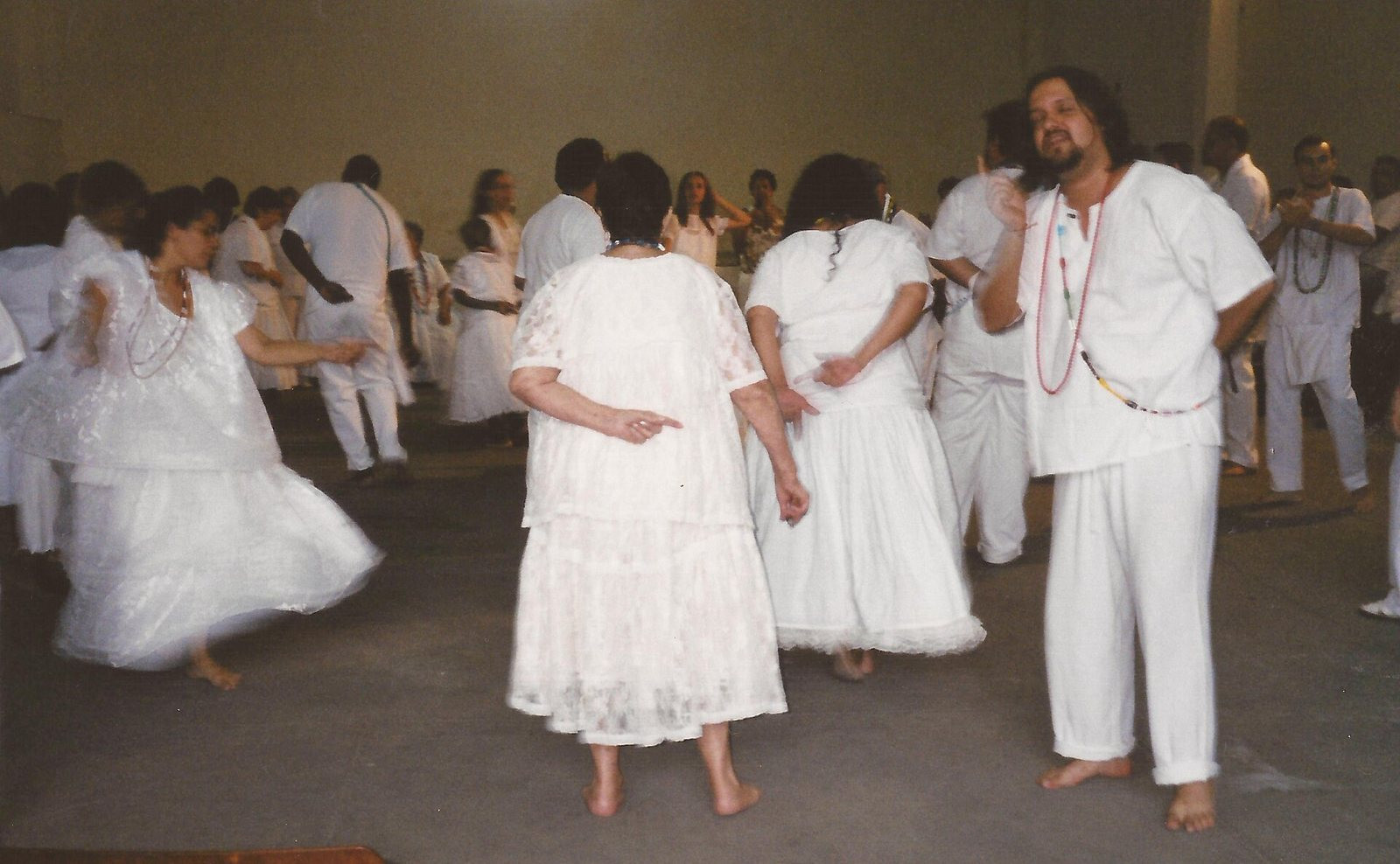
An Umbanda session at a festival of the União Espiritista de Umbanda do Brasil, Rio de Janeiro, 2004. The UEUB is the federation founded in 1939 as the Federação Espírita de Umbanda. Photograph by Junius, released into the public domain, via Wikimedia Commons.
The ceremony is called a gira, a turning. Mediums dressed in white gather in the terreiro, often barefoot. The room is cleansed with smoke, and the session opens with prayers, often including the Lord’s Prayer. Then come the pontos cantados, sung invocations, sometimes accompanied by atabaques, hand drums, and sometimes, in houses close to the Kardecist side, by nothing but clapping. Zélio’s Caboclo, according to the 1972 interview, used neither.
When a spirit “comes down”, the medium’s posture and voice change: the caboclo stands straight and whistles, the preto-velho bends and sits. Assistants called cambonos help the spirits and translate for visitors, who wait their turn for a consulta, a conversation, with one of them.
Central to the whole ethic is the word caridade, charity. Many houses insist that consultations are free, and they repeat the definition attributed to the Caboclo: Umbanda is the manifestation of the spirit for charity.
Flowers for Iemanjá
The beach full of people in white on New Year’s Eve has an Umbanda history as well.
According to the reporting of BBC News Brasil, on the night of 1949 into 1950 a small group of umbandistas went to Copacabana dressed in white, saluted Iemanjá, the orixá of the sea, and threw flowers and offerings into the water before midnight. The man behind this Flores de Iemanjá was Tancredo da Silva Pinto (1904-1979), the same priest who rejected the Zélio story, and whom his admirers called the “black pope of Umbanda”. The crowd grew every year, and the celebration became more plural and less tied to any one religion.
Today Rio’s New Year’s Eve gathers millions. Agência Brasil, reporting in 2016, traced its white clothes, its seven waves and its flowers thrown to the sea to the Afro-Brazilian religions. In 2016 the umbandistas of the Tenda Vovó Maria Conga told Agência Brasil that the city’s mega-event had made it difficult to carry their boats and gifts for Iemanjá through Copacabana, and that they had moved their walk to 2 February, Iemanjá’s day.
That same 8 November 2016, Rio’s mayor signed Decree 42.557 declaring Umbanda part of the city’s intangible heritage, next to bossa nova and the carnival blocos.
Stones through the window
Recognition has not brought safety.
In 2024 Brazil’s human rights hotline, Disque 100, registered 2,472 reports of religious intolerance, 66.8% more than the year before. Where the victim’s religion was recorded, Umbanda led the list, with 151 cases, followed by Candomblé with 117. Since Law 11.635 of 2007, Brazil marks 21 January as its day against religious intolerance, in memory of Mãe Gilda de Ogum, a Candomblé priestess from Salvador who died in 2000 after her terreiro was invaded and she was defamed.
Around Rio the violence can be armed. A drug trafficker known as Peixão, who has preached in an evangelical church, was described by the Rio press in 2024 as the master of a group of North Zone favelas that his gang has called the “Complexo de Israel” since 2020. In March 2023 a court sentenced him to six years and six months for ordering the destruction of a Candomblé terreiro in Nova Iguaçu, whose attackers, according to the prosecution, shouted that the macumbeiros would be expelled “by order of the traffic”.
Against this background the census tells a different story. In 2010, 0.3% of Brazilians declared themselves followers of Umbanda or Candomblé. In the census of 2022, published in June 2025, the figure was 1.0%, more than three times as many. An IBGE analyst suggested that many former “Spiritists” and “Catholics” now feel safe enough to say the word. Rio Grande do Sul, far from Niterói, has the highest proportion in the country, 3.2%. And of all those who declared Umbanda or Candomblé, 42.9% described themselves as white.
A birthday on the fifteenth of November
On 16 May 2012 President Dilma Rousseff signed Law 12.644. Its first article reads, in full: “The National Day of Umbanda is instituted, to be celebrated annually on 15 November.”
In practice the law chose the night in Niterói, the Jesuit who became a caboclo, the flower on the Kardecist table. It said nothing of Chatelain’s ki-mbanda, Wagener’s dancers, the healers prosecuted under article 158, the congress that preferred India to Angola, or the 523 objects that waited eighty years in a police museum to be called sacred.
A Kimbundu word for the art of healing, and a republic that wrote that art into its penal code. A young man, a flower and a spirit who refused to leave the table. Codifiers who dressed everyone in white and chose a Sanskrit name. Police files, saints on the shelf, old slaves on low stools, flowers on Copacabana and stones through a terreiro’s window.
Both birth certificates are real. The story of 1908 tells us what Umbanda wanted to be when it sought a place in the Republic; the long history tells us who made it, and at what cost.
The spirits in the story of Niterói were told to leave because they were Indians and slaves. They came back the next night, and they have kept coming back.
Original: https://pablo.space/posts/umbanda-or-the-spirits-sent-away-from-the-table