Vodou, or the Gods Who Crossed the Atlantic
2026-11-14, originally published on pablo.space.
← all Chamber of Reflections texts
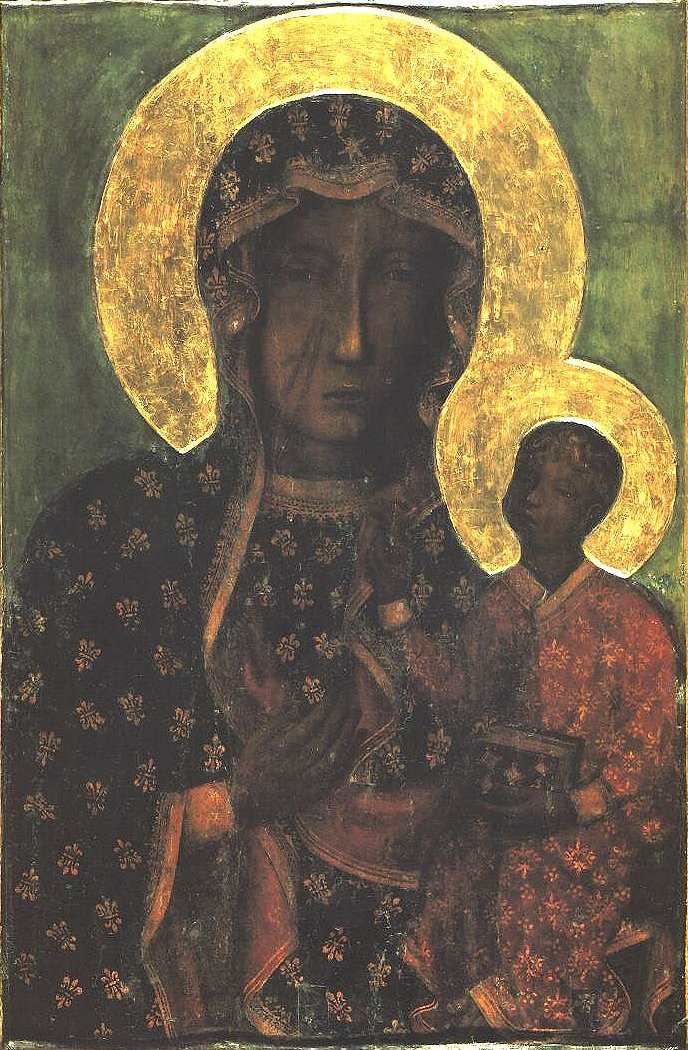
The Black Madonna of Częstochowa, icon, Jasna Góra Monastery, Częstochowa, Poland. Tempera on wood, of uncertain date; tradition places its arrival at Jasna Góra in 1382. Public domain, via Wikimedia Commons. In Haiti, printed copies of this Polish icon, scars and all, are one of the faces of the lwa Ezili Dantò.
Pins in a cloth doll, the walking dead, drums in the night: almost everything most of us “know” about voodoo was invented outside Haiti, much of it in the twentieth century. Haitian Vodou is something else: a living religion, born when the spirits of the Fon, the Yoruba and the Kongo crossed the Atlantic in the holds of slave ships and met the saints of French Catholicism in the most brutal colony of the Americas. This is an introduction to that religion, to its spirits and its saints, and to the long campaign of fear that turned its name into a word for fraud.
« Tous les esclaves qui seront dans nos îles seront baptisés et instruits dans la religion catholique, apostolique et romaine. »
(“All the slaves who are in our islands shall be baptized and instructed in the Catholic, Apostolic and Roman religion.”)
— Code Noir, Article 2, 1685
Pins, zombies and a Polish Madonna
Say the word voodoo and a whole cinema starts running in the head.
A doll bristling with pins. A woman walking through a cane field with empty eyes. And off the screen the word keeps working: voodoo economics, voodoo science, anything fraudulent or faintly ridiculous.
The picture at the top of this post is none of those things. It is a Polish icon of the Virgin and Child, one of the most venerated images in Catholic Europe. And in many Haitian homes and temples, a cheap printed copy of it stands for a spirit called Ezili Dantò: a fierce, dark-skinned mother who defends her children with a knife.
How a Madonna from Poland became a spirit in the Caribbean is exactly the kind of question that leads into the real story. Vodou has been called witchcraft, devil worship and black magic, by slave owners, missionaries, Marines and film studios. It is none of these.
Vodou is not “Western magic”, and it is not black magic. It is a religion, with a theology, a clergy, a calendar, an art and millions of faithful, and it was born out of slavery.
This is an introduction, and perhaps the first of a small series on the religions of the Afro-Atlantic world. As always, I write as a historian, not a practitioner: no ceremonies, no recipes, no instructions. Only history, art and belief, with the respect owed to a living faith.
A word from Dahomey
In Fon and the related Gbe languages of present-day Benin and Togo, the land of the old kingdom of Dahomey, vodún means a spirit, a deity, a sacred power. The word crossed the ocean with the people who spoke it.
The earliest French attestation the dictionaries record dates from 1797, in the great Description of Saint-Domingue by the colonial lawyer Médéric Louis Élie Moreau de Saint-Méry. He describes a dance that “porte le nom de Vaudoux”, kept above all by the people he calls Arada, for whom Vaudoux signifies “un être tout-puissant et surnaturel”, an all-powerful and supernatural being. He describes a sacred snake kept in a box, a “king” and a “queen”, and a priestess who, standing on the box, becomes the mouthpiece of the god. He was a hostile outsider, but his is the first written portrait of the religion.
From Vaudoux came the English voodoo, and with it a century and a half of contempt.
Haitians write the word in Kreyòl as Vodou. In April 2012 a group of scholars and practitioners, organized through KOSANBA, the scholarly association for the study of Haitian Vodou, asked the Library of Congress to change its subject heading for the religion, which was still “Voodooism”. That October the Library agreed. Its editorial summary is brief and remarkable: the petitioners “successfully argued that vodou is the more accurate spelling, and that the spelling ‘voodoo’ has become pejorative.”
The difference between Vodou and voodoo is the difference between a religion and a rumour.
The crossing
Saint-Domingue, the western third of the island the Taíno called Ayiti, became French in 1697 and within a century was the richest colony in the world, built on sugar, coffee and enslaved Africans. By 1789 there were nearly half a million of them, against roughly thirty thousand whites and a similar number of free people of colour.
The plantations killed so quickly that, by most estimates, the majority of the enslaved on the eve of the Revolution had been born in Africa.
They came from the Bight of Benin, speaking Fon, Ewe and Yoruba; from the Kongo and Angola in enormous numbers; from Senegambia and beyond. Each people brought its own spirits, ancestors and ways of mourning, and on the plantations they had to build, out of many traditions, something they could share.
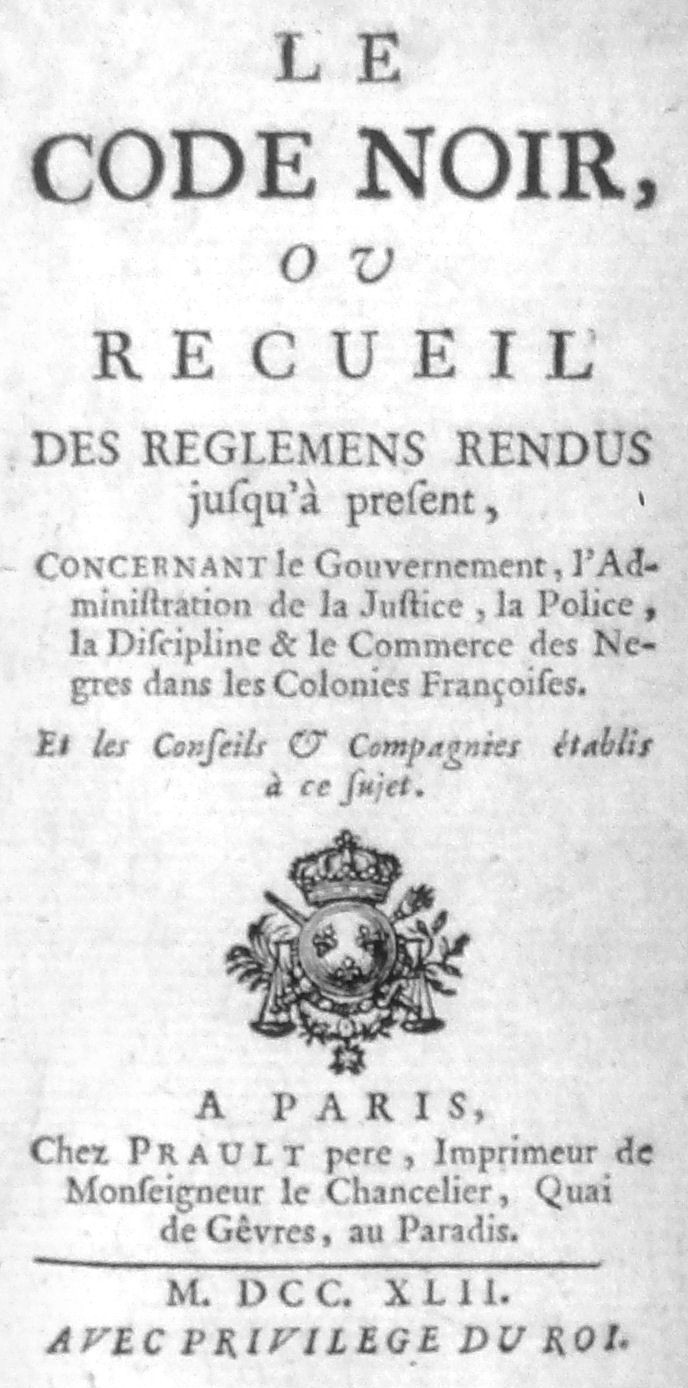
Title page of Le Code Noir, ou Recueil des réglemens, Paris: Prault père, 1742. A later compilation of the colonial slave laws, opening with the edict of 1685. Public domain, via Wikimedia Commons.
The law had already decided what their religion should be. The Code Noir, the royal edict of March 1685 that governed slavery in the French islands, ordered in its second article that every slave be baptized and instructed in the Catholic faith. The third forbade the public exercise of any other religion and declared gatherings for that purpose “illicites et séditieuses”. The sixteenth forbade slaves of different masters to assemble, by day or by night, on pain of the whip and the branding iron.
In practice, instruction was thin and baptism often perfunctory. But the saints arrived.
The Africans of Saint-Domingue were forbidden their spirits and given saints instead. They kept both.
Saints as masks, saints as mirrors
This is where the Polish Madonna comes back.
In Haitian temples and market stalls you will find Catholic chromolithographs, the cheap colour prints of saints sold all over the Catholic world. For those who serve the spirits, many of these images also show a lwa:
I. Saint Patrick, driving the snakes out of Ireland, is Danbala, the ancient serpent spirit, white, cool and silent.
II. The Mater Dolorosa, the Virgin of Sorrows, crowned and jewelled, her heart pierced, is Ezili Freda, the spirit of love, luxury and longing.
III. The Black Madonna of Częstochowa is Ezili Dantò, the hard-working, fiercely protective mother, often represented by a heart pierced with a dagger.
IV. Saint James the Greater, the warrior on horseback with his sword raised, is Ogou, the spirit of iron, war and politics.
V. An old man on crutches with dogs at his feet, Saint Lazarus, often stands for Papa Legba, the guardian of the crossroads, who opens the gate between people and the spirits.
The old explanation was that the saints were a mask: forbidden their own gods, the enslaved hid them behind Catholic faces. There is truth in it, but it is too simple. Many scholars now prefer to speak of correspondence rather than disguise. Someone who lights a candle before Saint James is not necessarily pretending. The saint and the lwa share a sword, a horse, a temperament; they can be seen as two faces of one power, or as companions. Many Haitians have long considered themselves good Catholics and servants of the spirits. The Church, for most of its history, insisted that one cannot be both. The debate is old, and I will not settle it here.
One curiosity, told as a story rather than history. In 1802 Napoleon sent an army to retake the colony, Polish legionnaires among them, and some changed sides. Haiti’s constitution of 1805, which barred whites from owning property, made an exception for “Germans and Poles naturalized by the government”, and their descendants still live in villages such as Cazale. It is often said they brought the Black Madonna with them. Perhaps; the prints circulated so widely that she could have arrived by any road.
A distant God and the spirits who stay close
I can only offer the broad lines of belief. Vodou has no pope, no single scripture, no central authority, and every temple has its own lineage.
Above everything is God, Bondye, from the French Bon Dieu. He is the creator, he is good, and he is very far away. He receives no ceremonies of his own. Haitians say si Bondye vle, “if God wills”, exactly as Brazilians say se Deus quiser.
Between Bondye and human beings are the lwa (also written loa), the spirits. They are not gods in the Greek sense, and they are not demons. They are powers with personalities: favourite colours, foods, drinks, days and songs; tempers and tenderness. Haitians often describe the practice not as “doing Vodou” but as sèvi lwa, serving the spirits. It is a relationship of reciprocity: the living feed and honour the spirits, and the spirits protect, heal, advise and warn.
Then there are the dead. The ancestors are at the heart of Vodou, and the ancestral home of the spirits is Ginen, the memory of Guinea, of Africa itself, imagined as lying beneath the waters.
Vodou also has its own account of the soul. In the classic descriptions by scholars such as Leslie Desmangles and Karen McCarthy Brown, each person has at least two: the gwo bon anj, the “big good angel”, the life force shared by all living things, and the ti bon anj, the “little good angel”, the individual self, conscience and memory. Hold on to the ti bon anj. We will meet it again with the zombi.
The nations of the spirits
The lwa are organized into families called nanchon, nations, and the word itself is a memory of Africa: the “nations” of the colony were the African peoples the enslaved came from.
The two great nations are Rada and Petwo.
The Rada spirits take their name from Allada, the old kingdom on the Slave Coast, the “Arada” of Moreau de Saint-Méry. Their temper is cool, dignified, benevolent: Danbala, Ezili Freda, Legba at the gate.
The Petwo spirits are hot, fast and fierce. Many scholars connect them with Kongo traditions and with the experience of slavery and revolt in the colony itself. Ezili Dantò belongs to them.
The two are not good and evil, not white and black magic. Hot and cool are temperaments, not moral categories. A temple may serve both.
And then there are the Gede, the family of the dead, led by Bawon Samdi, Baron Saturday, master of the cemetery, in his black top hat and dark glasses, with his wife Grann Brigitte. The Gede are funny, obscene, irreverent and wise; they mock the powerful and tell the truths no one else will. Their great feast falls in the first days of November, when Haitian cemeteries fill with people in purple and black. Readers of my post on All Souls will recognize the dates: the Catholic dead and the Gede share a calendar.
The horse and the rider
The centre of a Vodou ceremony is not a sermon. It is an arrival.
Ceremonies take place in a temple, the ounfò, led by a priest, the oungan, or a priestess, the manbo. In the middle of the floor stands the poto mitan, the centre post, the road by which the spirits come down. There are drums, songs, offerings and dances, each spirit greeted in turn, beginning with Legba, who must open the gate.
And sometimes a spirit comes. The person it “mounts” is called its chwal, its horse. Voice, gestures and face change: an old woman strides like a soldier for Ogou; a shy young man becomes a joking Gede. When the spirit leaves, the horse usually remembers nothing.
Outsiders have called this hysteria, fraud or demonic possession. Practitioners understand it as the highest moment of the religion: the spirit present among the people, speaking, advising, scolding. I will not try to explain it. Moreau de Saint-Méry’s priestess on the snake box, in 1797, was already a horse.
Before a ceremony, officiants trace on the floor the vèvè, intricate symbolic designs drawn freehand in cornmeal or other powders, one for each lwa: a heart for Ezili, serpents for Danbala, crosses and coffins for the Gede. They are among the most beautiful ritual arts of the Americas, made to be danced over and erased. Their origins are debated; scholars have pointed to Kongo cosmograms and to European emblems, Masonic ones among them (there were lodges in the colony). I leave them here as art, not as diagrams, and I will not reproduce one.
A night in the Caïman woods
In August 1791, on the northern plain of Saint-Domingue, the largest slave revolt in history began. Within weeks hundreds of plantations were in ashes.
Haitian national memory places at its beginning a ceremony in a forest called Bois Caïman, Bwa Kayiman. In the version every Haitian schoolchild knows, the leader Dutty Boukman, a coachman and oungan, with a manbo later named as Cécile Fatiman, gathered the conspirators in the woods during a storm, sacrificed a black pig, and bound them with a blood oath to fight for freedom.
What do the documents say?
The earliest published account is by Antoine Dalmas, a French physician on one of the first plantations attacked, written in American exile in 1793–94 and published in 1814. Before the rising, he reports, the leaders “célébrèrent une espèce de fête ou de sacrifice”, a kind of feast or sacrifice, in an uncultivated wood on the Choiseul estate called the Caïman, where the slaves gathered in very great numbers. A pig, entirely black, surrounded by offerings, was sacrificed to “génie tout-puissant de la race noire”, the all-powerful spirit of the black race; the participants drank its blood and prized its bristles as talismans. Then comes his verdict: these were “les rites superstitieux d’une religion absurde et sanguinaire”, the superstitious rites of an absurd and bloodthirsty religion.
Notice what is missing. Dalmas names no Boukman at the sacrifice and no priestess, and gives no date for it. Boukman as celebrant enters through later tellings: the Haitian historian Céligny Ardouin, writing in 1841, has him swear an oath commanded by a priestess. The famous prayer attributed to Boukman first appears, as far as historians have traced it, in a work by Hérard Dumesle of 1824, in verse. The name Cécile Fatiman comes later still. Even the date is disputed. The commemorated 14 August appears in the sources as the date of a planning meeting at the Lenormand estate, and the historian David Geggus, who has studied the sources most closely, has argued that the ceremony probably took place on the night of 21 August.
Some historians doubt it happened at all; most think something did.
For colonists like Dalmas, the ceremony proved that the revolt was savagery. For Haitians, it became the proof that their freedom was sacred. The same pig, the same night, two opposite meanings. And it was the hostile planter, writing to condemn it, who preserved it.
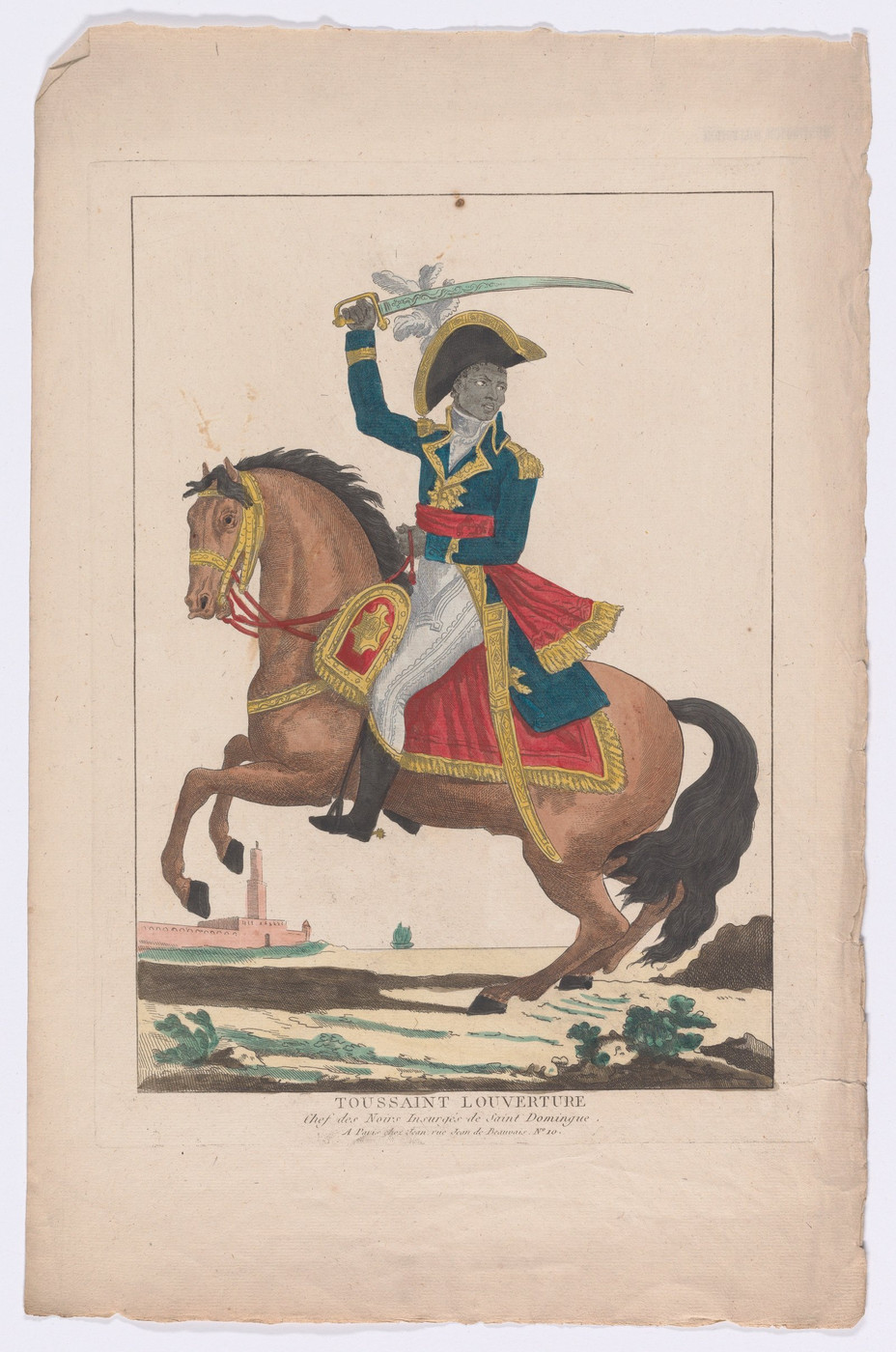
Anonymous French artist, Toussaint Louverture, Chef des Noirs Insurgés de Saint Domingue, 1802. Hand-coloured etching. The Metropolitan Museum of Art, New York, Gift of William H. Huntington, 1883 (83.2.934). Public domain (CC0), via The Met.
Toussaint Louverture, the revolution’s greatest leader, was a devout Catholic, and as governor he too restricted Vodou gatherings. The revolution was many things at once, and the spirits were only one of its forces. But they were there.
Under the eye of the Name
On 1 January 1804, at Gonaïves, Jean-Jacques Dessalines proclaimed the independence of Haiti, taking back the Taíno name of the island. It was the first free Black nation in the Americas, and the only one born from a successful slave revolt.
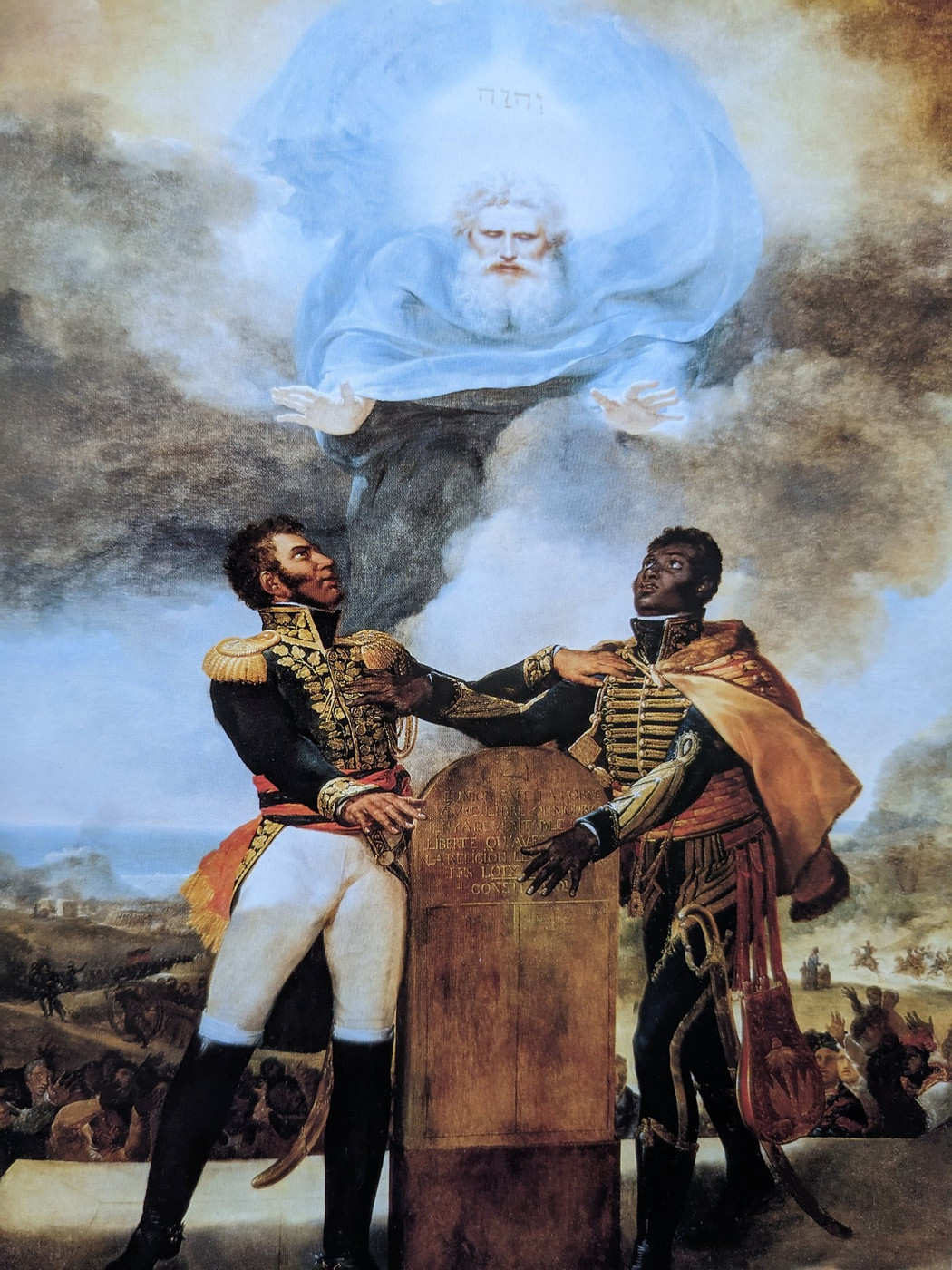
Guillaume Guillon-Lethière, Le Serment des ancêtres (The Oath of the Ancestors), 1822. Oil on canvas. Musée du Panthéon national haïtien, Port-au-Prince. Public domain, via Wikimedia Commons. Alexandre Pétion and Jean-Jacques Dessalines swear the union of the free people of colour and the formerly enslaved.
Lethière, born in Guadeloupe to a French colonial official and an enslaved woman, became a leading academic painter in Paris and sent this canvas to Haiti. Rediscovered in the cathedral of Port-au-Prince in 1991, it was pulled damaged from the ruins after the 2010 earthquake and restored in France.
Look at the sky. Above the two founders hovers the God of the Bible, and above his head, in Hebrew, the Name: יהוה. Readers of my post on the Tetragrammaton will recognize it. This is the official image of the new nation: a covenant sworn under the eye of the God of Israel.
The religion of most of the people who won that independence is not in the picture.
A religion on trial
You might expect a nation founded by former slaves to embrace the religion of the slaves. For most of the nineteenth and twentieth centuries, its rulers did the opposite.
The new state wanted recognition from powers that despised it, and its French-speaking Catholic elites knew that Europe and America pointed to “voodoo” as proof that Black people could not govern themselves. As the historian Kate Ramsey has shown in The Spirits and the Law (2011), Haiti’s own penal code of 1835 already listed makers of vaudoux among practitioners of punishable “spells”, and the code of 1864 widened the prohibition of what it called superstitious practices.
The Catholic Church, staffed after the concordat of 1860 largely by French clergy, led campaigns of its own: in 1896, when Monsignor Kersuzan, bishop of Cap-Haïtien, preached publicly against the cult; again in the years around 1913; and most violently in 1941–42, in the campagne anti-superstitieuse, backed at first by the government of President Élie Lescot. Temples were raided, drums and sacred objects burned. Catholics were asked to swear an oath renouncing the spirits; those who did were called rejete, “rejecters”. The campaign collapsed in 1942 amid protest, and the writer Jacques Roumain, founder of Haiti’s Bureau d’Ethnologie, became its sharpest critic.
All of it was done in the name of progress.
For a century and a half, Vodou was persecuted not only by foreigners but by Haitians who had learned to see it through foreign eyes.
The Marines and the magic island
In July 1915 the United States Marines landed in Port-au-Prince, and stayed until 1934. The occupation revived forced labour, crushed the peasant resistance of the cacos, and enforced the laws against “superstition” with new zeal.
It also gave the world the Hollywood voodoo.
The decisive book was The Magic Island (1929) by the American journalist William Seabrook, a gifted and sensational writer. The bestseller brought the Haitian zombi into English-language popular culture. In a chapter titled “Dead Men Working in the Cane Fields”, he explains:
“The zombie, they say, is a soulless human corpse, still dead, but taken from the grave and endowed by sorcery with a mechanical semblance of life.”
Within three years the idea was on the screen. White Zombie (1932), with Bela Lugosi as a sinister sugar-mill owner in Haiti who turns people, and a white bride, into the walking dead, is usually counted as the first feature-length zombie film.
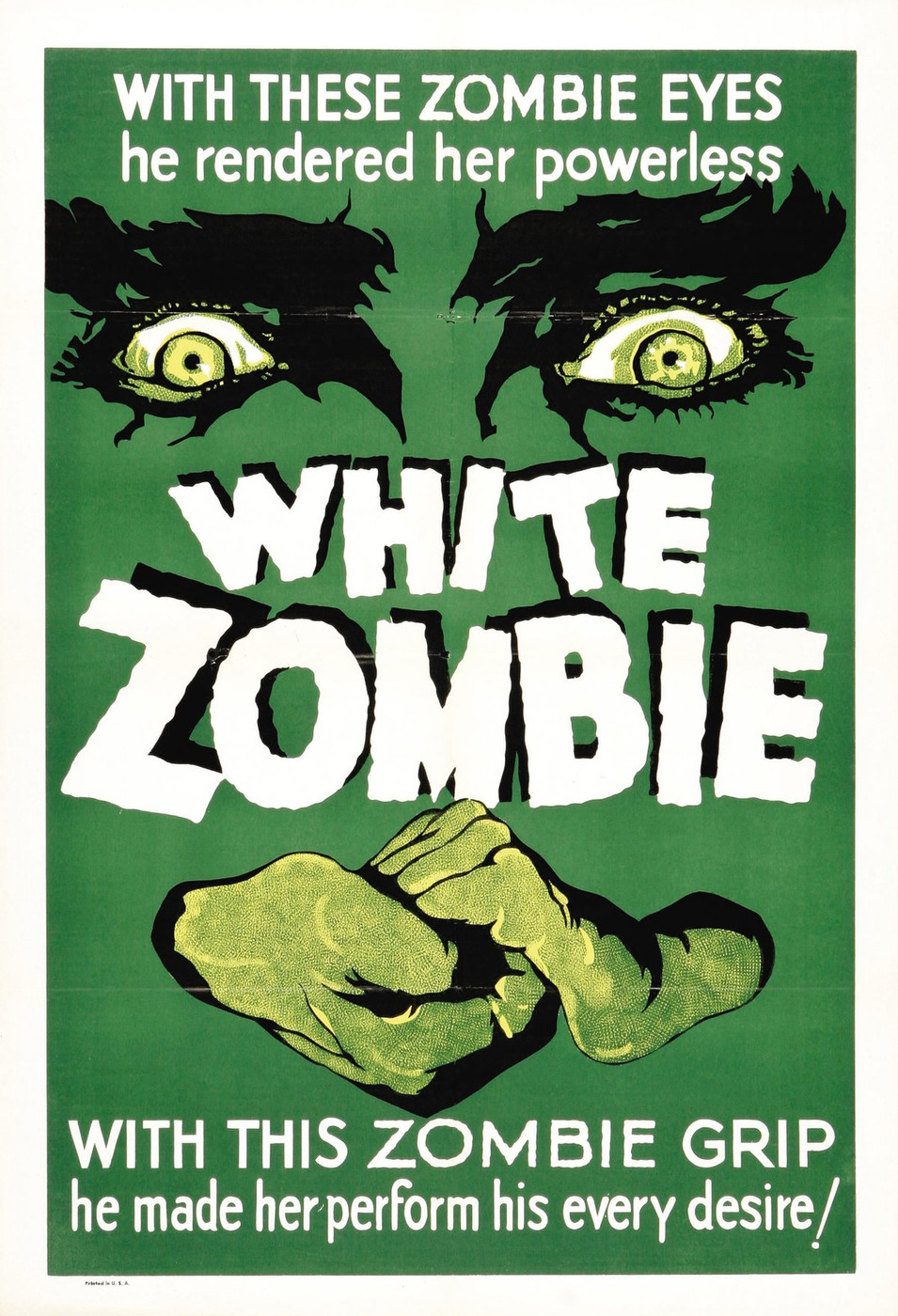
Poster for White Zombie, directed by Victor Halperin, released by United Artists, 1932. Artist unknown. Public domain, via Wikimedia Commons.
The poster says everything: a Caribbean religion reduced to hypnotic eyes and a grasping hand, sold to American audiences while American soldiers governed Haiti. I Walked with a Zombie followed in 1943, and then a long parade of cannibal priests and cursed dolls. All of it, naturally, harmless entertainment.
I say it as someone who loves old horror films: Hollywood took a figure of enslavement from a nation of former slaves and made it a thrill for the country occupying it.
The zombi before Hollywood
The Haitian zombi is a real belief, and it is very different from the film monster.
In Haitian tradition the zombi is not a corpse hungry for flesh. It is a person whose soul, or part of it, has been captured by a sorcerer, a bòkò, and who is made to work without will, without memory, without rest. Remember the ti bon anj: what is stolen is precisely the self.
It is hard not to see what this fear is about. A human being stripped of will, owned by another, forced to labour in the fields. Many scholars read the zombi as a memory of slavery: the worst fate a formerly enslaved people could imagine was not death, but being made a slave again. The fear, in Haiti, is less of meeting a zombi than of becoming one.
In 1985 the Canadian ethnobotanist Wade Davis published The Serpent and the Rainbow, arguing that zombification was a real punishment carried out with a powder whose active ingredient was tetrodotoxin, the puffer-fish poison, which can produce a death-like state. He leaned on the case of Clairvius Narcisse, pronounced dead in 1962, who reappeared in his village in 1980. The book became a Wes Craven film in 1988. Scientists were less convinced: in 1986 the pharmacologists C. Y. Kao and Takeshi Yasumoto reported only insignificant traces of the toxin in the samples they tested, and anthropologists criticized Davis’s history. Davis replied that preparations varied. The debate was never settled, and a Haitian belief became, once again, a foreign adventure story.
The doll that is not there
And the doll with the pins?
As far as the scholarship goes, the pin-stuck “voodoo doll” is not a characteristic part of Haitian Vodou.
Figures used in harmful magic, of wax or clay or cloth, are very old in Europe: the Greeks and Romans used them, and English witch trials are full of “poppets”, as my post on maleficium touched on. Dolls do appear in some Afro-Caribbean and African American practices, often for protection or as messages to the spirits. But the doll as the emblem of “voodoo” seems to owe more to European magic, the New Orleans souvenir trade and the cinema than to the temples of Haiti. Seabrook already tells of a wooden doll “made in his image” and of a charm “pierced all through with pins and needles”, and later writers and filmmakers fused the two.
Which brings me to a necessary distinction. New Orleans Voodoo is not Haitian Vodou. It is a related but separate Louisiana tradition, shaped by Africans brought to the colony, by Catholicism, and by thousands of refugees from Saint-Domingue who arrived around 1809. Its most famous figure is Marie Laveau, the “Voodoo Queen”, who died in 1881. Hoodoo, the African American folk magic of the South, is something else again. I keep them apart for the same reason I keep Kabbalah and Western occultism apart on this blog: mixing them is how bad history is made.
Painters, flags and a dictator
The twentieth century also brought a reversal. The ethnologist Jean Price-Mars, in Ainsi parla l’oncle (1928), argued that the peasant religion was the heart of Haitian culture, and then came the painters. In 1944 the American teacher DeWitt Peters opened the Centre d’Art in Port-au-Prince, and among the self-taught artists drawn to it was Hector Hyppolite (c. 1894–1948), an oungan who painted the lwa in house paint, reportedly with brushes of chicken feathers. André Breton saw his work in December 1945 and championed it in Paris. Haitian art and Vodou have been intertwined ever since, nowhere more beautifully than in the drapo Vodou, the sequined and beaded flags that greet the spirits in the temple and now hang in museums around the world.
Among the foreigners who truly listened was the American filmmaker Maya Deren, who went to Haiti in 1947 to film dance and kept returning. In 1953 she published Divine Horsemen: The Living Gods of Haiti, still one of the most respectful books on the subject. In its preface she described how the religion had overturned her project:
“I had begun as an artist, as one who would manipulate the elements of a reality into a work of art in the image of my creative integrity; I end by recording, as humbly and accurately as I can, the logics of a reality which had forced me to recognize its integrity, and to abandon my manipulations.”
There was a darker turn too. François Duvalier, “Papa Doc”, dictator from 1957 until his death in 1971, had begun as an ethnologist celebrating Haiti’s African heritage. In power he courted oungan, drew some into his militia, the Tonton Macoutes, and is widely said to have cultivated a resemblance to Bawon Samdi, with his dark suit and dark glasses. How much was calculated theatre and how much legend is hard to separate; scholars treat it as the political manipulation of a religion, not its endorsement of tyranny. Practitioners paid the price. After his son Jean-Claude fell in 1986, in the purge called dechoukaj, “uprooting”, many oungan suspected of serving the regime were attacked and killed.
The constitution of 1987 swept away the 1935 decree-law against “superstitious practices”. And on 4 April 2003 President Jean-Bertrand Aristide, himself a former Catholic priest, signed a decree recognizing Vodou as a “religion à part entière”, a religion in its own right, “un élément constitutif essentiel de l’identité nationale”, and allowing its priests to celebrate legally valid baptisms, marriages and funerals.
Three hundred and eighteen years after the Code Noir, the spirits were legal.
Cousins, not twins
Haitian Vodou has relatives all over the Atlantic world. They share ancestors; they are not the same religion.
I. West African Vodun, in Benin and Togo, is the parent tradition, still very much alive, with a national day in Benin every 10 January. It has its own history, which did not stop in the eighteenth century.
II. Cuban Santería, or Regla de Ocha, is built mainly on Yoruba traditions, with its orishas also paired with Catholic saints. A cousin, not a sister.
III. Brazil has its own family. Candomblé is organized in “nations”, among them Ketu (Yoruba), Angola (Bantu) and Jeje, which descends from the same Fon and Ewe world as Haitian Rada and calls its deities voduns. In São Luís do Maranhão, the Casa das Minas, mother house of the Tambor de Mina, serves voduns associated with the royal house of Dahomey; Pierre Verger proposed that it was founded by Nã Agontimé, a queen of Dahomey sold into slavery, a beautiful hypothesis that has never been proven.
IV. New Orleans Voodoo, as we have seen, is its own Louisiana tradition.
To a Brazilian reader much of this will sound familiar. I hope to return to these cousins in later posts, each in its own room. The gods of West and Central Africa did not survive the Atlantic once. They survived it many times, wherever enslaved people refused to forget.
Serving the spirits
Let us gather the threads.
A word from Dahomey that meant “spirit”. A law that ordered baptism and forbade the old gods. Saints that became faces of the lwa. A distant God, spirits with tempers, ancestors beneath the waters, souls that can be stolen. A pig sacrificed in a forest, remembered by an enemy, turned into a national myth. A free nation that put the Hebrew Name in its sky and the religion of its people on trial. Marines, a journalist, a poster with glaring eyes. A doll that was never really there.
The popular image of voodoo is a story about fear: of curses, of the walking dead, of Black people with power. That fear is not Haitian. It belonged to slaveholders, missionaries and occupiers, and was projected onto a religion for two centuries.
The truth is stranger and more human. Vodou is what a people stripped of everything built in order to keep their gods, their dead and themselves. It held together communities that slavery had torn apart, healed the sick when there were no doctors, gave courage to the revolt that ended slavery on the island, and survived every law, campaign and film made against it.
The zombi, Haitians say, is a person without a soul, working for someone else.
Vodou has always been the opposite.
Original: https://pablo.space/posts/vodou-or-the-gods-who-crossed-the-atlantic