John Dee, or the Man Who Wanted to Speak with Angels
2026-11-16, originally published on pablo.space.
← all Chamber of Reflections texts
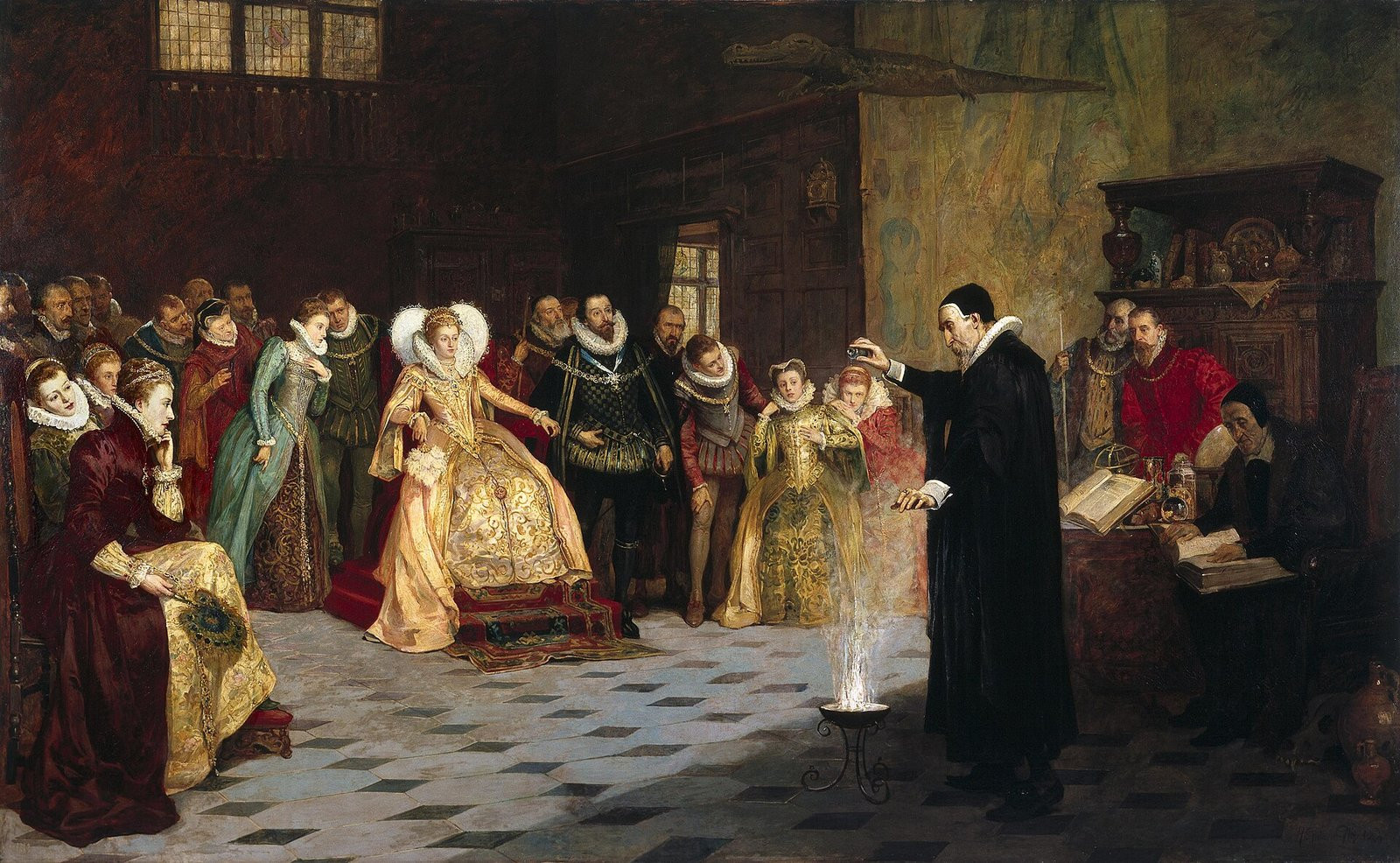
Henry Gillard Glindoni, John Dee Performing an Experiment before Queen Elizabeth I, late 19th century. Oil on canvas, 152 × 244 cm. Wellcome Collection, London. Public domain, via Wikimedia Commons. An X-ray taken in 2015 showed that Glindoni first painted Dee standing inside a circle of human skulls, and then painted them out.
John Dee was one of the most learned men in Elizabethan England: a mathematician, a geographer, an adviser to the Queen and the owner of perhaps the greatest private library in the country. In his fifties he began to talk to angels through a crystal and a much younger man named Edward Kelley, and for seven years he wrote down everything they said, including a language no one had ever heard. This is the story of those conversations, of the strange tongue Dee called Angelical, and of how, long after his death, it came to be called Enochian.
“Qui non intelligit, aut taceat, aut discat.”
(“Let him who does not understand either be silent or learn.”)
— Motto on the title page of John Dee’s Monas Hieroglyphica, Antwerp, 1564
The Queen’s conjuror
Every age keeps a Doctor Dee of its own.
In one version he is the Queen’s sorcerer, a sinister figure in black who reads the stars for Elizabeth I and raises spirits at night. In another he is a secret agent who signed his letters “007”. In yet another he is the keeper of a secret magical tongue, the language of the angels.
The documents tell a stranger story, and a sadder one.
When I wrote about the Book of the Watchers, Dee appeared only at the very end, as the man who borrowed Enoch’s name without having Enoch’s book. I promised he would get a room of his own. Here it is.
As always, I write as a historian, not as a practitioner. There are no invocations here, no tables to copy, no instructions for gazing into anything.
John Dee did not set out to become a magician. He set out to know everything, and when books and instruments ran out, he asked heaven to finish the lesson.
A mathematician first
Dee was born in London on 13 July 1527, the son of a mercer of Welsh descent at the court of Henry VIII. He went up to St John’s College, Cambridge, at fifteen, and became one of the original fellows of Trinity College when Henry founded it in 1546. There he built a flying beetle for a production of Aristophanes’ Peace, and later said this was where his reputation as a conjuror began.
He studied at Louvain, befriended the cartographers Gerardus Mercator and Abraham Ortelius, and was invited to lecture on Euclid in Paris while still in his twenties. In 1555, under Mary I, he was even arrested for casting horoscopes of the Queen and her half-sister Elizabeth, and cleared himself.
When Elizabeth came to the throne, Dee became her adviser on astrology and natural philosophy; he is said to have chosen the date of her coronation. He advised her navigators, and in 1577 published General and Rare Memorials pertayning to the Perfect Arte of Navigation, arguing for an English maritime empire. In 1570 he wrote the long “Mathematicall Praeface” to Henry Billingsley’s English Euclid, in English rather than Latin, for craftsmen and instrument makers who had never been to university. It became his most widely reprinted work.
There was always another Dee beside this one. In 1564, in Antwerp, he published the Monas Hieroglyphica, a short and famously obscure Latin treatise dedicated to the Emperor Maximilian II. It explains a single sign of Dee’s own invention, built from the symbols of the Moon, the Sun, the cross of the elements and Aries, which he believed expressed the unity of creation. On its title page he placed the warning I used as this post’s epigraph.
He was not joking. Almost no one has ever fully understood it.
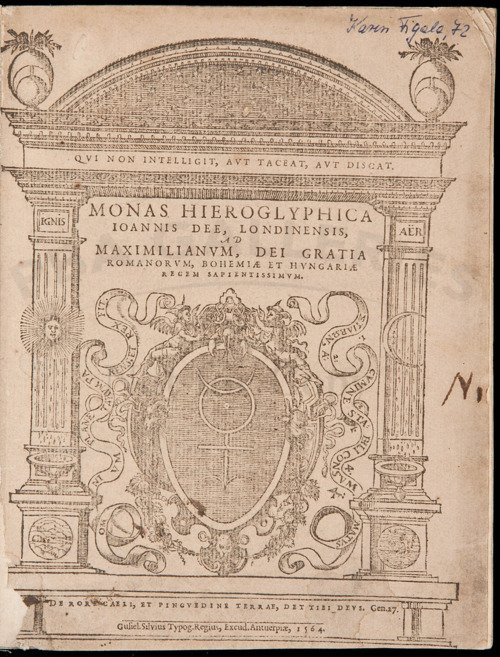
John Dee, Monas Hieroglyphica, title page, Antwerp: Willem Silvius, 1564. Woodcut. Public domain, via Wikimedia Commons. The verse at the foot of the arch is Genesis 27:28: “God give thee of the dew of heaven, and the fatness of the earth.”
At Mortlake, on the Thames west of London, he gathered books. Dee claimed more than 3,000 printed books and 1,000 manuscripts. It was a library for the whole of learning: mathematics, history, music, medicine, cryptography, alchemy.
By the early 1580s he was in his mid-fifties and disappointed. Patronage had not come in the measure he hoped. And the books had not given him what he wanted most: certain knowledge of the nature of things.
So he turned to the only teachers he thought could give it.
A man called Talbot
Dee could not see spirits himself. He needed a scryer, someone who could look into a polished stone and report what appeared there.
His first serious attempt was with a young man named Barnabas Saul, whose session of 22 December 1581 opens Dee’s record of the actions. It did not last. On 6 March 1582 Dee wrote in his diary that Saul “confessed that he neyther hard or saw any spirituall creature any more.”
Two days later a friend brought a visitor to Mortlake. The diary calls him Mr. Talbot. On Saturday 10 March 1582, Talbot asked to see something of “spirituall practise”. Dee’s record reads almost like a deposition. He excused himself “as not in the vulgarly accownted Magik, neyther studied, or exercised”, but confessed he had long wished for help in his studies through “the blessed Angels of God”. He brought out “my stone in the frame, (which was given me of a frende)”. Within about a quarter of an hour, Talbot said that he saw an angel in it, who called himself Uriel. (Later, Dee noted in the margin that this had not been the true Uriel.)
Talbot’s real name was Edward Kelley. He was born in Worcester on 1 August 1555, twenty-eight years after Dee. A story told after his death says he had lost his ears in the pillory at Lancaster for forgery, which is why artists always gave him a cap. It may be true. It may also be the kind of story that attaches itself to a man everyone later wanted to call a fraud.
What is certain is that from 1582 to 1589 the two men’s lives were bound together, and Dee wrote down almost every word Kelley reported.
The method matters. They did not draw circles or command demons. They prayed, often at length. Kelley looked into the stone; Dee sat with pen and paper, asked questions and recorded the answers. Dee saw and heard nothing. Every word of the angels passed through one man’s eyes and another man’s hand.
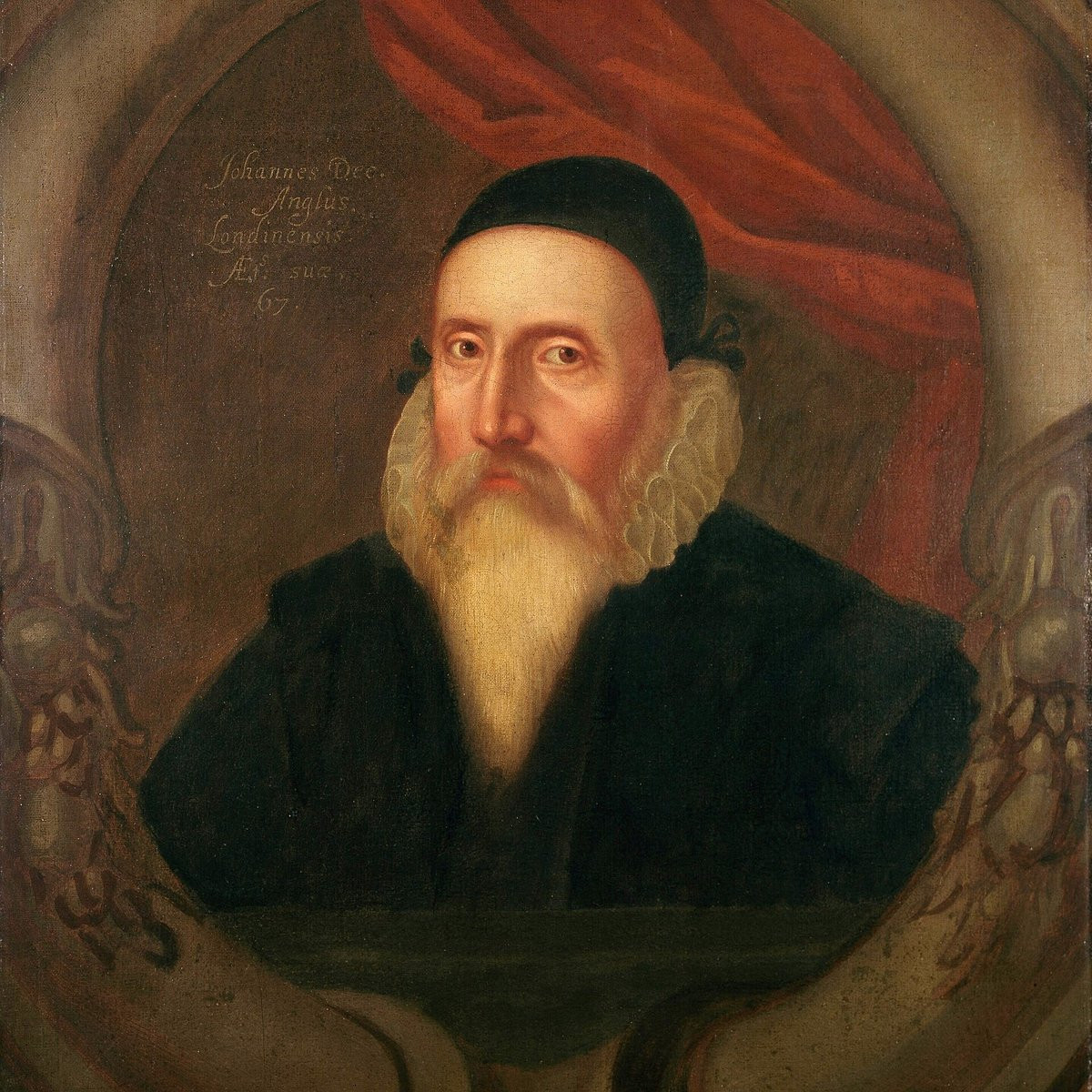
Unknown artist, Portrait of John Dee, c. 1594. Oil on canvas. Ashmolean Museum, Oxford. Public domain, via Wikimedia Commons. The inscription gives Dee’s age as 67. The portrait passed to Dee’s grandson and later to Elias Ashmole, who left it to Oxford.
The black stone
Some of the furniture of these sessions survives in the British Museum: wax discs engraved with the Sigillum Dei, the Seal of God, which supported the shew-stone and the legs of the table of practice; a gold disc engraved with one of Kelley’s visions; and a small crystal ball whose link to Dee is less certain.
The most famous object there is a black mirror of polished obsidian. It is not European at all. It is a Mexica (Aztec) cult object, made in the fifteenth or sixteenth century and brought to Europe after the Spanish conquest. Its fame as “Dr Dee’s mirror” comes from Horace Walpole, who acquired it in 1771 and wrote on its case: “The Black Stone into which Dr Dee used to call his spirits.” Dee’s surviving writings never explicitly mention it.
I find that oddly fitting. The most famous relic of Dee’s magic is a sacred object of another people, whose place in his story rests on a label written nearly two centuries after his death.
A book called Speech from God
In the spring of 1583 the angels began to deliver something larger than advice.
First an alphabet. On 6 May 1583, Dee drew in his journal the twenty-one letters of what he called the Adamical or Angelical alphabet, written right to left, each matched to a letter of the English alphabet of his day. Scholars have noted that the forms resemble an “Enochian” alphabet printed in the Voarchadumia of the Venetian priest Johannes Pantheus, a book Dee owned. If so, the angels had been reading in Dee’s library.
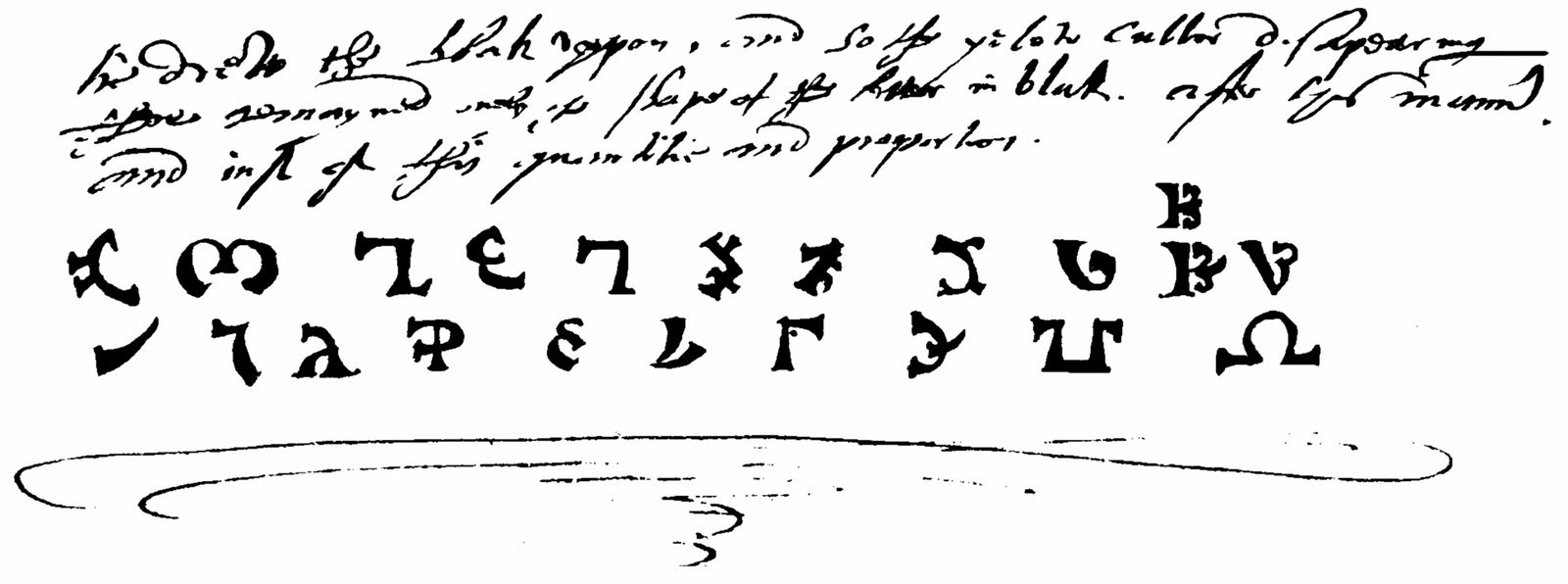
John Dee, the Angelical alphabet in his journal for 6 May 1583. British Library, Sloane MS 3188, f. 104. Public domain, via Wikimedia Commons.
Then came the book. In Meric Casaubon’s printed edition, the spirit says that it “shall be called Logah”, meaning “Speech from God”, though it was to be written LOGAETH. We now call it the Liber Loagaeth: forty-nine leaves, each side filled with a great table of 49 by 49 letters. Almost none of it was ever translated.
Imagine the labour: Kelley calling out letters one square at a time, Dee filling grids of more than two thousand cells, hoping the meaning would come later.
It never fully did.
Forty-eight keys, dictated backwards
In September 1583 the household left England. A Polish nobleman, Olbracht Łaski, had visited Mortlake that summer and invited them east. Dee’s diary records the departure on 21 September: “we went from Mortlake, and so the Lord Albert Lasky, I, Mr. E. Kelly, our wives, my children and familie.”
In Kraków, in the spring and summer of 1584, the most important texts arrived: the forty-eight Claves Angelicae, the Angelical Keys, often called the Calls. Unlike the Loagaeth, they came with English translations, so they are the only part of the corpus that can be read as language at all.
The method was, to put it gently, peculiar. The angel Nalvage explained it in a sentence Casaubon printed in 1659:
“Also in receiving of the calls, this is to be noted: that they are to be uttered of me, backward: and of you, in practise, forward.”
Dee understood why: spoken the right way round, the words would make everything they called appear and interrupt the lesson. So the first Keys were spelled out letter by letter, in reverse, and the English came separately. Later the method was relaxed.
The first of the forty-eight was never given, because, the angels said, one was “not to be opened”. Most of the rest turn out to be a single text repeated with a change of name for each of thirty “Aethyrs”. Later readers count nineteen Calls.
I will not reproduce them. Not because they are dangerous, but because on this blog they are documents.
The language Adam spoke
What did Dee believe he was receiving?
The angels told him that this was the tongue “which Adam verily spake in innocency”. After the Fall, they said, Adam had to learn by necessity a lesser speech, the one Kelley called Hebrew. Angelical was presented as the original language of creation, older than Hebrew, the language in which Adam named the animals.
For a Christian scholar of the Renaissance, that was the ultimate prize. Many learned men of the century dreamed of recovering the lingua adamica, the perfect language in which words and things had once been the same. Dee’s Christian cabala, his Hermetic reading and his mathematics all pointed the same way: recover the right letters, and you could read the book of nature directly.
And here, at last, Enoch enters the house.
In Kraków in June 1584, the angels told Dee that God had opened Enoch’s eyes, and “after 50. dayes Enoch had written” a book of holy knowledge. The wicked corrupted it, Enoch’s memory was washed away, and false spirits taught the world magic in its place. Now God would deliver the doctrine again, “to fulfill his promise with thee, for the books of Enoch.”
This is why the language would one day be called Enochian.
Notice what this Enoch is. He is not the scribe of the Watchers. There are no two hundred angels on Mount Hermon, no giants, no Flood as a cure. He is a Renaissance Enoch, the patriarch who kept a lost book of divine wisdom, exactly the figure a scholar longing for lost knowledge would hope to find. As I wrote last time: Dee borrowed Enoch’s name, not Enoch’s book.
An emperor and a nuncio
Dee did not keep these revelations to himself. He took them to princes.
On Monday 3 September 1584 the Emperor Rudolf II received him at Prague Castle. Dee’s own account has the emperor at a table with a silver chest and inkstand before him, and Dee’s Monas beside him. Dee told him he had spent forty years seeking knowledge from men and books, and none could teach him what he longed for. Then he delivered his message:
“The Angel of the Lord hath appeared to me, and rebuketh you for your sins.”
If Rudolf repented, his throne would be the greatest that ever was, and “the Devil shall become your prisoner”, a devil Dee took to be the Ottoman sultan. Then he added a sentence that is either moving or alarming, depending on the reader: “I feigne nothing, neither am I an Hypocrite, an Ambitious man, or doting, or dreaming in this Cause.”
Rudolf, the most occult-minded monarch in Europe, was polite and did not take him on. They also sought out King Stephen Báthory of Poland, who listened cautiously. In 1586, apparently under pressure from the papal nuncio, they were ordered out of Prague.
A Bohemian magnate rescued them. Vilém of Rožmberk, one of the most powerful men in the kingdom and a passionate patron of alchemy, gave them a home in his town of Třeboň. Dee’s diary for 14 September 1586 reads simply Trebonam venimus, “we came to Třeboň.” There, on 19 December, Kelley performed an alchemical projection which, Dee recorded, produced almost an ounce of “the best gold”.
Kelley’s fortunes were rising. His patience with the angels was running out.
All things in common
What happened at Třeboň in 1587 is the episode most retellings rush to. I will stay with the documents.
Kelley had tried to stop the actions more than once. On 11 April 1587 he signed a declaration ending: “I finally answer, that I will from this day forward meddle no more herein.” Then a new teaching came through the stone, from the spirit Madimi: the two men were to hold all things in common, their wives included.
Dee was anguished, and in the end he obeyed. On Sunday 3 May 1587, he wrote, “I John Dee, Edward Kelley, and our two wives, covenanted with God, and subscribed the same, for indissoluble and inviolable unities, charity and friendship keeping between us four, and all things between us to be common, as God by sundry means willed us to do.”
His diary says little more. On 28 February 1588, Jane Dee gave birth to a son, Theodorus Trebonianus Dee, named after the town, and Dee raised him as his own. Whether he was Dee’s child or Kelley’s, no document can tell us.
It is easy to make this a story about sex. It is more honest to read it as a story about authority. Some historians suspect Kelley used the angels to end a partnership he no longer wanted, by demanding the one thing he thought Dee would refuse. If so, he misjudged his man. Dee was willing to give up even his marriage rather than doubt the angels.
That is the real horror of the episode, and Casaubon would see it.
Two endings
Dee left Třeboň on 11 March 1589 and reached the Thames on 2 December. The two men never met again.
Kelley stayed in Bohemia, was knighted by Rudolf (in 1589 or 1590) and signed himself Sir Edward Kelley. Then he fell. In 1591 the emperor imprisoned him, and after a brief return to favour he was imprisoned again, at Hněvín Castle above Most, where he died in late 1597 or early 1598. One story says he was hurt escaping down the castle wall; another says he poisoned himself. Neither can be confirmed.
Dee came home to a ruined house. He had left his library with his brother-in-law, Nicholas Fromond, who, Dee complained, “unduely sold it presently upon my departure, or caused it to be carried away.” Many books later turned up in other hands, some with Dee’s signature scraped off. The legend of a mob burning the wizard’s books is more dramatic than the evidence.
In 1595 the Queen made him warden of Christ’s College, Manchester, where the fellows gave him little peace. Around 1605 he returned to Mortlake, out of favour under James I, selling his possessions to live, cared for by his daughter Katherine. He never stopped asking: Casaubon notes actions as late as 1607, with a new scryer named Bartholomew.
Dee died at Mortlake in December 1608 or March 1609; the parish registers and his gravestone are lost, so we cannot say which. His grave is unknown.
Horror or compassion
The man who made Dee’s angels public was Meric Casaubon, son of the great classical scholar Isaac Casaubon. In 1659 he printed Dee’s records, from the manuscripts in Sir Thomas Cotton’s library, under a title that is almost a book in itself: A True & Faithful Relation of What passed for many Yeers Between Dr. John Dee (A Mathematician of Great Fame in Q. Eliz. and King James their Reignes) and some Spirits.
Casaubon believed in spirits. That was his point. He did not think Dee a liar. He thought the spirits were real, and evil, posing as angels of light, and that Dee had been “at the first deluded (to which his own pride and presumption did expose him)”. Reading the whole record, he confessed:
“I cannot tell whether I should make him an object of more horror or compassion.”
It is one of the most humane sentences ever written about Dee, by the man who did most to damn him. For two centuries and more, Dee was remembered largely through Casaubon’s frame: the great mathematician deceived by devils.
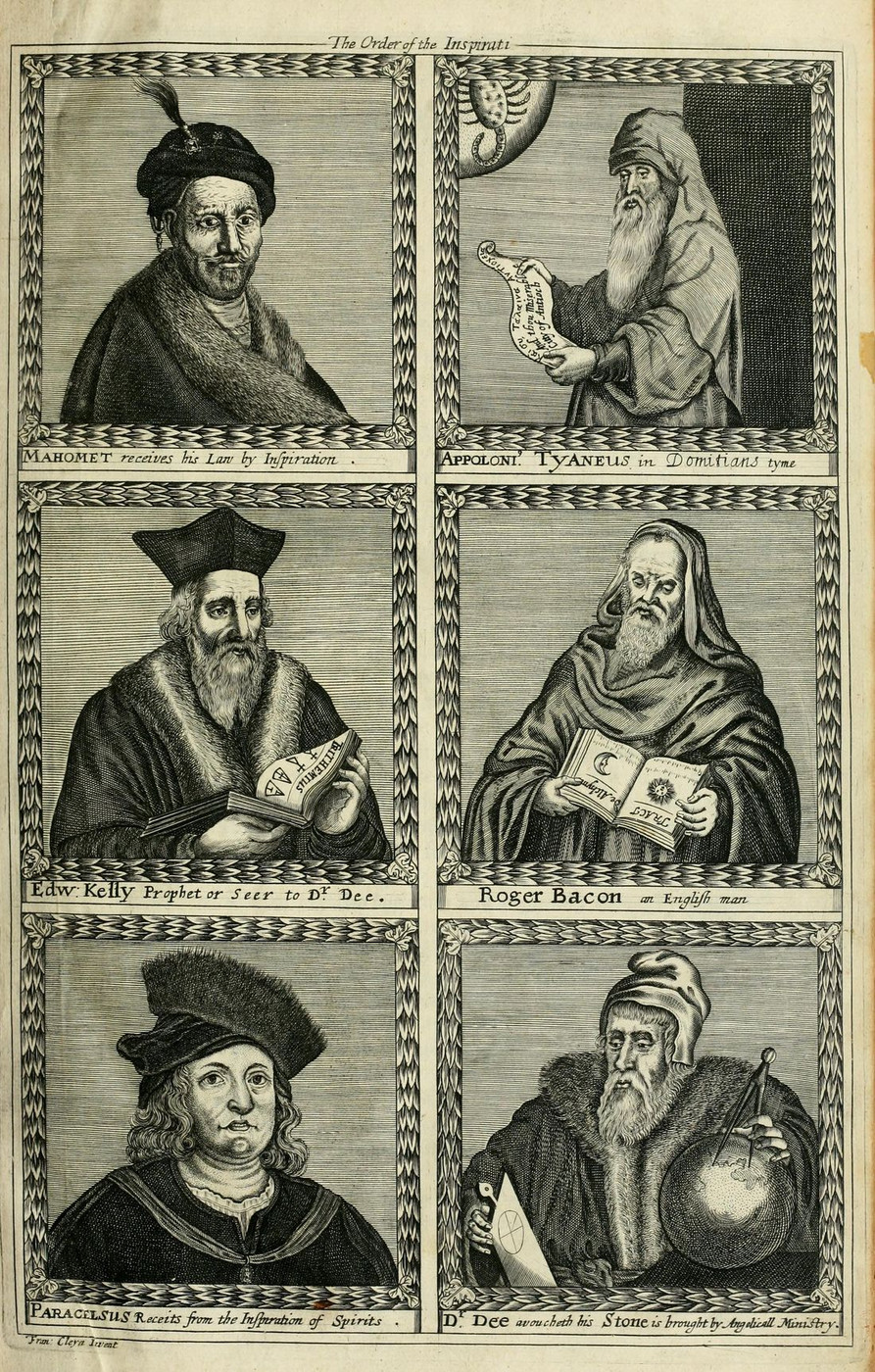
Frontispiece to Meric Casaubon, A True & Faithful Relation, London, 1659: “The Order of the Inspirati”, designed by Francis Cleyn. Engraving. Public domain, from the copy digitized by the Internet Archive.
The frontispiece says the rest. Kelley and Dee sit in “The Order of the Inspirati” beside Muhammad, Apollonius of Tyana, Roger Bacon and Paracelsus, a seventeenth-century Protestant’s gallery of “enthusiasts”. Dee holds a globe and compasses, as if to say: here is a mathematician who forgot his instruments.
One irony ties this post to the last. In his preface Casaubon explains what the Book of Enoch was, and points readers to the “great fragment of it in Greek” in Joseph Scaliger’s notes on Eusebius, the fragment preserved by the Byzantine chronicler George Syncellus. The scholar who printed Dee’s Enoch had read more of the ancient Enoch than Dee ever had.
A drawer full of angels
Casaubon did not have everything. The earliest records and the original manuscript of the forty-eight Keys were missing.
They resurfaced in one of the best stories in the history of books, which Elias Ashmole recorded in 1672. A London confectioner named Jones and his wife had bought a cedarwood chest, said to have come from the goods of a surgeon who probably bought it after Dee’s death. Twenty years later, moving it, they heard something rattle, and Jones found a secret drawer full of manuscripts, with a rosary and cross of olive wood. Not understanding the papers, their “servant Maide” wasted, in Ashmole’s words, “about one halfe of them under Pyes & other like uses.”
Half of Dee’s angels went under the pies.
The rest survived the Great Fire of 1666 and came to Ashmole through the widow’s second husband, a Tower warder named Thomas Wale. Ashmole paid with a bound copy of his own book on the Order of the Garter. The rescued records are now in the British Library among the Sloane manuscripts.
A note for readers of this blog: Ashmole is also one of the earliest Englishmen on record as having been made a Freemason, at Warrington in 1646. You will sometimes read that this makes him the founder of English Freemasonry, or that he carried Dee’s angels into the Craft. Neither claim stands on evidence.
Is it a language?
So what, linguistically, is Angelical?
The most careful answer came in 1978, when the Australian linguist Donald Laycock (1936–1988) published The Complete Enochian Dictionary. He was a sceptic, but a scrupulous one, and his conclusions are worth stating carefully.
I. The vocabulary is small: about 250 distinct words with known meanings, more than half of them occurring only once.
II. The sounds are English. Dee noted that one word rhymed with “George”, and Laycock found that the resulting pronunciation “makes it sound much more like English than it looks at first sight”.
III. The grammar follows English word order, with few articles or prepositions. Words like ol (I), goho (says) and Iad (God) sit where an Englishman would put them.
IV. The untranslated tables of the Loagaeth are different again. Laycock saw in them the patterns of glossolalia, speech produced in trance, rather than a language.
The scholarly view remains close to Laycock’s: Angelical behaves like a language invented by an English speaker, not like a language older than Hebrew.
Who invented it? Kelley, consciously or not, is the obvious candidate, since everything passed through him.
How Angelical became Enochian
For two centuries the manuscripts slept in the British Museum.
They woke in the 1880s and 1890s, when the founders of the Golden Dawn went looking for material in the Reading Room. Dee’s tables, names and Calls were built into the teachings of the order’s inner grades, fused with its elemental and tarot correspondences; Laycock credits Westcott with the so-called Enochian chess, a divination game played on Dee’s tables. In that world the name stuck. Dee had called it Angelical, or the Language of Angels. The occultists called it Enochian.
Then came Aleister Crowley. In late 1909, in the Algerian desert, with the poet Victor Neuburg, Crowley used the Calls to explore the thirty “Aethyrs” one by one, and published the results in 1911 as The Vision and the Voice.
I mention this as reception history, not recommendation. Dee’s private, anguished, devoutly Christian conversations had become a magical system. He wanted the angels to reconcile Christendom. His heirs used them to explore the Abyss.
Myths at the door
A few ghosts need showing out.
I. Dee was the original 007. The claim comes from a 1968 book by Richard Deacon, pen name of Donald McCormick, who said Dee signed secret letters to the Queen with two circles and a stretched seven. No such signature has been found. After searching through many of them, Teresa Burns concluded that his real signature “looks more like a whirlwind than a 007” (as quoted by Jeremy Duns, who has documented McCormick’s fabrications).
II. Dee was the model for Prospero. The Tempest, written around 1610–1611, shortly after Dee’s death, shows a learned magician with books and a spirit servant. Frances Yates and others suggested Dee as a model. It may be right, but it is a suggestion; nothing in Shakespeare names him.
III. Dee was a black magician. Read a single action and this one disappears. They begin and end with prayer. Whatever one thinks of what Kelley saw, Dee believed he was speaking to the angels of the Christian God. Even Casaubon, who thought the spirits were devils, never thought Dee had wanted devils.
What Dee wanted
Let us gather the threads.
A mathematician who wrote for craftsmen. A courtier who imagined an empire. A collector who built the greatest library in England and lost it. A Christian who believed that knowledge of creation was still being given out, and might be given to him if he prayed enough.
He met a young man with a dubious past who could see what he could not. Together they produced tables of letters, a book of speech from God, forty-eight keys dictated backwards, an alphabet older than Hebrew, a story about Enoch’s lost book, and a covenant that cost Dee his peace. Then the partnership broke, the library was gone, and the old man went on asking until the end.
Dee did not want to command angels. He wanted to be taught by them. That is the difference between him and almost everyone who later used his name.
The angels never finished the lesson. The language they left is too small, too English and too strange to be the speech of Adam. And yet it has outlived its scribe by four hundred years, passing through a chest, a drawer, a pie dish, a museum, a Victorian order and a desert.
Let him who does not understand either be silent, or learn.
Dee never chose silence.
Original: https://pablo.space/posts/john-dee-or-the-man-who-wanted-to-speak-with-angels