The Pirahã, or the Unfinished World
2026-11-17, originally published on pablo.space.
← all Chamber of Reflections texts
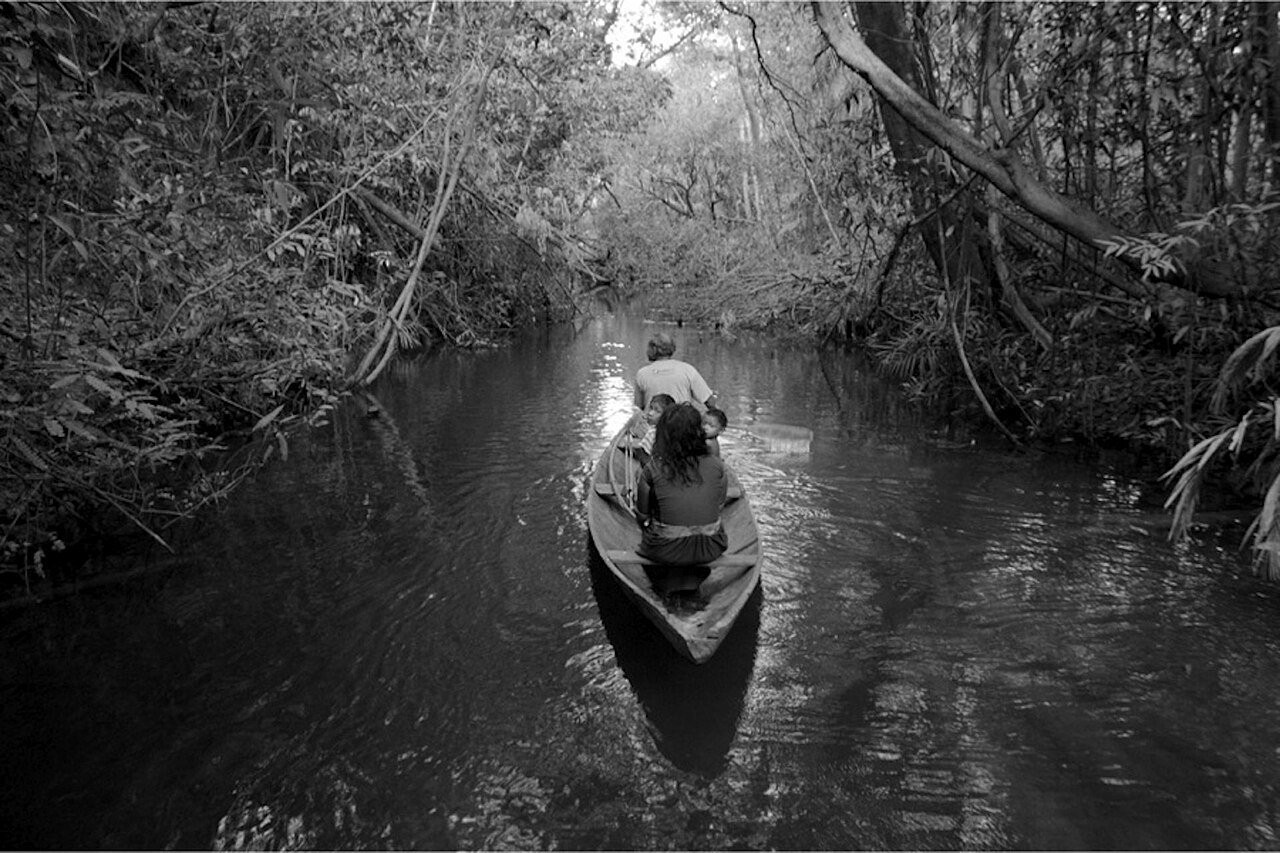
A Pirahã family travelling by canoe on a forest river, Amazonas, Brazil. Photograph by Caleb Everett, published in April 2017 with his article on “anumeric” peoples in The Conversation. CC BY-SA 4.0, via Wikimedia Commons.
“When pressed about creation, for example, Pirahã say simply, ‘Everything is the same,’ meaning that nothing changes, nothing was created.”
Daniel L. Everett, Current Anthropology, 2005, p. 633
A people said to have no god and no creation story, and the older record of earths stacked above their river and a demiurge who has to remake the moon.
The tribe without a god
On the internet the Pirahã have become a parable. A few hundred people on a tributary of the Madeira, the story goes, have no god, no creation myth, no numbers and no colour words, and they talked an American missionary out of his faith: the “atheist tribe”.
Every item on that list has a source. Almost every item also has a quarrel attached, and the quarrels say more about the Pirahã than the list does.
The canoe at the top of this post was photographed by Caleb Everett, an anthropologist who spent part of his childhood among the Pirahã because his father, the missionary in the parable, had gone there to translate the Bible. The father is the main witness for the people without a god. The best witness against the simple version of that claim is a Brazilian anthropologist from Rio de Janeiro who spent eighteen months on the same river and wrote a book called The Unfinished World.
“Atheist” is a word from our own arguments, and it fits the Pirahã badly. The record does support the narrow claim: no one has documented among them a god who made the world from nothing, nor anyone who prays to such a god. The same record is crowded with beings, layers of earth above and below the river, names that come from those layers, and dreams treated as journeys. What it lacks is a creator, and that is a smaller thing than lacking a cosmos.
An earlier post on this blog surveyed what Europeans wrote about Indigenous beliefs in Brazil, from the first letters of 1500 onwards. This is the first closer look, and it belongs to the same thread as the post on Umbanda. As always here, I write as a historian, from the outside, about a living people whose own view of these matters is in no book. Translations from Portuguese are mine unless stated.
The people of the Maici
The Pirahã live along the Maici river and part of the Marmelos, in the municipality of Humaitá, in the south of the state of Amazonas. The Maici feeds the Marmelos, and the Marmelos runs into the Madeira from the left bank.
Their own name for themselves is hiaitsiihi. In the entry Marco Antônio Gonçalves wrote for the Instituto Socioambiental (ISA), the word names the class of ibiisi, “bodies” or humans, that the Pirahã themselves are, as distinct from white people and other Indigenous peoples. “Pirahã” is the name used by their neighbours, and the one they use in dealing with outsiders.
Their language belongs to the Mura family. The Mura, once a large and feared people of the Madeira, now speak Portuguese, and Pirahã is the family’s last living language. Curt Nimuendajú, the German-born ethnologist, first tied the two groups together; his chapter “The Mura and Pirahã” appeared in the Smithsonian’s Handbook of South American Indians in 1948.
Observers in the 1920s and again in the 1970s estimated about ninety people. Measles killed fourteen in 1968 and more than thirty in 1974, according to reports summarised by ISA. FUNAI counted 141 in its first census, in 1985; there were about 360 by 2000, and the health service of the Ministry of Health recorded 592 in 2014.
The land was demarcated in 1994. A presidential decree of 3 November 1997 confirmed the Terra Indígena Pirahã, 346,910 hectares in Humaitá, “for the permanent possession of the Indigenous groups Pirahã and Mura”. Its southern edge is the bridge where the Transamazônica highway crosses the Maici.
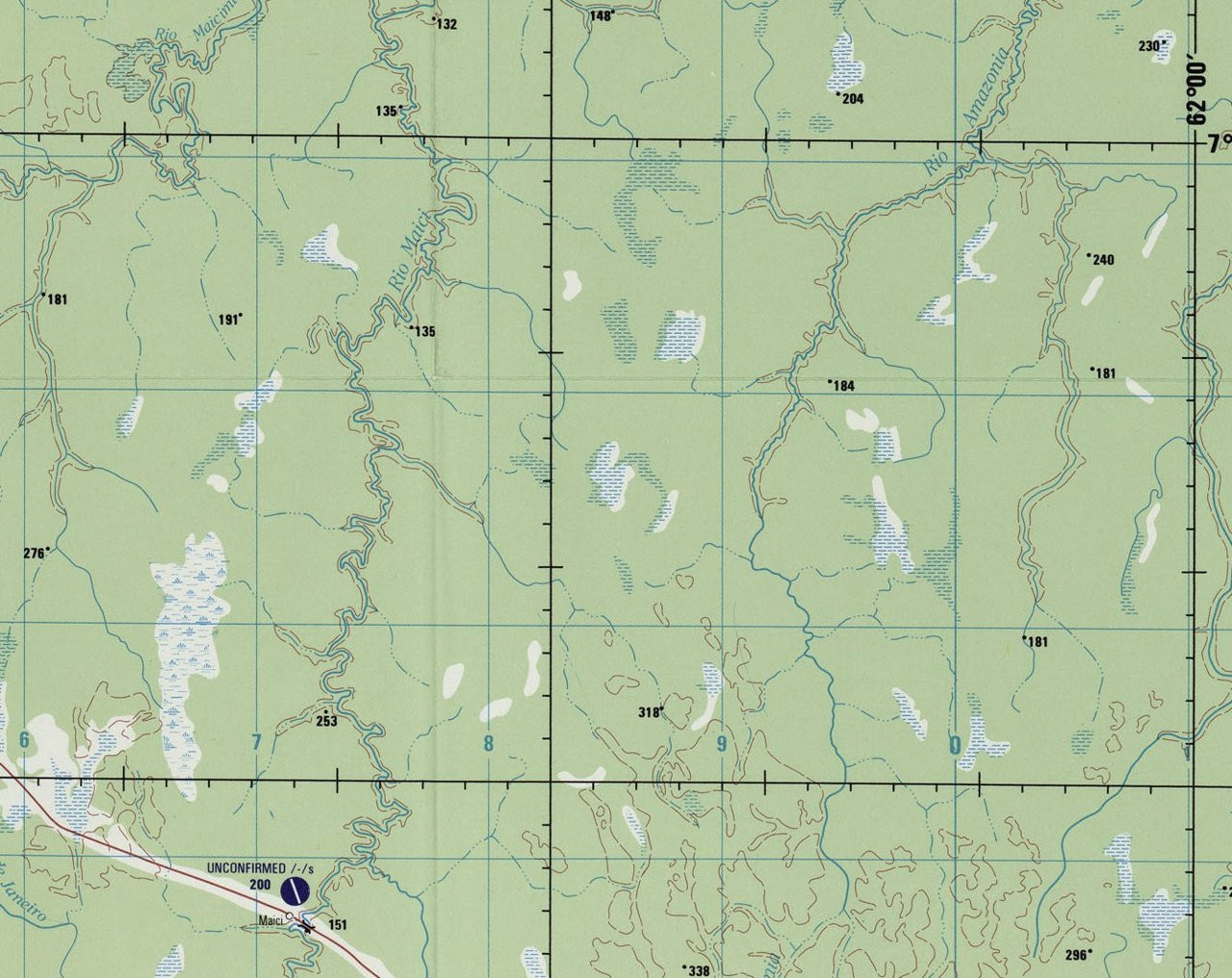
The Maici river and the Transamazônica highway, detail of sheet SB 20-15 “Maici, Brazil”, Joint Operations Graphic 1:250,000, U.S. National Imagery and Mapping Agency, 1996. The highway bridge over the Maici marks the southern limit of Pirahã land. Public domain, via Wikimedia Commons.
Strangers on the river
Nimuendajú reached the Pirahã in 1921 and found one village on a long straight reach of the Marmelos and another on the lower Maici. In the same year the Indian Protection Service, the SPI, opened a post on the Maici. Nimuendajú described them as “happy in their poverty”, peaceful even towards the Brazil-nut gatherers who invaded their groves and abused them. The phrase belongs to its time.
The missionaries arrived in 1959. The Summer Institute of Linguistics, an evangelical organisation that translates the Bible into unwritten languages, kept a presence on the Maici until 1980. Arlo Heinrichs and his wife worked there in the 1960s; Steve Sheldon and his wife Linda replaced them in 1967 and stayed ten years. Heinrichs told the journalist John Colapinto, for a long profile in The New Yorker of 16 April 2007, that two years passed before he attempted a Bible story, the Prodigal Son. A Pirahã man listened and found it interesting. “But there was no spiritual understanding,” Heinrichs said. “It was just a story.”
In 1977 Sheldon became director of the Institute in Brazil and asked a young couple, Daniel and Keren Everett, to take his place. Everett had been converted at seventeen and trained at the Moody Bible Institute in Chicago. His task was the same as theirs: learn a language no outsider spoke and give its speakers the Gospel in it.
“Have you met this man?”
He learned the language, and wrote a doctoral thesis on it at the State University of Campinas and a grammar for the Handbook of Amazonian Languages. The Gospel went less well.
Colapinto’s profile sums up the problem in one sentence: the Pirahã “had always reacted to stories about Christ by asking, ‘Have you met this man?’”
Everett came to see that question as the key to the whole culture. He called it the immediacy of experience principle. In the 2005 paper, it reads: “Grammar and other ways of living are restricted to concrete, immediate experience (where an experience is immediate in Pirahã if it has been seen or recounted as seen by a person alive at the time of telling).” A man you have seen is worth talking about, and so is a man your father saw; a man nobody alive has seen falls outside the principle.
The question worked on the missionary too. In Colapinto’s account, Everett’s faith had been thinning for years as he read philosophy and made friends outside the church. In 1999 he went back to the Maici, translated the Gospel of Luke and read it aloud. When he became convinced that the Pirahã gave the text no spiritual meaning, he admitted that he gave it none either, and declared himself an atheist. He told the story at length in Don’t Sleep, There Are Snakes (2008).
The first convert of the mission, then, was the missionary. The parable starts here, and its only narrator is the man who changed.
Everything is the same
In 2005 Everett published “Cultural Constraints on Grammar and Cognition in Pirahã” in Current Anthropology. The paper lists what the principle was meant to explain: no numbers and no counting, no colour terms, no embedding of one clause inside another, the simplest kinship terms and pronouns yet documented, no memory beyond two generations, no drawing or art, and “the absence of creation myths and fiction”.
On that last point Everett wrote that he had tried to discuss cosmology and the origin of the universe with the Pirahã many times. When pressed, they said “Everything is the same”. Nothing changes, and nothing was created. The New Yorker gave a plainer version of the same reply: “It has always been this way.”
Many years later, in a commentary written with the psychologist Catherine Caldwell-Harris, Everett recalled the questions he used to ask in his early fieldwork: what was the jungle like before there were people, or trees, or animals? The answers came back as questions: “Did you see the jungle without trees?” And then: “The Pirahãs have always been here.”
Read slowly, those replies make a coherent position: the world has no first day, because no one was there to see it.
One, two and many
The numbers made the Pirahã famous outside anthropology. In 2004 the psychologist Peter Gordon, a former colleague of Everett at the University of Pittsburgh, published in Science a study of Pirahã adults matching rows of objects. Gordon read their words hói and hoí as something close to “one” and “two”, followed by a word for “many”.
In 2008 Michael Frank, Everett, Evelina Fedorenko and Edward Gibson went back with new tests and reported in Cognition that the Pirahã have “no linguistic method whatsoever for expressing exact quantity, not even ‘one’”. The words meant a small amount and a somewhat larger amount, relative to whatever was being compared. With the objects in front of them, the Pirahã matched large sets perfectly. They were inaccurate only when the task required holding an exact quantity in memory. The authors concluded that exact number words are a cultural invention, a “cognitive technology”.
Colour was disputed before Everett arrived. Sheldon had collected colour data for Brent Berlin and Paul Kay, and Pirahã entered their Basic Color Terms (1969) with fixed colour words. Sheldon later told Colapinto the data were unreliable, because the villagers refused to be questioned apart and gave the visitor what he seemed to want.
Grammar caused the loudest fight. In 2002 Marc Hauser, Noam Chomsky and Tecumseh Fitch had proposed that recursion, the embedding of a structure inside another of the same kind, might be the core of the human faculty of language. Everett answered that Pirahã has none. In 2009 the linguists Andrew Nevins, David Pesetsky and Cilene Rodrigues replied in the journal Language, using Everett’s own earlier grammar, that Pirahã shows embedded clauses after all and that its supposed gaps are familiar from other languages. Everett answered in the same issue, they answered him again, and the debate has never closed.
Nevins, Pesetsky and Rodrigues also did something else, less noticed. To test the cultural half of the argument, they went to the Brazilian ethnography.
A being on the far beach
Before the ethnography, one scene from Everett’s own book.
It was 6:30 on a Saturday morning in August 1980, in the dry season. Everett woke to shouting on the high bank of the Maici in front of his hut. Nearly the whole village was there, pointing at a sandbar across the river, and some were crying. A man named Kohoi explained, impatient with the foreigner’s blindness: “Xigagaí, one of the beings that lives above the clouds, is standing on the beach yelling at us, telling us he will kill us if we go to the jungle.”
Everett looked and saw an empty white beach about a hundred yards away. His six-year-old daughter Kristene saw nothing either. The Pirahã went on seeing the being. In a note to the 2005 paper Everett wrote that the experience had haunted him ever since, because it showed that spirits were “not merely fictional characters to the Pirahã, but concrete experiences”.
He opened his memoir with that morning. The name will return under another spelling.
An anthropologist counts the earths
Marco Antônio Gonçalves, of the Federal University of Rio de Janeiro, spent eighteen months with the Pirahã between 1986 and 1993. He wrote a master’s thesis on names and cosmos (1988), a book on naming called O significado do nome (1993), and a doctoral thesis that became O mundo inacabado: ação e criação em uma cosmologia amazônica (“The unfinished world: action and creation in an Amazonian cosmology”), published by the university press in 2001. Everett, who disagrees with him on several points, called his studies “easily the most reliable ever done by any anthropologist on Pirahã”.
Gonçalves describes a stratified cosmos. Layers of earth lie one above another, parallel and physically separate, and each is called by the same word for “earth”. Every layer has water, land, trees and animals, differing in shape, size and number. The Pirahã told him they did not know for certain how many layers there were; in practice people kept details of five, two above, two below and their own in the middle.
The middle layer belongs to the ibiisi, beings with bodies of the proper human form: the Pirahã, white people and other Indigenous peoples. The other layers hold the abaisi, anthropomorphic beings whose form is imperfect, deformed, as if body and name did not quite match. Animals there are mixed up too. In Gonçalves’s examples, quoted in the translation of Nevins, Pesetsky and Rodrigues, “the paca is big and looks like a caititu”, and the jaguar “has an elongated head and looks like a queixada”. Only in the Pirahã layer are things “complete, unmixed, perfect”.
An abaisi begins as an accident to a human body, a double that keeps changing as its human changes, down to a haircut. After death a person becomes other beings again: the kaoaiboge, peaceful eaters of fruit and fish, and the toipe, their cannibal pursuers, who live in the layer just below the living.
Everett’s own list of spirits agrees on the outline. In the 2005 paper he names the kaoáíbógí, the most common kind, “fast mouth”, living in holes in the ground, along with beings of the sky and beings of the trees. During one of his literacy classes, the villagers read aloud the word bigí, which he glosses as “ground” and “sky” at once, laughed at hearing their own word for the sky, and ended the lessons on the spot.
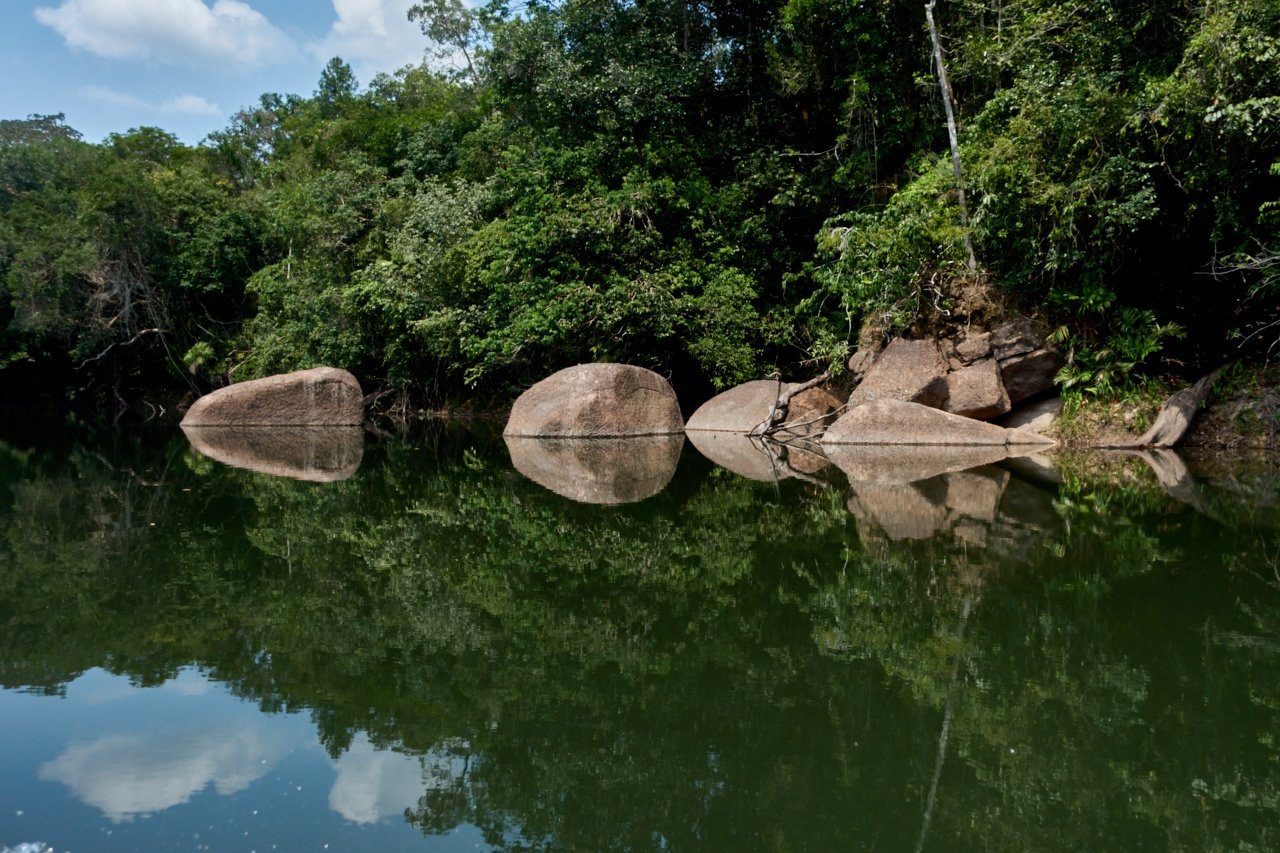
Stone formation along the Rio dos Marmelos, Amazonas, 9 October 2015. Photograph by Tom Fischermann. The Marmelos, a black-water river with white beaches in the dry season, forms the northern edge of Pirahã land. CC BY-SA 4.0, via Wikimedia Commons.
The man who shot the moon
Gonçalves also wrote down a story about the beginning of the present world. Nevins, Pesetsky and Rodrigues translated it into English from his 1993 book, and it is the passage that started the quarrel.
Long ago the layer just above the Pirahã hung much lower, and the moon rose very close. One night a man climbed a tall tree and shot an arrow into the moon. Its blood poured out, the moon died, and the sky began to fall. The men propped it up with tree trunks, but they could not stop the darkness. Rivers dried, fish died, and the people survived on water from a vine and on a single small snake.
Then Igagai, a being of the upper layer who knew how to make fish and animals, began to throw them down to the empty middle layer. The fish kept missing the river and dying in the forest, so he made the river dolphin and taught it to make fish. He made another moon, opened a hole so that water from the river above could fill the rivers below, and made first the Maici and then the Marmelos. When war with other peoples had left only three women alive, he gave them a fruit so that they would bear sons. When they cried for fire, he heard them and sent it.
Igagai and Xigagaí are, by every sign, one name in two spellings: Everett writes the glottal stop with an x, Gonçalves leaves it out, and in 2009 Everett himself referred to this story as the text “on Xigagai”. The being who stood on the beach threatening the village in 1980 is, in Gonçalves’s ethnography, the one who remade the world.
Gonçalves was careful about what the story is. “The myth is not about the origin of the world proper,” he wrote, “but about the recreation of the world.” There is no account of where Igagai and the other abaisi came from: “They are as a given, created eternally.” In the review of O mundo inacabado published in the journal Mana in 2003, the anthropologist Oiara Bonilla summarises his further point: Igagai must remake the sun and the moon every day, and sends the animals that humans eat. The title of the book means exactly that. The world was never finished, and it still has to be made.
So there is a demiurge, in the old Platonic sense of a craftsman who shapes a world. There is no creator who calls the world out of nothing, and there is no worship.
Fragments from conversation
Everett’s reply to Nevins, Pesetsky and Rodrigues, also published in Language in 2009, went straight to the source. He wrote to Gonçalves and printed the answer in his own English translation.
Gonçalves explained that he had never cited a complete text in Pirahã and had never collected an origin myth as a narrative. The story was assembled from “fragments, pieces of stories that were collected from conversation, from questions and responses”. He had always said that myths were hard to collect among the Pirahã and unimportant to them, and that the richest speech about the cosmos came from dreams and from sessions with the spirits, “because the ritual and the dreams are real experiences”. The passage Everett quoted closes with a sentence both men could sign: “they construct a cosmology without myths.”
The two readers drew different conclusions from that agreement. For Everett, the fragments were “amalgams” picked up from river traders who shared the myths common to the whole Amazon, and therefore not Pirahã at all. For Gonçalves, a cosmology does its work in action, in names, festivals, shamanic sessions and dreams, whether or not anyone tells it as a story.
The scholars of religion Benjamin Purzycki and Richard Sosis, discussing the case in 2022, called the requirement that myths be exclusively indigenous “entirely arbitrary”.
Names from the upper earths
Gonçalves first entered the cosmos through names, and names show how close the layers are to daily life.
According to his account for ISA, a Pirahã receives a first name in the womb, tied to the circumstances of conception; it is the name of the body. Later in life a person receives names of abaisi, the beings of other layers, and these are names of the “soul” and of destiny. Each such name secures a future: after death, a person with eight abaisi names will become eight kaoaiboge and eight toipe. Enemies once provided names too. Foreigners still receive names by the old logic, matched to the body of a dead Pirahã whom they resemble.
The names arrive through the shaman. In Gonçalves’s description, the shaman “changes places” with an abaisi or with the dead: he visits their layer while they come to the layer of the living, and through him they present new names. The shaman is, in his phrase, the only being capable of representing the whole cosmology at each session.
Everett describes the same sessions from the outside. Men, never women, speak in a falsetto as kaoáíbógí, usually around the full moon, and afterwards deny having been there. Gonçalves adds why the moon matters. The Pirahã told him the full moon is the oven where Igagai toasts his manioc flour, and their two festivals, the small and the large, are held to make noise so that Igagai can hear them and know exactly where they are. The old world was destroyed, in the fragments of the story, because Igagai did not know where the Pirahã were. It was the women’s crying that let him find them.
Dreams count as experience
A long chapter of O mundo inacabado transcribes dreams. In Bonilla’s summary, dreaming frees a part of the person, which travels to other layers and other times, and Gonçalves argues that among the Pirahã it is “the dreams that richly elaborate the rules, the relations and the ideal forms of life”.
Here the two ethnographers come closest. Everett’s principle admits what a living person has seen, and a dream is something a living person has seen, as is a being on a beach, which is why a people indifferent to a man nobody has met can speak of Igagai. In his 2009 reply Everett quoted Gonçalves on dreams and ritual as “lived experiences” and wrote that the two of them were “saying nearly the same thing”.
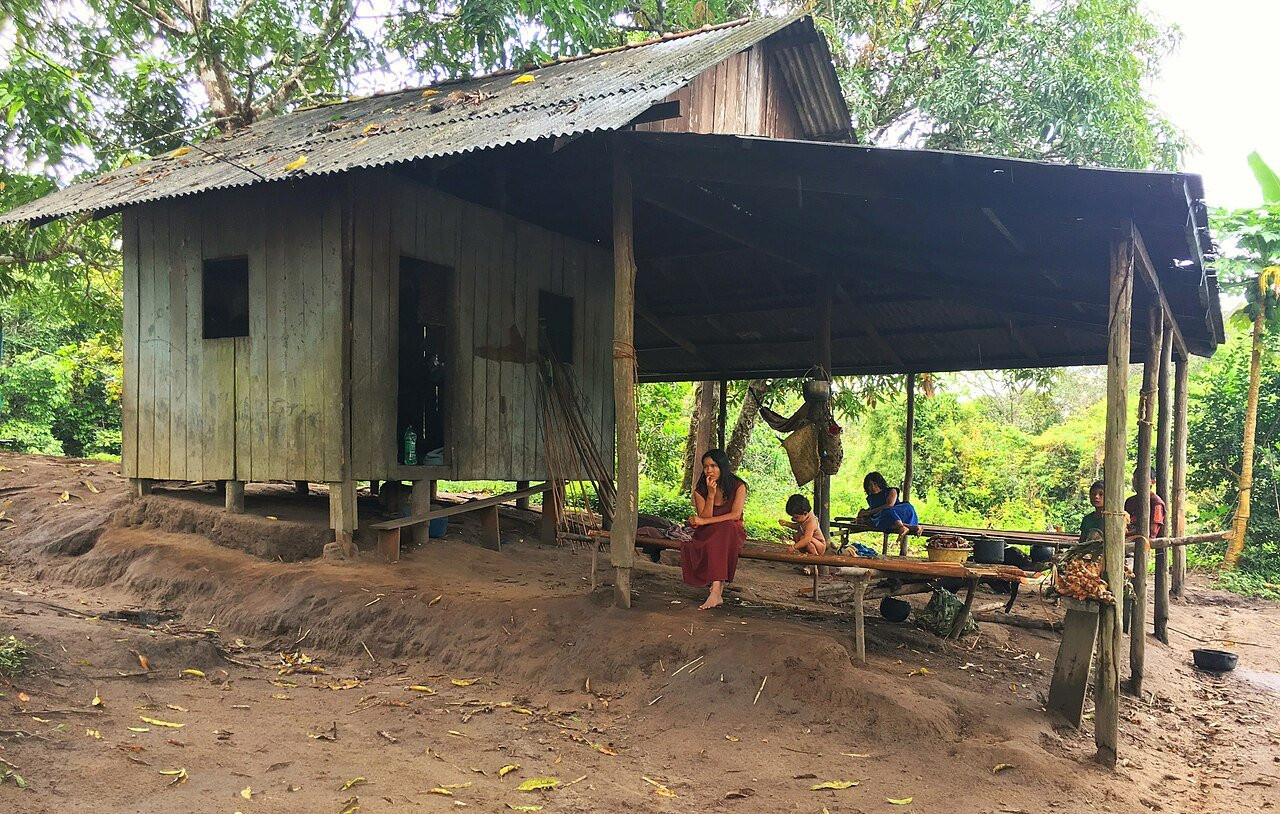
“Aqui mora o povo indígena Pirahã” (“Here live the Pirahã people”), Amazonas, 7 April 2018. Photograph by Mariana PA Vasconcelos, entered in Wiki Loves Earth 2022, taken near the Transamazônica. CC BY-SA 4.0, via Wikimedia Commons.
From spirits to entities
In their 2022 book on the evolution of religion, Purzycki and Sosis treated the Pirahã as a small-scale society with religion, on the strength of Everett’s own descriptions of spirits, dances and myths. Everett answered with Caldwell-Harris in the Journal for the Cognitive Science of Religion in 2023, under the title “Religion Is of Reduced Importance When Not Needed to Solve the Problems of Social Living”. Their thesis is blunt: “the Pirahã are not religious”.
To defend it, Everett withdrew his own earlier vocabulary. Translating the Pirahã words as “spirits”, he wrote, had been “an incorrect rendering of the Pirahã perspective into a Eurocentric worldview”. He now says “entities”, and proposes as a better gloss “a non-Pirahã humanoid with ambiguous or unverified properties”. The same words, he notes, can be used for the Pirahã’s traditional enemies and for Western visitors like himself. Asked whether these beings are real, some Pirahã say yes and some say no.
He also gave the necklaces a new meaning. In 2005 he had written that their main purpose was to ward off evil spirits. In 2023 he called them noise makers, worn in the forest to alert jaguars, snakes and enemies to the wearer’s presence.
The argument has a curious shape. The man who once called the beings spirits now says the word was imported, while Gonçalves had long described the same beings as parts of an ordered cosmos. Both, from opposite sides, have been taking European words back off the Pirahã.
An outside word
“Atheist” belongs to the same family of borrowed words. It took its modern sense in Christian Europe, for people who deny a god their neighbours affirm, and it presupposes the question that the Pirahã, by every account we have, decline to ask: who made all this?
Their answer, as Everett heard it, is that everything is the same and the Pirahã have always been here. The ethnography of Gonçalves adds that the world, though it never began, is constantly being remade by beings of other earths, and that people take part in that remaking through names, noise, shamans and dreams. Neither account contains a creator, a supreme being, a prayer or an offering. Both contain more than a word like “atheist” can hold.
They also stand apart from their neighbours. The Pirahã are not Tupi-Guarani, and nothing in the sources quoted here resembles Tupã, the wandering prophets or the Land without Evil of the Tupi chronicles behind much of the earlier post. The borrowing ran the other way in small things: Everett believes even their pronouns came from Tupi, perhaps through neighbours like the Tenharim and Parintintin.
The Pirahã have no creator and no worship, and on that narrow point Everett’s record holds. They do have a cosmos, layered and populated and in constant repair, and the word “atheist” describes our question better than their world.
The Maici still runs north under the Transamazônica, and on its beaches, in the dry season, someone may still be standing whom only the Pirahã can see.
Original: https://pablo.space/posts/the-piraha-or-the-unfinished-world